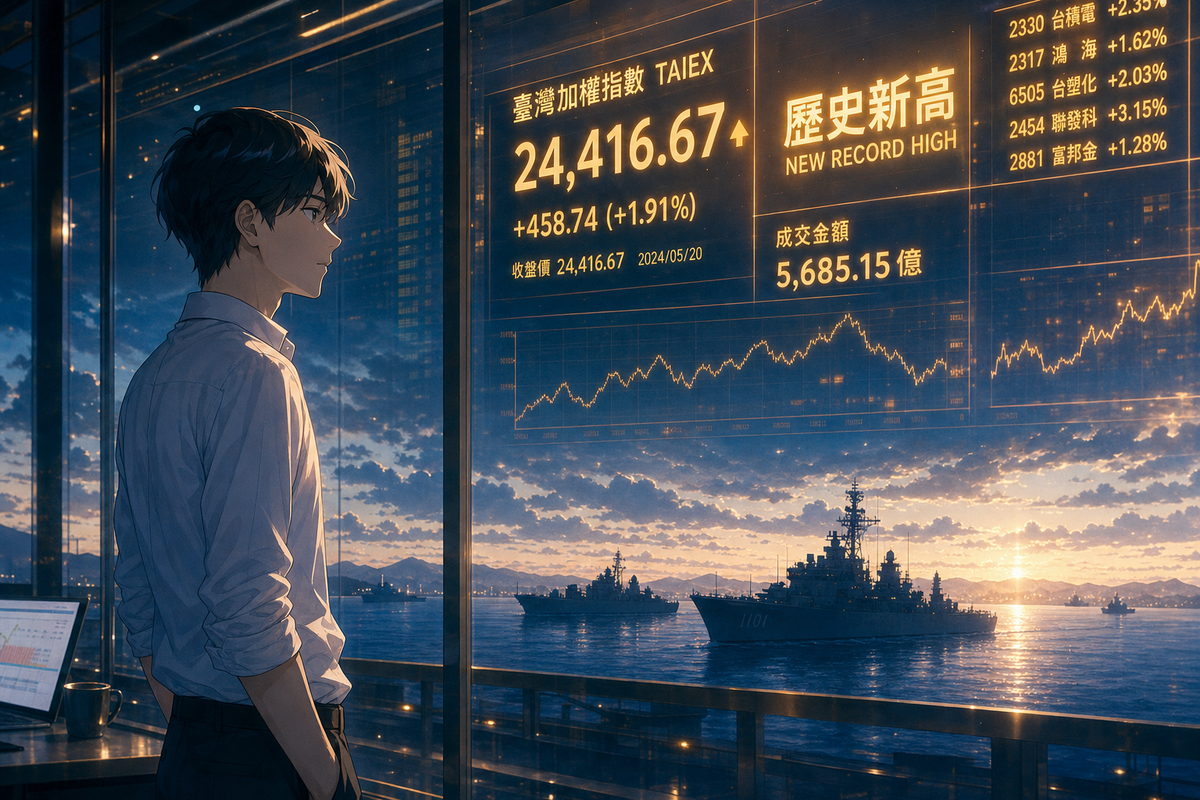
2026年6月22日,台股加權指數收盤47,741.51點,單日暴漲1,276點,成交額達新台幣1.44兆元。同一週,台灣啟動五天即時戰備演習,中共解放軍23架次軍機繞台,福建號航空母艦穿越台海。
這兩件事同時發生,沒有矛盾,也沒有巧合。這就是答案本身。
資本比政策誠實
台灣企業對中國的直接投資,在2010年代高峰時佔對外投資總額的60至70%。到了2026年,這個數字已跌破1%。沒有任何一份政府白皮書宣告過「去中化完成」,但企業的資金早就走了。
資本不說謊。它只計算風險與報酬,然後靜靜地移動。
這種轉向不是一夜之間發生的。它是無數個企業財務長在試算表上點下「確認」的積累——把工廠搬到越南、把採購訂單轉給印度供應商、把研發預算留在新竹。每一個決策都太小,不值得開記者會;但加總起來,就是對外投資結構從60%到不足1%的歷史性翻轉。
任何政策宣示都做不到這種精度。市場做到了。
台積電是這個故事的核心,也是它的風險
6月22日當天,台積電一檔股票貢獻了指數800點的漲幅,股價單日漲4.15%至2,510元。台積電佔台股總市值逾40%,這個數字意味著:台灣股市,在結構上已等同於一檔全球半導體ETF。
台積電2025年全年營收達758億美元,年增32%,全球晶圓代工市佔54.2%,3奈米製程市佔超過90%。市值超過2兆美元,是亞洲第一。這些數字背後,是台灣七十年的資本積累史——1951年人均GDP不足150美元,2024年已超過34,000美元。新竹科學園區1980年設立,是那條護城河的起點,但護城河是後來幾十年一鏟一鏟挖出來的。
但正因為如此集中,風險也同樣集中。2026年6月8日,美國非農就業數據強於預期,市場擔憂聯準會升息,台股單日重挫1,568點,台積電盤中觸及歷史新低。從那天到6月22日的反彈,中間只隔了兩週。台灣股市對全球貨幣政策的敏感度,和它對地緣政治的免疫力,幾乎同樣極端。
軍事緊張與市場繁榮,不是悖論
很多人把「演習週台股新高」讀成一個弔詭現象,好像市場集體失憶了。我認為讀反了。
投資人對台積電的信心,本來就不建立在「台海和平」的假設上。它建立在一個更冷酷的邏輯上:先進製程的技術門檻,全球目前只有少數幾個地方能突破,而台積電守著其中最關鍵的那道關卡。只要這個事實不變,資金就會繼續流入,不管福建號在哪裡。這不是樂觀,這是結構性判斷。
「矽盾」的邏輯不是讓台灣免於衝突,而是讓衝突的代價高到讓所有人都不想真的按下去。市場定價的,正是這個「誰也不敢摧毀台積電」的隱性協議。
至於這個協議能撐多久,沒有人知道。台積電的2奈米製程預計2026年底量產,下一個製程節點之後還有下一個。只要技術領先的缺口維持,協議就繼續有效。一旦競爭者追近,整個定價邏輯就要重算。
47,741點是今天的答案。它不承諾明天。
— 張書安
The Week TAIEX Hit 47,741 — and the Fujian Sailed Through
On June 22, 2026, the TAIEX closed at a historic 47,741.51 points, surging 1,276 points in a single session on turnover of NT$1.44 trillion. That same week, Taiwan launched a five-day live-fire readiness exercise, PLA aircraft flew 23 sorties around the island, and the Fujian carrier sailed through the Taiwan Strait.
Both things happened at once. There is no contradiction here. That simultaneous reality is the point.
Capital Moves Before Policy Does
In the 2010s, Taiwan’s outbound investment to China accounted for 60 to 70 percent of the total. By 2026, that figure has fallen below 1 percent. No government white paper declared “de-Sinicization complete.” The money simply left.
This shift accumulated through thousands of unglamorous decisions — a CFO moving a factory to Vietnam, a procurement team switching to an Indian supplier, an R&D budget staying in Hsinchu. None of those moves was newsworthy alone. Together, they produced a structural reversal that no policy announcement could have engineered with the same precision.
TSMC Is Both the Story and the Risk
TSMC contributed roughly 800 index points to that June 22 surge, with its share price rising 4.15 percent to NT$2,510. The company accounts for more than 40 percent of the TAIEX’s total market capitalization — which means Taiwan’s stock market is, structurally, a global semiconductor ETF with extra steps.
TSMC posted full-year 2025 revenue of $75.38 billion, up 32 percent year-on-year. Its global foundry market share stands at 54.2 percent, with over 90 percent of the 3-nanometer segment. Market capitalization exceeds $2 trillion, the largest in Asia. Those numbers rest on seventy years of compounding: per capita GDP under $150 in 1951, over $34,000 by 2024. The Hsinchu Science Park, established in 1980, was the starting line — the moat was dug over the decades that followed.
That concentration is also the vulnerability. On June 8, 2026, stronger-than-expected U.S. payroll data triggered rate-hike fears, and the TAIEX fell 1,568 points in a single session — the third-largest single-day drop in its history — while TSMC hit an intraday record low. From that trough to the June 22 all-time high took less than two weeks. Taiwan’s equity market is as hypersensitive to U.S. monetary policy as it is apparently immune to military provocation. Both extremes are real.
The Paradox That Isn’t
Reading “record high during live-fire drills” as a market anomaly misses the logic. Investors pricing TSMC are not betting on Taiwan Strait peace. They are betting on a colder proposition: the advanced process node gap is wide enough, and the cost of destroying Taiwan’s semiconductor capacity is high enough, that no rational actor wants to close that gap with force. The market is pricing an implicit agreement — not security, but mutual deterrence through economic indispensability.
That implicit agreement holds as long as the technology lead holds. TSMC’s 2-nanometer production is expected to ramp by end of 2026. The next node after that is already in development. If a competitor narrows that gap meaningfully, the entire pricing logic needs recalculating. The “silicon shield” is not a fixed asset — it requires continuous reinvestment to stay relevant.
47,741 is today’s answer. It does not promise tomorrow’s.
— 張書安
延伸閱讀
https://justfly.idv.tw/s/MK87hQt