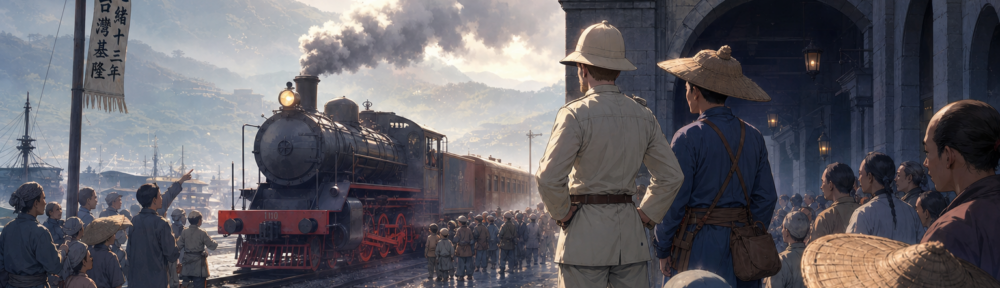
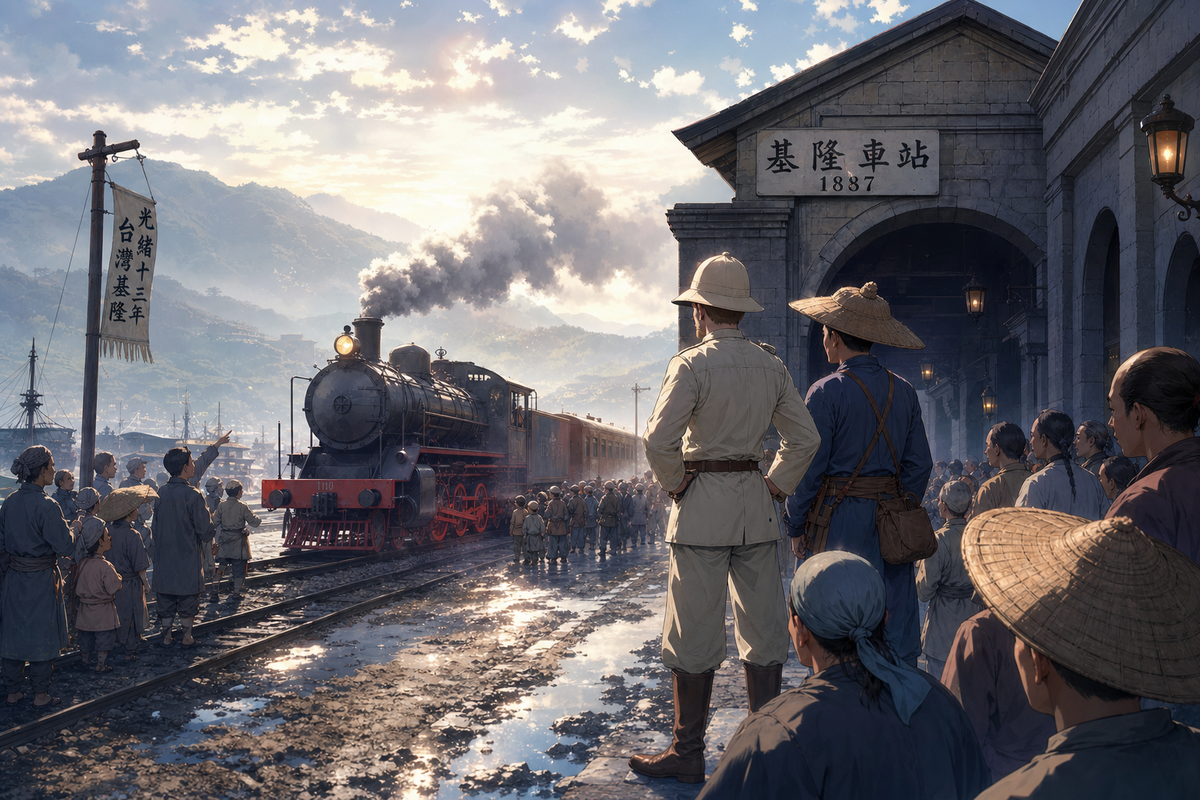
1887年4月,基隆站。
第一列火車頭噴出白煙,緩緩駛離月台。沿途湧出的農民從沒見過這種東西——有人叫它「鐵馬」,有人說是「噴火的龍」。這28.6公里的軌道穿過七星山脈,靠英國工程師設計、台灣工人徒手鑿山。據記載,每公里都有工人犧牲。
這條鐵路,是中國第一條客運鐵路,比後來大家熟悉的京張鐵路早了整整二十年。但開這列火車的,不是日本人。
被兩套敘事同時排除的人
劉銘傳,清代首任台灣巡撫,1885年台灣建省後走馬上任,任期六年(1885-1891)。他在任內建了鐵路、拉了電報線連接台北台南與大陸、設立郵政系統,推動西式軍事訓練。用二十一世紀的話說,他把一個農業邊陲省份硬生生地接上了工業文明的插座。
但翻開台灣的歷史教科書,劉銘傳的篇幅薄得像一張便條紙。
原因不難理解,只是沒人願意直說:他夾在兩套互不相讓的歷史框架之間。
第一套框架,是「中華文化主體」的敘事。在這個框架裡,清代台灣是正統中華文明向南延伸的邊地,重點是漢人移民、儒家教化、鄭成功的遺緒。劉銘傳的現代化工程是外來官僚推動的軍事現代化,不是這套敘事想要強調的文化傳承。更尷尬的是,他的努力在1895年馬關條約後被割讓出去,如何在「中華正統」框架中為一個失去的省份的建設者立傳,本身就是個政治難題。
第二套框架,是「日本帶來現代化」的殖民敘事。在這個框架裡——無論是日治時代本身的宣傳,或是後來某些台灣史學對日治進步性的強調——現代化的起點被設定在1895年之後。縱貫鐵路、現代醫療、義務教育,全是日本人的功績。這個敘事並非全錯,日治五十年的基礎建設確實龐大,但它有一個方便的省略:1908年日治時代南北縱貫線向南延伸至高雄,是沿著劉銘傳已有的鐵路路基繼續蓋的。地基是清代打的,樓卻歸日本人記功。
兩套框架都不需要劉銘傳,他就這樣消失了。
「鐵馬」跑過的地方
我並不是要翻案,把劉銘傳的功績無限放大,或者用他來否定日治時代的任何建設。歷史從來不是一場「誰先誰好」的排名賽。
但有一個具體的事實值得正視:1887年,台灣的農民第一次看到火車,叫它「噴火的龍」。這個震驚發生在清代,發生在漢人官僚主導的建設工地上,發生在一個正在被工業文明第一次擊中的農業社會裡。這個震驚,與1895年之後發生的任何事都無關。
歷史的「第一次」有時候比我們以為的更早,而且往往出現在意識形態不方便承認的地方。
當我們說「是誰建設了台灣」
台灣省1885年設立,劉銘傳任首任巡撫,積極推動建設鐵路、電報、郵政。1895年馬關條約,清廷割讓台灣。這三個時間點之間只有十年,劉銘傳的整個現代化實驗,壽命還不到一個任期的兩倍。電報線架起來了,鐵路通車了,然後政權換了。
日本殖民政府接手後,在這些地基上繼續建造,規模更大,系統更完整。這是事實。但「接手後繼續建造」和「從零開始建造」是兩件不同的事。
當我們說「台灣是誰建設的」,我們其實在問的是另一個問題:我們願意讓哪個版本的過去,成為現在的根基?這個選擇,從來都不是中立的。
— 戴安邦
Taiwan’s First Train Wasn’t Japanese
Keelung Station, April 1887.
A locomotive exhaled white steam and pulled away from the platform. Farmers who had never seen anything like it crowded the tracks. Some called it a “iron horse.” Others said it was a “fire-breathing dragon.” The 28.6-kilometer line cut through the Qixing Mountain range — designed by British engineers, dug by Taiwanese workers without modern machinery. The records say workers died for every kilometer laid.
That railway was the first passenger rail line in China, completed twenty years before the famous Jingzhang Railway. The man who built it wasn’t Japanese.
Erased by Two Competing Stories
Liu Mingchuan was the first governor of Taiwan Province, appointed when the province was formally established in 1885, serving until 1891. During those six years, he built the railway, strung telegraph lines connecting Taipei, Tainan, and the mainland, established a postal system, and pushed through Western-style military modernization. He wired an agricultural frontier into industrial civilization.
Open a Taiwanese history textbook. His entry fits on a sticky note.
The reason isn’t complicated — it just rarely gets said plainly. Liu falls between two historical frameworks that have no use for him.
The first is the Sinocentric narrative: Taiwan as the southernmost reach of Chinese civilization, with the emphasis on Han migration, Confucian culture, and Koxinga’s legacy. Liu’s modernization drive was the work of a Qing bureaucrat — not the cultural inheritance this story wants to celebrate. And since Taiwan was ceded in 1895 via the Treaty of Shimonoseki, writing triumphantly about what a Qing governor built in a province that was then handed over poses an obvious political awkwardness.
The second is the colonial modernization narrative, in which Japan arrives in 1895 and switches the lights on. The north-south trunk railway completed in 1908 under Japanese rule, modern medicine, compulsory education — all credited to Japanese administration. This isn’t entirely wrong. But the 1908 trunk line extended southward along the rail corridor Liu Mingchuan had already established. The foundation was Qing. The credit went to Japan.
Neither story needs Liu Mingchuan, so he disappeared.
What the Dragon Left Behind
The point here isn’t to simply invert the historical rankings and crown Liu Mingchuan as Taiwan’s true modernizer. History isn’t a competition for who got there first.
But a specific fact deserves acknowledgment: in 1887, Taiwanese farmers saw a train for the first time and called it a fire-breathing dragon. That shock happened under Qing administration. It happened before 1895. It happened to people who had no framework for what industrial civilization even was.
The “first time” often arrives earlier than ideology finds convenient to admit.
Who Built Taiwan, Exactly?
Taiwan Province was established in 1885. Liu Mingchuan served as governor until 1891. The Treaty of Shimonoseki was signed in 1895. Between the province’s founding and its cession, ten years. Liu’s entire modernization experiment ran shorter than two full terms.
The Japanese colonial government inherited the infrastructure and built far more on top of it — more systematically, more extensively. That is fact. But “built on top of existing infrastructure” and “built from nothing” are not the same statement.
When we ask who built Taiwan, we are actually asking a different question: which version of the past are we willing to let anchor the present? That choice has never been neutral.
— 戴安邦
延伸閱讀
https://justfly.idv.tw/s/GjkMXar