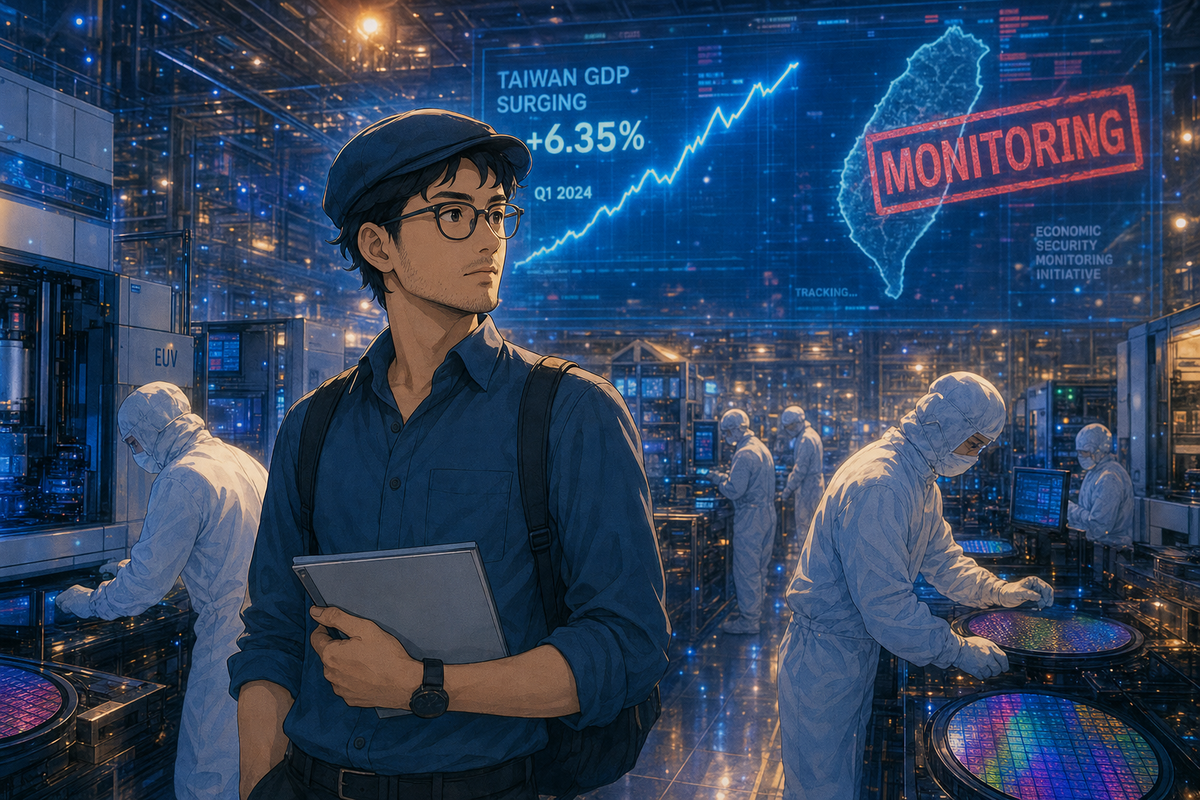
2026年7月24日,美國財政部發布半年度匯率報告,台灣進入10國監控名單,和日本、韓國、中國並列。理由明確:對美貿易順差達1450億美元,年增720億,近乎翻倍;經常帳盈餘佔GDP 19.6%,創下歷史新高。幾乎同一時間,國際信評機構惠譽(Fitch Ratings)上調台灣2026年GDP成長預測至9.4%,國泰金控更將全年預測推至10.1%——幾個月前的預測還只有5.8%。
繁榮與施壓在同一份日曆上並排出現。順差愈大,報告封面上的理由愈充分,這是同一套邏輯的兩端。
從農業社會到半導體核心,帳單遲早要來
台灣用了將近四十年,從勞力密集的輕工業出發,穿越重化工業,最終落腳在半導體這個全球供應鏈最難複製的節點。2026年第一季,GDP成長達13.7%;主計總處在5月底將全年預測上調至9.64%,標注這是16年新高。AI伺服器、晶片封測、CoWoS需求的量級讓所有機構的估算模型每隔幾週就需要重算。
美國外交關係委員會的報告指出,2026年台灣對美月度出口已首度超越中國,這是數十年來頭一次。驅動因素是美國對晶片的暴增需求,加上美中貿易急劇萎縮。台灣從「對美中間代工者」的位置,移動到了「美國最直接的科技供應國」。
這個位置的代價,正在浮現。
盟友關係不擋貿易武器
美財政部判定台灣符合三項監控標準中的兩項:貿易順差規模,以及經常帳盈餘佔GDP比。第三項是外匯市場干預量,台灣未達標,因此停在「監控」而非「操縱國」。台灣央行表示已對外資固定收益持股設30%上限,並限制ETF對沖投機,以壓制新台幣的投機性炒作。
措辭溫和,壓力是真的。若台灣在未來兩份報告中連續達標,就有被標記為「操縱國」的風險——那個標籤在貿易談判桌上的重量,跟「監控名單」是兩回事。更直接的是,美國貿易代表署(USTR)已依Section 301對台課徵10%關稅。成功出口創造的順差數字,現在成了對方施壓的彈藥。
國泰金控旗下研究團隊的分析指出,台灣經濟現已「幾乎完全由AI需求驅動」。這句話在成長敘事裡聽起來是讚美,放到貿易談判的脈絡裡,暴露的卻是另一層脆弱:單一驅動的結構,讓順差數字高度集中,也讓美國的施壓目標更加清晰。
矽盾的另一面
「矽盾」這個概念長期被用來描述台灣半導體實力的地緣政治保護作用——美國不能讓台灣有事,因為晶片供應鏈會垮。這個邏輯在安全面向上或許仍然有效。但它沒有說的是:同樣的關鍵地位,在貿易談判裡的作用方向完全相反。台灣愈關鍵,美國愈有誘因要求台灣讓步——開放資本市場、承受新台幣升值壓力、調整出口節奏。
這不是台灣第一次面臨「贏了也有代價」的處境。1980到1990年代,台灣出口擴張時期,美國同樣多次援引貿易順差施壓,要求市場開放與匯率調整。那一輪壓力最終催生了台灣金融市場的若干自由化。2026年的版本,背景是AI產業的結構性爆量,壓力的量級和複雜度都不一樣。
惠譽在上調台灣GDP預測時,同時點出了「全球貿易不確定性、地緣政治緊張與關稅衝擊風險」。這幾個字並排在成長預測旁邊,讀起來像但書,實際上是同一個故事的兩面。台灣2026年的經濟數字嵌在地緣政治結構裡,數字愈亮眼,這個位置愈難以迴避。
1450億美元的順差,19.6%的經常帳盈餘佔比,10%的GDP成長。每一個數字都是台灣四十年產業轉型的量化成果。同一排數字,現在也是美國財政部報告封面上的理由。
— 姚宇
The Week Taiwan’s Boom Became a Target
On July 24, 2026, the U.S. Treasury released its semi-annual currency report and placed Taiwan on a ten-nation monitoring list alongside Japan, South Korea, and China. The grounds: a bilateral trade surplus with the U.S. reaching $145 billion — nearly doubling year-over-year — and a current account surplus equal to 19.6% of GDP, a record high. Almost simultaneously, Fitch Ratings raised its 2026 GDP growth forecast for Taiwan to 9.4%, and Cathay Financial Holdings pushed theirs to 10.1%, up from just 5.8% a few months earlier.
Prosperity and pressure arrived on the same calendar week. That is not a coincidence. It is a logic.
Four Decades of Transformation, and the Bill
Taiwan’s shift from labor-intensive light manufacturing to semiconductor dominance took roughly four decades. In Q1 2026, GDP grew 13.7%. Taiwan’s Directorate-General of Budget, Accounting and Statistics revised the full-year forecast to 9.64% in late May — a 16-year high. AI servers, advanced chip packaging, and CoWoS demand grew fast enough that institutional forecasts needed revision every few weeks.
A Council on Foreign Relations report identified a structural milestone: in 2026, Taiwan’s monthly exports to the United States surpassed China’s for the first time in decades. The driver was surging U.S. demand for semiconductors, compounded by the sharp contraction in U.S.-China trade. Taiwan had moved from “intermediary manufacturer” to “America’s most direct technology supplier.”
That position comes with costs that the growth headline does not capture.
Ally Status Doesn’t Neutralize Trade Tools
The Treasury determined Taiwan met two of three criteria for the monitoring list: the size of the trade surplus, and the current account surplus as a share of GDP. Taiwan missed the third criterion — foreign exchange market intervention volume — which kept it at “monitoring” rather than “manipulator.” Taiwan’s central bank noted it had capped foreign investors’ fixed-income holdings at 30% and restricted ETF hedging to suppress speculative pressure on the New Taiwan Dollar.
The language is measured. The pressure is real. If Taiwan meets all three criteria in two consecutive reports, the “currency manipulator” label becomes a possibility — and that designation carries a different weight in trade negotiations. More concretely, the U.S. Trade Representative has already applied a 10% tariff on Taiwan under Section 301. The surplus numbers that reflect export success are now ammunition for the other side of the table.
Cathay Financial Holdings’ research team described Taiwan’s economy as “almost entirely driven by AI demand.” In a growth narrative, that reads as strength. In a trade negotiation context, it signals a concentrated vulnerability: a single-driver surplus structure makes the pressure target obvious and the numbers hard to dispute.
The Other Side of the Silicon Shield
The “silicon shield” concept has long been invoked to describe how Taiwan’s semiconductor centrality protects it geopolitically — the U.S. cannot afford to let Taiwan’s chip supply chain collapse. That logic may still hold on the security dimension. What it does not address is that the same strategic centrality operates in reverse at the trade negotiation table. The more indispensable Taiwan becomes, the stronger the American incentive to demand concessions — currency appreciation, capital market liberalization, adjusted export pacing.
Fitch, when raising Taiwan’s GDP forecast, simultaneously flagged “global trade uncertainty, geopolitical tensions and tariff shock risks.” Those qualifiers sit right next to the growth number, and they are not a footnote. They are the same story told from a different angle.
Taiwan’s 2026 numbers — $145 billion in trade surplus, 19.6% current account ratio, 10%-plus GDP growth — are the quantified output of four decades of industrial transformation. They are also the figures on the cover of the U.S. Treasury’s monitoring report. Both things are true at once, and there is no version of Taiwan’s current position where that tension resolves cleanly.
— 姚宇
延伸閱讀
https://justfly.idv.tw/s/ejz3t6p