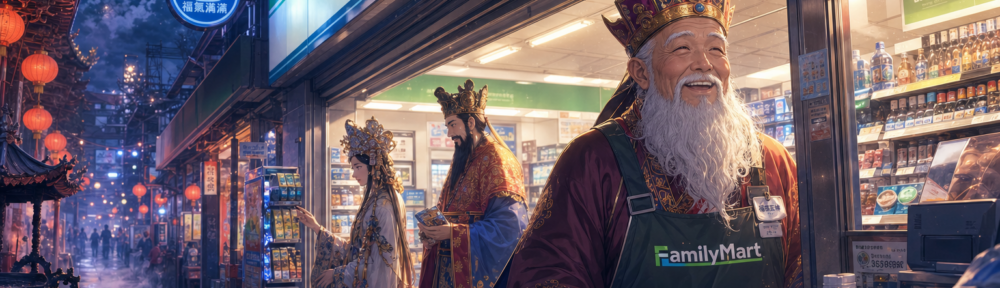
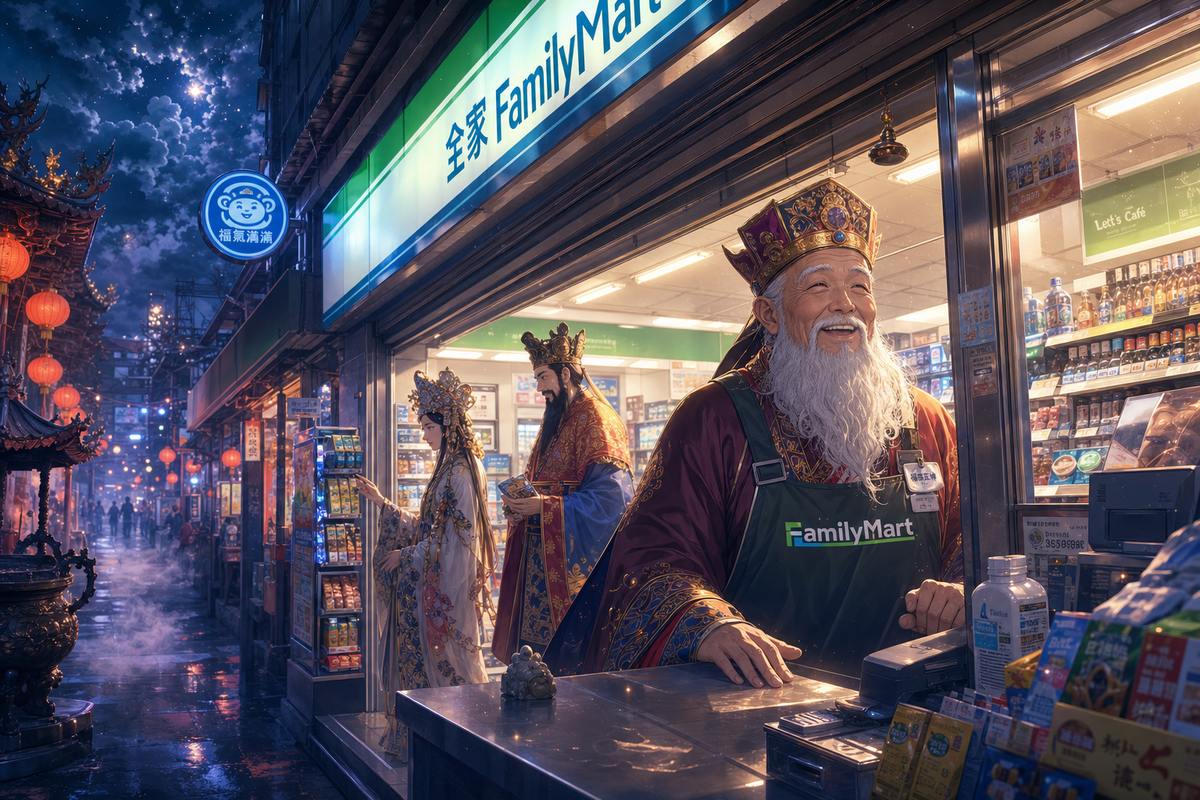
土地公坐在收銀台後面,城隍爺是值班主管,媽祖則負責海運物流。《神明便利商店》這個漫畫IP,把台灣民間信仰的職責分工翻譯成一套任何人都能秒懂的組織架構——這套對應邏輯本來就存在於台灣人的日常想像裡,翻譯出來只是讓它被看見。
12,000座廟與全球密度前列的便利商店,同時長在這座島上
台灣有超過12,000座廟,便利商店密度在每萬人口的比率上位居全球前列。這兩個數字並排擺在一起,給出的是一個解釋框架:對台灣人來說,廟宇和便利商店都是日常空間,都是走出門隨時會遇見的存在。把神明放進便利商店,不是降格,是平移。
《神明便利商店》的IP設定,核心在於它把神明的「職能」翻譯成現代人最熟悉的職稱。土地公管一方土地,便利商店店長管一方商圈——職能相同,語言不同。城隍爺掌管陰間的司法與行政,值班主管在夜班負責現場秩序——這個比喻之所以成立,是因為兩者都有「管轄範圍內的全責」這個結構核心。這是用Z世代的語法重新標注一張早就存在的地圖。
廟宇做IP,天然條件比政府文創品牌好太多
2026年台南「藝術三月」期間,台南市立美術館《萬物的邀約》展覽與《神明便利商店》跨界聯名,背後有台灣首廟天壇天公廟、臺灣府城隍廟、媽祖宮等六間廟宇共同協助。這個組合的商業邏輯,作為一個長期觀察文化授權市場的人,我必須說:廟宇做IP的條件,比任何政府文創品牌都來得紮實。
原因有三層。第一,廟宇有自己的故事資產,而且是已經被時間驗證的故事。媽祖原名林默娘,宋朝湄洲人,因海上救溺成神,是台灣最重要的海上守護神;保生大帝原名吳夲,北宋醫者,以醫術救人而成神——兩者同源福建,各自主管不同領域,這種「神職分工」本身就是現成的角色設定,不需要IP公司從零打造世界觀。第二,廟宇有實體粉絲基礎,叫做「信徒」,年齡層從60歲阿嬤到20歲大學生都有,這種跨世代的自然受眾,是任何流行IP羨慕的起點。第三,廟宇有節慶作為定期發酵機制——農曆三月,台灣民間有一句天氣諺語:「大道公風,媽祖婆雨」,農曆三月十五保生大帝生日帶風,三月二十三媽祖生日帶雨,這個週期年年循環,是任何行銷團隊都買不到的自然流量。
台灣漫畫的歷史記憶,讓這件事有深度
《神明便利商店》能在Z世代之間有受眾,不只是因為神明「變可愛了」,背後有一條更長的文化線索。台灣在1970至80年代曾是亞洲「漫畫王國」,彼時受惠於日本漫畫進口管制政策,本土漫畫產業有過一段繁盛期。2009年,文化部推出CCC創作集,以台灣歷史與文化為題材,試圖重振本土漫畫創作——那是一次由上而下的政策嘗試。廟宇IP的出現,是民間版的自發延續,路徑更純粹:沒有補助邏輯,只有故事本身的吸引力。
展覽同期,《勝利女神:妮姬》與台灣墨繪工藝展開快閃合作,進一步強化廟宇美學在次文化市場的滲透力。這個交叉訊號說明的是:次文化消費者在找有來歷的視覺語言。台灣的廟宇建築、神像工藝、陣頭美學,剛好是全套能說出出處的視覺系統。
神聖感沒有消失,只是換了一個容器
展覽的核心命題,是「餐桌」與「神桌」的儀式感轉換——食物作為語言,連接對家人的愛與對神明的祝福。這個命題成立的前提,是台灣民間信仰從來不追求神聖與日常的分離。媽祖遶境,人群跟著神轎走幾十公里;土地公廟就蓋在巷口轉角;拜拜的供品裡有珍珠奶茶和乖乖——台灣人從來沒有覺得這些「不莊重」,因為這就是台灣人理解信仰的方式:神明在你的日常裡,而不是在你看不見的地方。
《神明便利商店》只是把這個既有的邏輯,翻譯成了一套可以被輸出的視覺語言和IP系統。廟宇是台灣最保守的文化機構,卻正在成為最懂流行文化的IP製造者。這個表面上的矛盾,拆開看並不奇怪:廟宇的「保守」一直是守護故事核心,對形式本身從來沒有潔癖。形式可以換,土地公還是土地公。
當廟宇IP成為商業成功案例,下一個被複製的會是廟宇美學,還是廟宇的故事邏輯?前者容易,後者很難。前者一個設計師一週能交稿,後者花了一千年。
— 葉知舟
Taiwan’s Temples Are the Best IP Studios Nobody Expected
Tudigong sits behind the register. The City God is the shift supervisor. Mazu handles maritime logistics. The comic IP Gods Convenience Store maps Taiwan’s folk religion onto a corporate org chart — not because that’s cute, but because that mapping already exists inside how Taiwanese people understand their gods.
Two Density Statistics That Explain Everything
Taiwan has over 12,000 temples. Its convenience store density ranks among the highest per capita in the world. Put those two numbers next to each other and you don’t get a fun cultural trivia factoid — you get an explanatory framework. For Taiwanese people, temples and convenience stores are both ambient infrastructure, encountered daily without planning. Putting gods inside a convenience store isn’t a demotion. It’s a lateral translation.
The character logic of Gods Convenience Store works because the underlying functional parallel is real. Tudigong governs a territorial patch; a store manager governs a commercial block. The City God administers justice over his jurisdiction through the night; the shift supervisor holds full accountability for the floor after hours. Both roles share the same structural core — bounded territory, full responsibility. This isn’t trivialization. It’s annotation in a dialect the audience already speaks.
Why Temples Have Better IP Conditions Than Any Government Culture Brand
During Tainan’s “Art March” 2026, the Tainan Museum of Art’s exhibition The Invitation of All Things ran a crossover with Gods Convenience Store, supported by six temples including Taiwan’s founding temple Tiāntán Tiāngōng Temple and the Tainan City God Temple. The commercial logic here is worth stating plainly: temples have more durable IP conditions than any government-backed creative brand.
Three layers explain why. First, temples own story assets already validated by centuries of use. Mazu, born Lin Moniang in Song Dynasty Meizhou, became the sea’s guardian deity after drowning while saving sailors. Baosheng Dadi, born Wu Tao, was a Northern Song physician deified for his healing. Both trace origins to Fujian; both govern distinct domains. That god-role specialization is a ready-made character bible — no IP studio needed to build the world from scratch. Second, temples have an existing fan base called believers, spanning age ranges from teenagers to grandparents. No pop IP launches with that kind of cross-generational footprint. Third, temples have festivals as built-in activation cycles. Taiwanese folk tradition holds a weather proverb: when Baosheng Dadi’s birthday arrives on the fifteenth day of the third lunar month, wind comes; when Mazu’s birthday follows on the twenty-third, rain follows. That annual rhythm is natural recurring traffic no marketing budget can manufacture.
The Manga Kingdom That Forgot It Was One
Taiwan’s Z generation didn’t adopt Gods Convenience Store simply because the gods look approachable now. There’s a longer cultural thread. In the 1970s and 1980s, Taiwan was Asia’s “manga kingdom” — a domestic comics industry that thrived partly because import controls limited Japanese manga competition. In 2009, the Ministry of Culture launched CCC (Creative Comic Collection), a top-down policy initiative using Taiwanese history and culture as subject matter, aiming to revive local comics. That was institutional. The temple IP phenomenon is its civilian continuation — no subsidy logic, just the pull of stories that already have roots.
Around the same period, Goddess of Victory: Nikke ran a pop-up collaboration with Taiwanese ink-painting craft, further demonstrating that subculture consumers are actively seeking visual languages with traceable origins. Not aesthetics that arrive from nowhere, but aesthetics that can answer the question: where did this come from?
The Sacred Didn’t Go Anywhere. The Container Changed.
The exhibition’s core question — the ritual logic of the dining table versus the altar table, food as the language connecting love for family and offerings to gods — only makes sense in a context where sacred and everyday were never cleanly separated to begin with. Mazu processions draw crowds walking dozens of kilometers behind the palanquin. Tudigong shrines sit at alley corners. Offerings include bubble tea and snack crackers. None of this reads as irreverent to Taiwanese worshippers because Taiwanese folk belief was never structured around the inaccessibility of the divine.
Temples are Taiwan’s most conservative cultural institutions, and they’re becoming its most fluent IP producers. That apparent contradiction dissolves once you realize their conservatism was never about resisting new forms — it was always about guarding the story core. The format can change. Tudigong is still Tudigong.
The harder question, now that temple IP is a proven commercial format: will the next wave of imitators copy the temple aesthetic, or the temple’s story logic? The former takes a graphic designer a week. The latter took a thousand years.
— 葉知舟
延伸閱讀
https://justfly.idv.tw/s/Uiu4efq