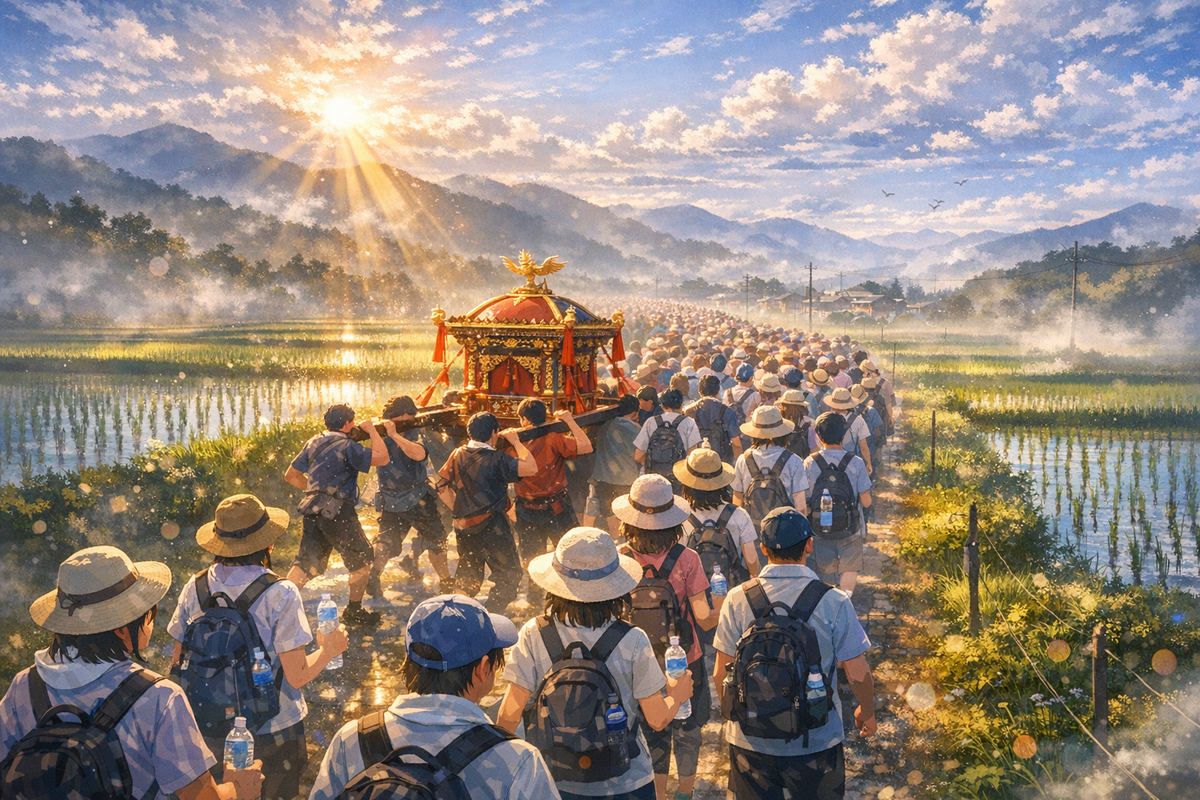
站在苗栗白沙屯的稻田邊,我看著神轎突然右轉進一條沒有標示的小路。46萬人跟著轉。沒有廣播,沒有指示牌,沒有任何人宣布「我們改變路線了」。整個隊伍像候鳥轉向一樣自然。
這是2026年白沙屯媽祖遶境的第三天。8天行程從苗栗拱天宮走到雲林北港朝天宮,沒有固定路線,神轎往哪走就往哪走。我本來打算只跟一天,但這個系統的運作方式讓我著迷——作為一個習慣解說山林生態的人,我現在看到的是一個完全不同的生態系統。
無中心的動員機制
46萬人參與,沒有政府主辦,沒有企業贊助。這是台灣最大規模的非官方社會動員。對比政府舉辦任何活動的行政成本和動員難度,白沙屯遶境的效率近乎不可思議。沒有人發號施令,沒有人分配任務,整個系統靠信仰共識自動運轉。
這讓我想起森林裡的菌絲網絡。沒有中央大腦,但每棵樹都能透過地底的真菌系統分享養分和警訊。白沙屯遶境也是這樣——沒有指揮中心,但每個信徒都知道自己該做什麼。有人提供住宿,有人煮食物,有人扛轎,有人只是走。所有功能自動填補。
農曆三月的氣候政治
媽祖生日在農曆三月二十三日。台灣有句老話:「大道公風、媽祖婆雨」。三月十五保生大帝生日會颳風,三月二十三媽祖生日會下雨。說迷信不準確——三月正好是東北季風轉西南季風的氣候轉換期,天氣劇烈變動,老一輩的觀察有它的依據。
信徒稱這些雨為「洗路」,相信神明出巡前降雨是為了淨化香路。但我看到的是另一層意義:台灣的民間信仰系統深度嵌入氣候節律,與土地同步呼吸的那套知識,不是從課本來的,是一代一代走出來的。媽祖原本是宋代莆田漁民林默娘,因海上救人殉難後神化。她的信仰從海岸線延伸到內陸農業區,成為台灣西部最廣泛的社會基礎設施。
為什麼是苗栗到雲林
白沙屯到北港的路線穿越台灣西部農業核心地帶。這條香路上的參與者橫跨各年齡、職業、政治立場。我在隊伍裡遇到退休公務員、科技業工程師、農民、大學生。沒有人討論政治,沒有藍綠標籤,只有共同的步行節奏。
這是台灣社會罕見的跨政治光譜共識場域。在選舉語言越來越撕裂的台灣,廟宇系統反而成為去政治化的凝聚機制。它提供的是另一套完全不同的集體體驗——靠行走,靠參與,不靠論述,不靠說服。
韌性從何而來
第五天傍晚,神轎在一個小村莊停駐。村民早已準備好食物和水,彷彿他們提前知道媽祖會經過這裡。但其實沒有人知道。他們只是準備了,如果媽祖來,就接待;如果不來,明年再試。
這就是白沙屯模式的核心:準備好了,但不預設路線。不是控制,是適應。台灣的社會韌性可能不在政治動員能力裡,而在這種每年春天的集體行走中——46萬人願意放下既定行程,跟著一個沒有固定路線的神轎走8天。這是對不確定性的高度耐受,是對集體判斷的深度信任。
我最後走了5天。回到山上繼續帶團解說生態系統。但現在我知道,台灣最有韌性的生態系統不只在森林裡,也在每年農曆三月的香路上。
— 鍾雅筑
460,000 People, No Fixed Route: The Ecology of Baishatun Mazu
Standing by a rice field in Baishatun, Miaoli, I watched the palanquin suddenly turn right into an unmarked lane. 460,000 people turned with it. No announcement, no signage, no one declaring “we’re changing route.” The entire procession shifted like migrating birds.
This was day three of the 2026 Baishatun Mazu pilgrimage. Eight days from Gongtian Temple in Miaoli to Chaotian Temple in Yunlin’s Beigang, with no fixed route—the palanquin goes where it goes. I’d planned to follow for just one day, but the mechanics of this system fascinated me. As someone who guides people through mountain ecosystems, I was now observing an entirely different kind of ecology.
Mobilization Without Center
460,000 participants. No government organizer. No corporate sponsor. This is Taiwan’s largest unofficial social mobilization. Compare this to the administrative cost and difficulty of any government-organized event—the efficiency of Baishatun pilgrimage borders on miraculous. No one gives orders. No one assigns tasks. The entire system self-organizes through faith consensus.
It reminded me of mycorrhizal networks in forests. No central brain, yet every tree shares nutrients and warnings through underground fungal systems. Baishatun works the same way—no command center, but every believer knows their role. Someone offers lodging, someone cooks, someone carries the palanquin, someone just walks. All functions automatically fill.
The Climate Politics of Lunar March
Mazu’s birthday falls on the 23rd day of the third lunar month. Taiwan has an old saying: “Baosheng Dadi brings wind, Mazu brings rain.” The 15th brings wind, the 23rd brings rain. Not superstition—observation. March is precisely when the northeast monsoon shifts to southwest, a period of dramatic weather change.
Believers call these rains “washing the road,” believing the deity sends rain to purify the pilgrimage path. But I see another layer: Taiwan’s folk religion system is deeply embedded in climate rhythms. It’s a knowledge system breathing in sync with the land—built not from textbooks but from generations of walking the same routes. Mazu was originally Lin Moniang, a Song Dynasty fisherwoman from Putian who died saving people at sea and was deified. Her worship spread from coastlines to inland agricultural areas, becoming the widest social infrastructure across western Taiwan.
Trust Through Walking
The Baishatun-to-Beigang route crosses Taiwan’s agricultural heartland. Participants span all ages, occupations, political positions. I met retired civil servants, tech engineers, farmers, university students. No one discussed politics. No blue-green labels. Only shared walking rhythm.
This is a rare cross-political-spectrum consensus space in Taiwan. As electoral language grows more divisive, temple systems function as depoliticized cohesion mechanisms. What they offer is a completely different collective experience—through walking, through participation, not through discourse or persuasion.
Where Resilience Lives
Evening of day five, the palanquin stopped in a small village. Villagers had food and water ready, as if they knew Mazu would pass through. But no one knew. They simply prepared—if Mazu comes, they host; if not, try again next year.
That’s the core of the Baishatun model: not planning, but preparing. Not control, but adaptation. Taiwan’s social resilience may not lie in political mobilization capacity, but in this annual spring walk—460,000 people willing to drop their schedules and follow a palanquin with no fixed route for eight days. This is high tolerance for uncertainty, deep trust in collective judgment.
I walked five days total. Then returned to the mountains to resume guiding ecosystem tours. But now I know Taiwan’s most resilient ecosystem isn’t only in forests—it’s also on the pilgrimage routes every lunar March.
— 鍾雅筑
延伸閱讀
https://justfly.idv.tw/s/bDenLDS