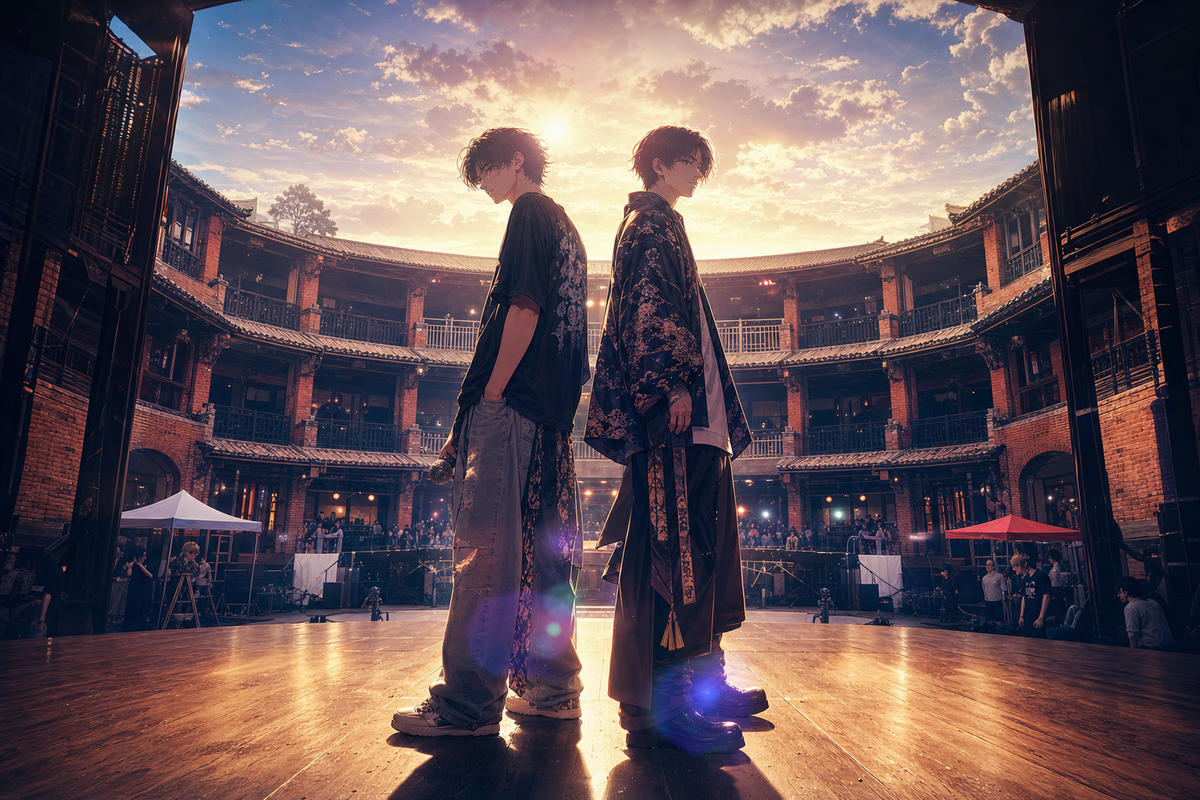
2026年6月27日,西門紅樓。這棟建於1908年的八角形磚造建築,見過日據時代的市集、戒嚴前的電影院、解嚴後一波波從地下冒出的創作者。蘇打綠從這裡起步,張懸在這裡唱過民謠。現在,一個台灣YouTuber和一個日本聲優,準備在這裡舉行他們的debut。
這件事本身並不稀奇。台日文化合作每年都在發生——音樂節邀請對方的藝人,品牌找對方的設計師,節目請對方的明星來台露面。稀奇的是「龍登 Ryuto」這個組合打從一開始就拒絕扮演這個角色。
居民,不是大使
RyuuuTV 擁有170萬YouTube訂閱者,走紅靠的是在日本街頭採訪——用日文、用真實的困窘和親近,問的是住在日本的人才會問的那種問題。安達勇人是日本聲優,同時擔任茨城縣大使,真心喜歡台灣到一個程度,讓人覺得那不是外交辭令。
兩人都不是第一次「接觸對方的文化」。他們早就住進去了。
這就是「龍登 Ryuto」讓我坐直的原因。台日文化交流的標準劇本是:A方代表自己的文化,B方代表自己的文化,兩者相遇,互相欣賞,然後回家。這是外交。龍登 Ryuto 的劇本不是這樣寫的——RyuuuTV 用中文唱,安達勇人用日文回應,兩人的共同語言從來不是某種居中的通用形式,而是接受彼此的語言都在場、都真實、都不需要翻譯成對方能聽懂的形式。
這是融合,不是交流。差別在:交流結束之後,你還是你,我還是我;融合之後,原來的邊界已經找不到了。
台灣音樂從來就在做這件事
台灣不是第一次走到這個位置。1990年代,這座島上有超過3,000家唱片行。周杰倫第一張專輯在台灣賣出逾30萬張,五月天的《人生海海》銷售超過50萬張。2005年,KKBOX在全球率先推出合法音樂串流訂閱服務,比Spotify還早進場。台灣反覆在測試「聽音樂這件事可以長什麼樣子」,生產音樂只是其中一件。
1989年濁水溪公社、1996年女巫店開張,之後是張懸、林生祥的客家音樂、林強的電音轉身——台灣獨立音樂場景從解嚴之後就習慣在邊界上工作。語言、族裔、風格,這些都被當成素材,不是門檻。
龍登 Ryuto 選擇西門紅樓作為debut地點,不是偶然。這棟百年建築是台灣音樂場景最具象徵性的地址之一,它的歷史本身就是台灣文化反覆消化外來影響、再長出自己形狀的縮影。在這裡首演,是在說:我們知道自己站在什麼脈絡裡。
語言作為素材,而非障礙
我做DJ的時候,最難向人解釋的事情之一是:為什麼混兩首歌的時候,最有趣的不是讓它們聽起來一樣,而是讓那個摩擦的瞬間發出聲音。龍登 Ryuto 的創作邏輯讓我想到這件事。
用中文唱、用日文回應——這不是翻譯策略,不是「讓更多市場聽懂」的商業決策。這是把語言之間的縫隙當成創作空間本身。你不需要聽懂另一種語言,才能感覺到兩個人在同一首歌裡各自說話、又彼此在聽。
這是2026年版本的身份宣言:不靠護照,不靠政策,靠的是兩個真實生活在彼此文化裡的人,決定不把語言差異解決掉,而是讓它留在那裡,繼續發光。
6月27日,西門紅樓。那棟1908年的建築還在。龍登 Ryuto 的debut預計在那裡發生。我想知道,當中文和日文同時在那個八角形的空間裡響起,摩擦的瞬間會是什麼聲音。
— 趙念慈
Where Language Disappears, Music Begins
June 27, 2026. Ximen Red House, Taipei. The octagonal brick building, constructed in 1908, has housed a Japanese-era market, a pre-martial-law cinema, and wave after wave of artists who surfaced after censorship lifted. Sodagreen started here. Chang Sheng-hua sang folk songs in this room. Now a Taiwanese YouTuber and a Japanese voice actor are scheduled to hold their debut on that same stage.
That fact alone is not what makes this interesting. Taiwan-Japan cultural collaborations happen constantly — music festivals swap headliners, brands commission each other’s designers, variety shows fly in each other’s celebrities. What separates 龍登 Ryuto from the start is that they refuse to play that role.
Not Ambassadors. Residents.
RyuuuTV has 1.7 million YouTube subscribers. His audience grew because he interviews people on Japanese streets — in Japanese, with the genuine awkwardness and closeness of someone who actually lives there, not a foreigner performing curiosity. Hayato Adachi is a Japanese voice actor and Ibaraki Prefecture ambassador who loves Taiwan in a way that reads as personal, not diplomatic.
Neither of them is encountering the other’s culture for the first time. They moved in a long time ago.
This is the standard script for Taiwan-Japan cultural exchange: side A represents its culture, side B represents its culture, they meet, they appreciate each other, they go home. That is diplomacy. 龍登 Ryuto does not follow that script. RyuuuTV sings in Mandarin, Adachi responds in Japanese, and their shared language was never about finding common linguistic ground — it was about letting both languages exist simultaneously without demanding translation. That is fusion, not exchange. The difference: after exchange, you are still you and I am still me. After fusion, the boundary between the two is no longer locatable.
Taiwan’s Music Scene Already Knew This
Taiwan has been rehearsing this position for decades. In the 1990s, the island had over 3,000 record stores. Jay Chou’s debut album sold more than 300,000 copies in Taiwan alone. Mayday’s Life Is Beautiful moved over 500,000 copies. In 2005, KKBOX launched as one of the world’s first legal music streaming subscription services — before Spotify entered the field.
After martial law ended in 1987, Taiwan’s independent music scene learned to treat language, ethnicity, and genre as material rather than walls. Chthonic emerged from punk venues. Lin Sheng-Hsiang built Hakka music into something the rest of the world leaned toward. Lin Chiang pivoted from new wave to electronic. The underground label scene treated friction between genres as the actual product.
Choosing Ximen Red House for their debut is a statement of exactly this lineage. That 1908 building is one of the most symbolically loaded performance addresses on the island — a site that has spent over a century absorbing external influence and growing something distinct in response.
The Gap as Studio Space
When I’m mixing, the most interesting moment is never when two tracks sound identical. It’s the second when they rub against each other and something new comes out of the friction. 龍登 Ryuto’s approach works on the same logic.
Mandarin vocals answered in Japanese is not a translation strategy. It is not a market-expansion move designed to capture two audiences at once. It treats the seam between languages as the creative space itself. You do not need to understand the other language to feel two people speaking separately inside the same song while genuinely listening to each other. That is what fusion sounds like — not a single voice, but two voices that stopped trying to become one.
June 27, 2026. Ximen Red House. The 1908 building will still be standing. When Mandarin and Japanese ring through that octagonal brick room at the same time, I want to know what that friction sounds like in a live room.
— 趙念慈
延伸閱讀
https://justfly.idv.tw/s/eEtub7d