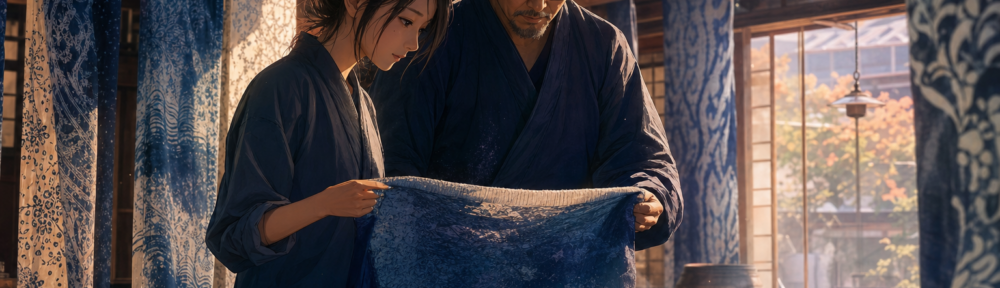
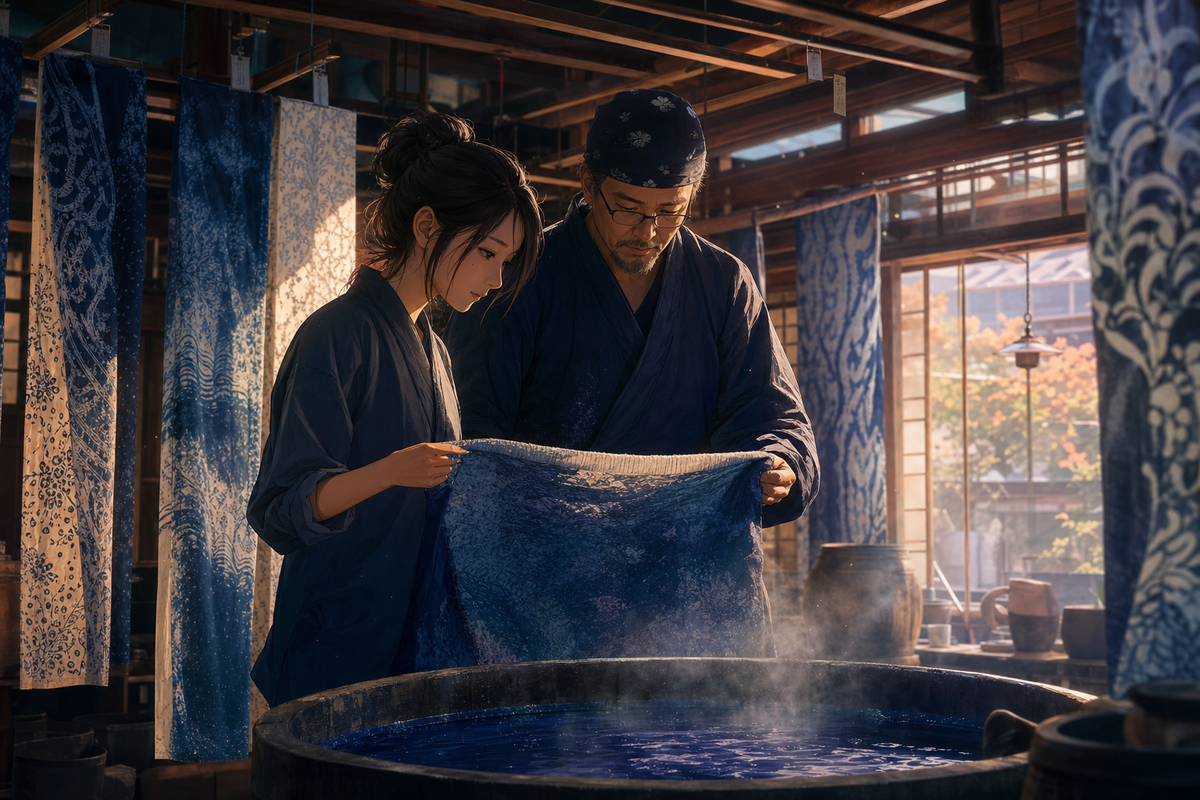
蠟液落在布上的瞬間,邊緣會自己決定形狀。
這是臈纈染(Rōketsuzome,蠟防染)最難掌控、也最迷人的地方:蠟滲透纖維的速度、溫度、濕度,決定了染色邊緣那條不規則的暈線。你無法用CAD畫出那條線。奈良時代(8世紀)的工匠就是靠這條不可預測的邊緣,在絲帛上留下自然的顏色層次。一千三百年後,京都染色工坊SHOBIEN仍在用同樣的邏輯操作蠟鍋。
台灣設計師品牌C JEAN的創辦人簡君嫄找上他們,不是為了在吊牌上加一行「京都職人手染」。
找的是工法,不是標籤
台灣設計圈這幾年有一種傾向:把「工藝合作」當品牌故事的填充物。某種藍染、某位阿嬤的手工、某個部落圖騰,全都可以被壓縮成一個campaign的視覺錨點,然後品牌繼續做它本來在做的事。C JEAN與SHOBIEN的合作不是這個邏輯。
簡君嫄帶進這次合作的,是她長期關注的設計語言——布料作為時間的容器。臈纈染的蠟防技法,用阻抗創造圖案:先決定什麼地方不要染色,再讓染料去填滿剩餘的空間。這個「負空間優先」的邏輯,和她慣用的剪裁哲學有結構上的呼應。SHOBIEN精通的,是如何控制那個「阻抗」——蠟的厚薄、熱度、入蠟角度——讓最後脫蠟後出現的邊緣剛好落在「自然」與「設計意圖」之間的窄帶裡。
這種程度的技術對話,不是一封商業合作邀請信可以啟動的。兩地手藝人是主動尋找彼此的相遇。
台日紡織,百年糾纏
台灣和日本的織品文化關係,比很多人以為的更有根底。日治時期,日本工程師在台灣建立織品工業基礎,引入大型織機與染整技術。到了1950至60年代,台灣花布業進入全盛期——全台超過200家印花工廠,年產量達數千萬碼,生產重鎮集中在桃園、新竹一帶。文化學者陳宗平在《花布時代》裡記錄的,是台灣紡織文化認同如何在那個年代被鑄造出來——產業密度、移植技術、在地圖樣,三條線纏在一起。
這段歷史很少被拿來當台日設計合作的前情提要,但它確實是。C JEAN與SHOBIEN的共創,站在這條脈絡的延長線上:遲來的對話繼續往前走。
我自己畫插畫時,偶爾會用到布料作為參考——把布料的染色層次和手感記在素描本裡,不拍照。臈纈染的那種暈邊,是我一直想在水彩裡複製卻很難複製的效果。第一次看到SHOBIEN的作品時,我第一個反應是「這個邊緣是怎麼做出來的」。那條邊緣的背後,是一個工匠在蠟液溫度、入蠟速度和布料纖維密度之間同時做判斷的身體記憶。
幾近失傳是什麼意思
「幾近失傳」這個詞被用得很濫。臈纈染在日本的處境,更準確的說法是:精通者越來越少,但SHOBIEN這樣的工坊仍在運作,技法本身沒有斷裂,是傳承的縱深在縮短。這個縮短的危機,才是「幾近」的真正意思。
當一個技法的傳承者只剩下少數幾個據點,每一次有外部創作者帶著嚴肅的設計意圖進來合作,就是在那個據點外圍多建一道防線。不是因為「文化保存很重要」這種空話——而是因為如果下一代有更多人知道這個工法可以做出什麼,願意繼續學的人機率就高一點。
C JEAN這次的新系列,把臈纈染帶回當代穿著的語境。布料上那條蠟封的邊緣,是奈良時代留下來的技術基因,現在包在一件2026年剪裁的衣服裡。這個並置本身,比任何文案都有說服力。
台灣設計師在做的事
台灣當代設計生態有一個值得注意的結構性條件:台灣設計師天然地站在多種文化影響力的交叉點,這個位置必須主動操作才能用,放著不動什麼都不會發生。往日本走,有百年殖民共構的工藝連結。往東南亞走,有南島語族的織品記憶。往西走,有大陸傳統的染織技法。
簡君嫄選擇走向京都,選擇的是一個技術語言上有深度對話空間的方向。設計判斷,不是地理浪漫。
蠟液落在布上,邊緣自己決定形狀。但是誰選擇把蠟液落在那塊布上,那是人的判斷。
— 蔡子涵
Wax and Memory: C JEAN Revives a Dying Japanese Dyeing Art
The moment hot wax touches fabric, the edge decides its own shape.
That uncontrollable border — where wax seeps into fiber at a rate determined by temperature, humidity, and the density of the weave — is both the technical challenge and the defining characteristic of Rōketsuzome, Japan’s wax-resist dyeing tradition. Artisans in the Nara period (8th century) were already exploiting that unpredictable edge to build layered color gradients on silk. Thirteen centuries later, Kyoto dyeing studio SHOBIEN still works by the same logic.
Taiwan-based designer Chien Chün-yuan, founder of C JEAN, approached them — not to stamp “Kyoto artisan-dyed” on a hang tag.
The Craft, Not the Credential
There’s a pattern in contemporary design where “craft collaboration” gets compressed into a campaign visual: a grandmother’s hands, an indigenous motif, a regional dye. The brand gets its story; the craft gets its fifteen seconds. C JEAN and SHOBIEN didn’t operate that way.
What Chien brought to this collaboration was a structural affinity. Rōketsuzome works through resistance: you decide where dye cannot go, and let the remaining space fill with color. That logic of negative space first mirrors the cutting philosophy she’s developed across C JEAN’s collections. SHOBIEN’s expertise is the precise control of that resistance: wax thickness, heat, application angle, so the edge after de-waxing lands in the narrow band between “accident” and “intent.”
That level of technical dialogue doesn’t start with a sponsorship inquiry. The two studios found each other because both were looking.
A Hundred Years of Textile History Between Taiwan and Japan
The connection between Taiwanese and Japanese textile culture runs deeper than most contemporary collaborations acknowledge. During the Japanese colonial period, Japanese engineers established Taiwan’s textile industry infrastructure, introducing large-scale looms and dyeing technology. By the 1950s and 1960s, Taiwan’s printed fabric industry was at its peak — over 200 printing factories operating across the island, with annual output reaching tens of millions of yards, concentrated in the Taoyuan and Hsinchu areas.
Cultural scholar Chen Zong-ping documented this era in The Age of Patterned Cloth (花布時代), tracing how Taiwan’s textile identity was forged in that period of industrial density. That history is rarely invoked as context for contemporary Taiwan-Japan design partnerships, but it is the actual foundation. C JEAN × SHOBIEN continues a conversation that has been running, in various forms, for over a century.
What “Nearly Lost” Actually Means
“Nearly lost” gets applied loosely to living craft traditions. A more accurate description of Rōketsuzome’s situation: the number of practitioners with deep mastery has contracted to a small number of studios, but the technique itself hasn’t broken — the transmission depth is shortening. That’s the real danger in “nearly.”
When a technique survives in only a few workshops, each serious outside collaborator who brings genuine design intent into the process extends the chain slightly. Not because preservation is abstractly virtuous, but because visibility raises the probability that the next generation finds something worth learning. C JEAN’s new series places Rōketsuzome inside contemporary wearable context. The wax-resist edge on that fabric carries a technical memory from 8th-century Nara, now cut into a 2026 silhouette.
Where Taiwan Designers Stand
Taiwan’s designers occupy a structural position at the intersection of multiple cultural lineages — Japanese colonial craft history, Southeast Asian weaving traditions, mainland Chinese dyeing techniques. That position requires active navigation; it doesn’t convert into anything on its own. Chien’s move toward Kyoto was a design decision: this is the direction where a technical conversation with real depth is possible.
The wax hits the fabric. The edge finds its own shape. But who decides to pick up the brush — that’s still a human judgment.
— 蔡子涵
延伸閱讀
- 車埕貯木池一天撈走400尾外來魚,真正的收穫是那張體重表
- 空白文庫本:讀者替自己寫作者頁
- 嘉義竹蒸籠還在冒煙,日本找不到的手藝就在這裡
- 赤峰街小店搬去承德路,那杯咖啡的味道會留下嗎
- 大洲臥龍山莊以外:一張和紙,把台灣策展人帶進城下町
https://justfly.idv.tw/s/qvQ9mkD