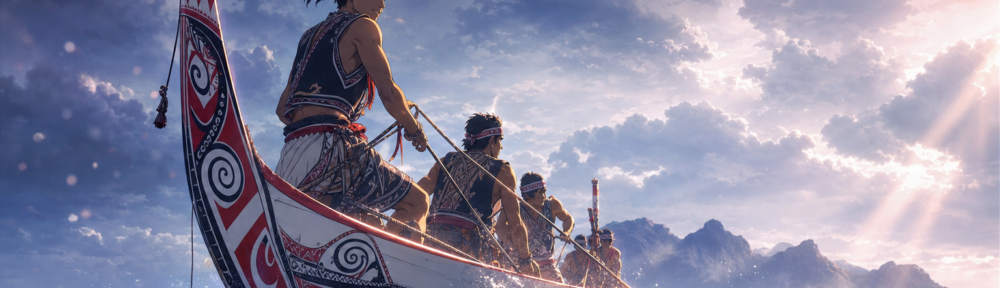
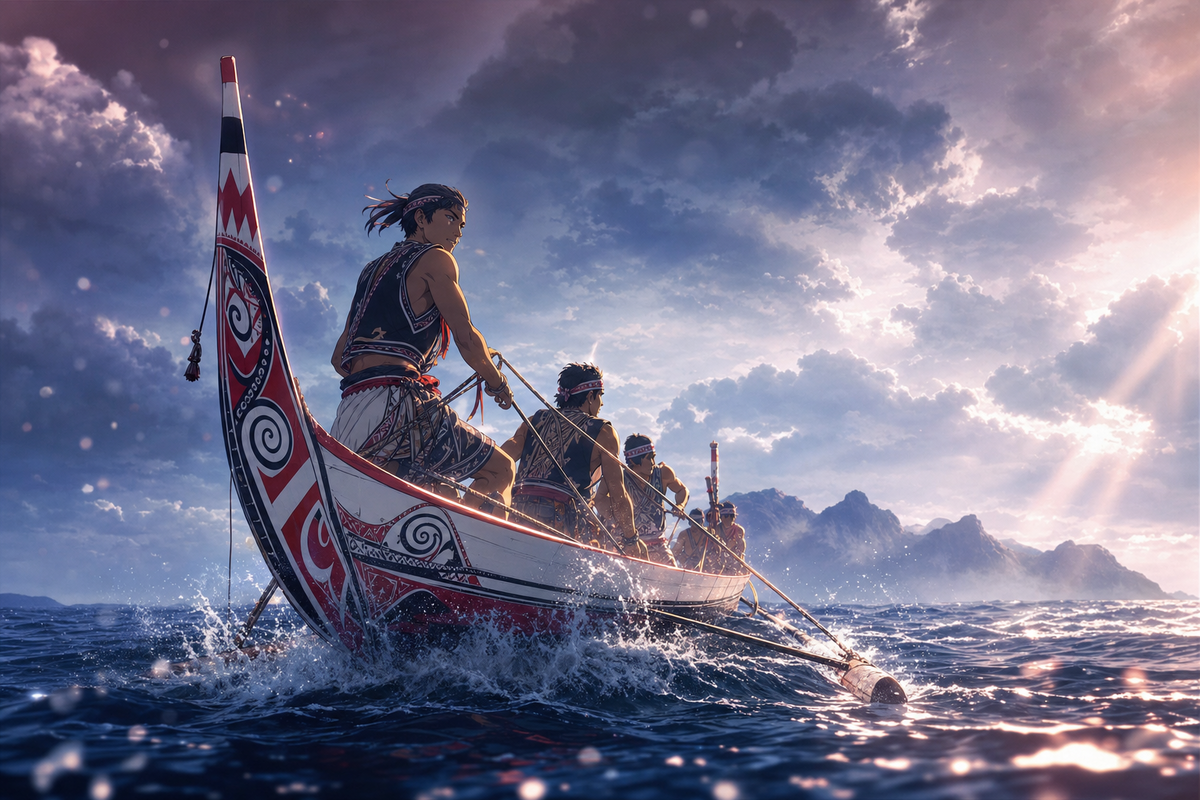
浪高4米。Ovayan在巴士海峽裡。
這不是一句詩。這是2026年真實發生的海況描述——達悟族的拼板舟,在台灣與菲律賓之間那條讓颱風借道的水道裡,划過去了。目的地是巴坦島,距離約190公里。CNN和Reuters在同一天發出全球報導。原民會主委把這趟航行定性為「文化外交」。
台灣沒有外交承認。一艘木船完成了一次政府做不到的事。
蘭嶼,和它唯一的船
要理解Ovayan,得先理解蘭嶼這座島本身的孤立狀態。達悟族,自稱Tao(「人」的意思),是台灣16個官方認定原住民族之一,全族人口約4,000人,只住在蘭嶼(Orchid Island)。台灣原住民總人口2024年約58萬,阿美族一族就佔了約21萬——達悟族的體量在裡面幾乎是邊注。
但達悟族在語言學上的位置,跟他們的人口數量完全不成比例。台灣其他15族講的是福爾摩沙語群,達悟族講的是馬來-玻里尼西亞語系——這個語系的另一端延伸到夏威夷、馬達加斯加、紐西蘭。達悟族是台灣唯一一族直接屬於這個分支,意思是他們和菲律賓巴坦島的人,在語言結構上的親緣關係,比和台灣本島的大多數原住民族還要近。
Ovayan是達悟族的拼板舟。三色船身:紅、白、黑。每一個幾何紋路都有特定意義,製作耗時數月,工藝代代口傳。它不是裝飾品,它是一個完整的知識體系,被壓縮進木頭和顏料裡。
5,000年前那次出發,留下的語言痕跡
語言學和遺傳學目前的研究共識,指向台灣是南島語族最可能的發源地。約5,000年前,一波太平洋大遷徙從台灣啟動,人群和語言向整個太平洋蔓延——最遠抵達復活節島,最西抵達馬達加斯加,橫跨地球將近一半的經度範圍。
台灣原住民語言佔南島語系主要分支大約一半。要研究南島語系的根,台灣的語言資料幾乎是不可繞過的材料。更往前推:台灣最古老的人類活動遺址是長濱文化,距今約5萬年。南島語族的遷徙故事,是在一個已經有人住了幾萬年的島上發生的。
4,000年後,一艘Ovayan划回了那個出發點的方向。
CNN報導的,是一件早就存在的事
媒體的邏輯是:有事發生,才是新聞。2026年的橫渡巴士海峽,對CNN和Reuters來說是一個「事件」。但對語言學家來說,這趟航行只是在物理空間裡重複確認了他們已經在詞彙比對和基因分析裡看見的東西。
這中間的落差有個具體的樣子:一件5,000年前就已經發生的事,需要一艘木船在2026年划過190公里的海峽,才能讓全球媒體發稿。學術論文做不到這件事。外交文件做不到。只有Ovayan在4米浪裡撐過去,才讓這個故事變成一條可以被轉發的新聞。
文化外交從來不是外交部的專利,但這次尤其明顯——台灣對菲律賓沒有正式邦交,官方管道能做的事極為有限。原民會主委的「文化外交」定性,在這個脈絡下聽起來不像是修辭,更像是一種無奈的精準描述。
船回到海上
達悟族約4,000人,住在一座面積不大的火山島上,說一種和鄰近島嶼親緣更近的語言,造一種耗時數月的木船。台灣的主流敘事裡,他們長期處於邊緣位置。
但在2026年的這次橫渡裡,他們是核心。政府沒有安排這件事,某個機構的贊助也不是讓它成立的決定性因素——是那艘船本身就是論述。紅白黑三色的幾何紋路,在4米浪裡,回到了5,000年前出發的方向。
外交部沒有這種工具。
— 詹爍茹
One Wooden Boat Did What Diplomacy Could Not
Four-meter swells. Ovayan in the Bashi Channel.
In 2026, a Tao Indigenous canoe from Taiwan’s Orchid Island crossed approximately 190 kilometers of open water to reach the Batanes Islands of the Philippines. CNN and Reuters filed the same day. The head of Taiwan’s Council of Indigenous Peoples called it “cultural diplomacy.”
Taiwan has no formal diplomatic recognition from the Philippines. A wooden boat did what the foreign ministry could not.
The Island and Its Only Boat
The Tao (達悟族) are one of Taiwan’s 16 officially recognized Indigenous peoples, with a population of roughly 4,000, living exclusively on Orchid Island. Taiwan’s total Indigenous population stands at approximately 580,000 as of 2024 — the Amis alone number around 210,000. In that context, the Tao are a footnote in headcount.
Linguistically, they are anything but. While Taiwan’s other 15 Indigenous groups speak languages classified under the Formosan branch, the Tao language belongs to the Malayo-Polynesian family — the same branch that extends to Hawaii, New Zealand, and Madagascar. The Tao are the only group in Taiwan with this direct linguistic affiliation, making them closer in language structure to the people of the Philippine Batanes than to most of their fellow Indigenous Taiwanese.
The Ovayan is the Tao’s traditional plank-built canoe: a three-color hull in red, white, and black, each geometric pattern carrying specific meaning, the craft taking months to build, the technique transmitted by hand and memory across generations. It is not a ceremonial object kept ashore. It goes to sea.
The Migration That Left Half a Language Family Behind
Linguistics and genetics research converge on a single conclusion: Taiwan is the most likely origin point of the Austronesian peoples. Approximately 5,000 years ago, a Pacific diaspora launched from this island, eventually reaching Easter Island to the east and Madagascar to the west — spanning nearly half the Earth’s longitude.
Taiwan’s Indigenous languages account for roughly half of the major branches of the Austronesian language family. That is not a minor data point. It means that any serious reconstruction of where Austronesian languages came from has to run through the linguistic material preserved on this island. And the island itself is ancient: Taiwan’s oldest confirmed human activity site, the Changbin Culture, dates back approximately 50,000 years.
The Ovayan’s 2026 crossing traveled in the direction of that original departure.
The News Was 5,000 Years Old
Media logic requires an event. The 2026 Bashi Channel crossing gave CNN and Reuters an event. For anyone who had already read the linguistic and genetic literature, though, the canoe was physically re-enacting something that comparative vocabulary tables and DNA studies had been quietly confirming for decades.
That gap is worth noting. An academic paper tracing Austronesian cognates does not move the news cycle. A wooden boat in four-meter waves does. The Ovayan made the story transmissible in a way that no journal article could — which is its own kind of argument about how cultural facts get recognized by the world.
Taiwan’s government had no diplomatic instrument for this moment. No treaty, no consular relationship, no formal channel between Taipei and Manila that could have delivered what one boat delivered. The Council of Indigenous Peoples head’s phrase — “cultural diplomacy” — sounds less like a slogan and more like an accurate description of an available option when official ones are closed.
Back to the Channel
Four thousand people on a volcanic island, speaking a language more closely related to Philippine tongues than to most of their neighbors in Taiwan, building canoes that take months to finish — the Tao sit at the margins of most conversations about Taiwan’s identity.
The Bashi Channel crossing put them at the center of a different conversation: not about Taiwan’s political status, but about where an entire language family came from, and who has been carrying that proof in the geometry of a painted hull.
The red, white, and black lines on an Ovayan are not decoration. They are evidence. In 2026, that evidence crossed 190 kilometers of open water and arrived.
— 詹爍茹
延伸閱讀
- 大象體操去日本不是巡演,是找同族
- 車埕貯木池一天撈走400尾外來魚,真正的收穫是那張體重表
- 空白文庫本:讀者替自己寫作者頁
- 嘉義竹蒸籠還在冒煙,日本找不到的手藝就在這裡
- 赤峰街小店搬去承德路,那杯咖啡的味道會留下嗎
https://justfly.idv.tw/s/fTYmxHC