
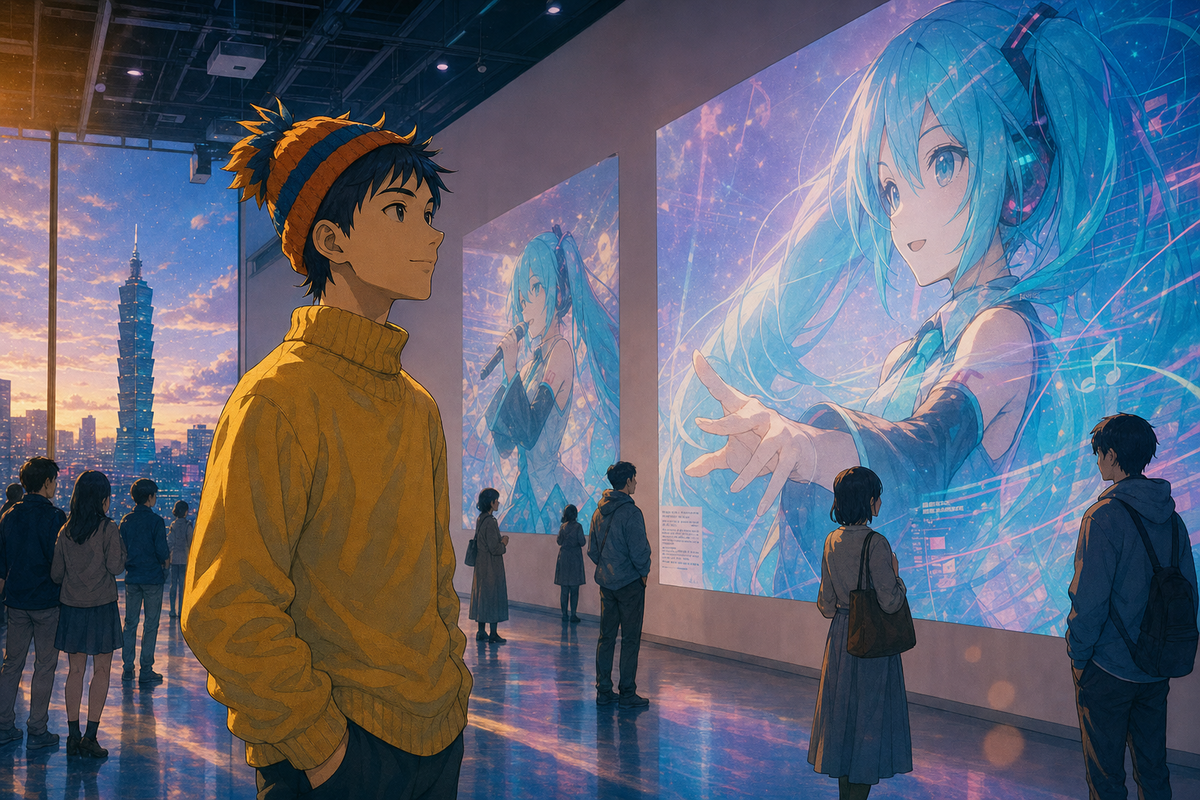
白石畫廊台北館,8月8日。初音未來的當代藝術展《ART OF MIKU》,海外首站落在這裡。不是倫敦、不是洛杉磯、不是上海,是台北。一個以虛擬歌手身分誕生、早已是全球流行現象的角色,在決定把藝術等級的第一個海外展覽放在哪裡時,答案是台灣。
緊接著,以極端視覺風格聞名的「恐怖心展」,預計於9月於台北舉辦日本國外首次展覽。同一時期,原田治 OSAMU GOODS 50周年特展(海外首場大型特展)也正在台灣展出,地點為華山1914文創園區,展期至9月13日。三件事壓在同一個時間帶,不像巧合,更像是某種布局收網的時刻。
「首站」這個決定,重量不一樣
「首站」是有成本的。它意味著沒有前車之鑑,沒有已驗證的觀眾反應,沒有票房參考值。主辦方要自己估算市場的理解深度,自己押注文化接受度,自己面對可能失算的風險。選一個「首站」,其實是選一個你最信任的觀眾群。
初音未來走到這一步,背景複雜。她從一套語音合成軟體長成了一個擁有億級粉絲基礎的文化符號,從演唱會到時裝週合作,商業觸角延伸極廣。但「藝術展」這個形式是另一個賭注——它要求觀眾不只是粉絲,而是能在畫廊語境裡讀懂她的人。選台灣當這個賭注的第一個落點,說明台灣的次文化觀眾在主辦方眼中具備這個能力。
這個評估未必是情感驅動的,市場成熟度、通路基礎、語言接近性、城市文化密度,都是計算變項。但計算的結果是台灣,就是計算的結果。
藏壽司×吉伊卡哇已經聯名到第四次了
佐證這個方向的,還有一個更日常的數字:藏壽司與吉伊卡哇在台灣的聯名已是第4度。一個 IP 如果只是文化輸出的嘗試,聯名一次就夠。聯名到第四次,說明台灣消費者的回應達到了讓雙方都願意持續押注的水準。
這種「反覆押注」本身就是一種市場信任佐證。它不需要任何文化政策聲明,帳目說話。
台灣在日本次文化輸出地圖裡的位置,常被低估
流行的敘事是:台灣人喜歡日本文化,所以日本東西賣得好。這個敘事把台灣放在「消費者」的位置,被動等待。但《ART OF MIKU》海外首站、「恐怖心展」日本境外首次,選擇的邏輯倒過來更準確——台灣被當作一個可以首發的市場,一個理解深度足夠、反應品質足夠讓人願意把「第一次」放在這裡的地方。
這兩種角色之間的差距,很大。
東南亞市場體量更大,日本 IP 在那裡同樣受歡迎;紐約有更強的藝術市場背書;首爾有更成熟的次文化展覽基礎設施。台灣不是唯一的選項,但在特定類型的日本次文化輸出裡,台灣在優先名單的前排出現的頻率,說明有某種反覆被確認的市場判斷在運作。
原田治 OSAMU GOODS 是另一個例子。50周年特展是一個非常「內行」的紀念企劃,針對的是知道原田治是誰、知道 OSAMU GOODS 的設計語言的觀眾。這不是大眾 IP,是給次文化圈子裡的人看的展覽——而這個展覽同樣選擇來台灣。
策展人的問題不是「為什麼」,是「接下來呢」
從策展的角度看,這個時間帶集結的三個展覽,不只是日本次文化來台,更像是一次集體的觀眾測試。每一個展覽結束後,都會有數據——人流、媒體聲量、社群傳播、周邊銷售。這些數據會被帶回日本,進入下一次決策。
台灣之所以可能持續在這份優先名單上,取決於這次的結果。如果《ART OF MIKU》台北站的觀眾反應讓主辦方滿意,下一個「海外首站」的候選清單還會有台灣。如果沒有,邏輯就會往別處修正。
《ART OF MIKU》台北站已於2026年8月1日正式開幕(第一階段至8月23日,第二階段8月29日至9月20日)。測試已經開始。
— 張誠書
Japan Keeps Choosing Taiwan First
At Whitestone Gallery Taipei, on August 1, the art exhibition ART OF MIKU opened its overseas premiere. Not London. Not Los Angeles. Not Seoul. The first stop outside Japan for an art-format exhibition built around one of the world’s most recognized virtual icons lands in Taipei.
Shortly after, the “horror sensibility” exhibition known for its extreme visual aesthetic is scheduled to hold its first-ever event outside Japan — also in Taipei. The OSAMU GOODS 50th anniversary exhibition, celebrating the legacy of illustrator Osamu Harada, is also running in Taiwan during the same window — at Huashan 1914 through September 13, its first major overseas show. Three premieres, one city, one concentrated window of time.
What “First Stop” Actually Costs
A premiere location carries real stakes. There is no prior box office to reference, no proven audience response curve, no safety net. Organizers are betting on their own read of a market’s cultural literacy. Choosing a “first stop” is, fundamentally, choosing the audience you trust most.
The decision to bring ART OF MIKU — not a merchandise pop-up, but a contemporary art exhibition designed for gallery contexts — to Taipei first signals that the organizers believe Taiwanese audiences can engage with the work on its intended terms. That judgment involves market maturity, distribution infrastructure, cultural proximity, and urban density. The calculation landed on Taiwan.
A Collaboration Renewed Four Times
The Kura Sushi × Chiikawa collaboration in Taiwan has now reached its fourth iteration. One co-branded campaign is a market test. Four is a verdict. The consumer response in Taiwan has been strong enough, repeatedly, that both sides keep committing resources to another round. No cultural policy declaration needed — the renewal cycle is the statement.
This pattern of repeat investment is a more honest signal than any single viral campaign. It means the connection between certain Japanese IPs and Taiwanese consumers has been stress-tested and confirmed across multiple data points.
Consumer vs. Trusted First Audience
The common frame positions Taiwan as an enthusiastic Japanese popular culture consumer — a market that buys what Japan exports. That framing is accurate but incomplete. The more precise observation from these three exhibitions is that Taiwan is being positioned as a validation stage: a place where Japanese cultural producers are willing to run their overseas premiere before they know how the rest of the world will respond.
Southeast Asian markets are larger by population. New York carries stronger art-world prestige. Seoul has deep subculture exhibition infrastructure. Taiwan is not the only viable option in any of these categories. But for a specific type of Japanese subculture output — the kind that requires an audience with genuine familiarity, not just goodwill — Taiwan keeps appearing near the top of the shortlist. That frequency reflects a judgment that has been made and re-confirmed more than once.
The OSAMU GOODS anniversary show underscores this. It is not a mass-market IP event. It targets people who already know Harada’s design vocabulary, who can read the reference without being told what it means. That show is coming to Taiwan.
The Results Will Determine the Next List
From a curatorial standpoint, this cluster of exhibitions functions as a collective audience test. Attendance numbers, media coverage, social spread, merchandise performance — all of it goes back to Japan and feeds the next round of decisions. Taiwan’s position on future “first stop” shortlists depends directly on what these shows return.
If ART OF MIKU performs well in Taipei, the template holds. If it doesn’t, the logic shifts somewhere else. The first stage opened August 1 and runs through August 23; the second stage follows August 29 through September 20.
— 張誠書
延伸閱讀
https://justfly.idv.tw/s/ZpGDPzW