
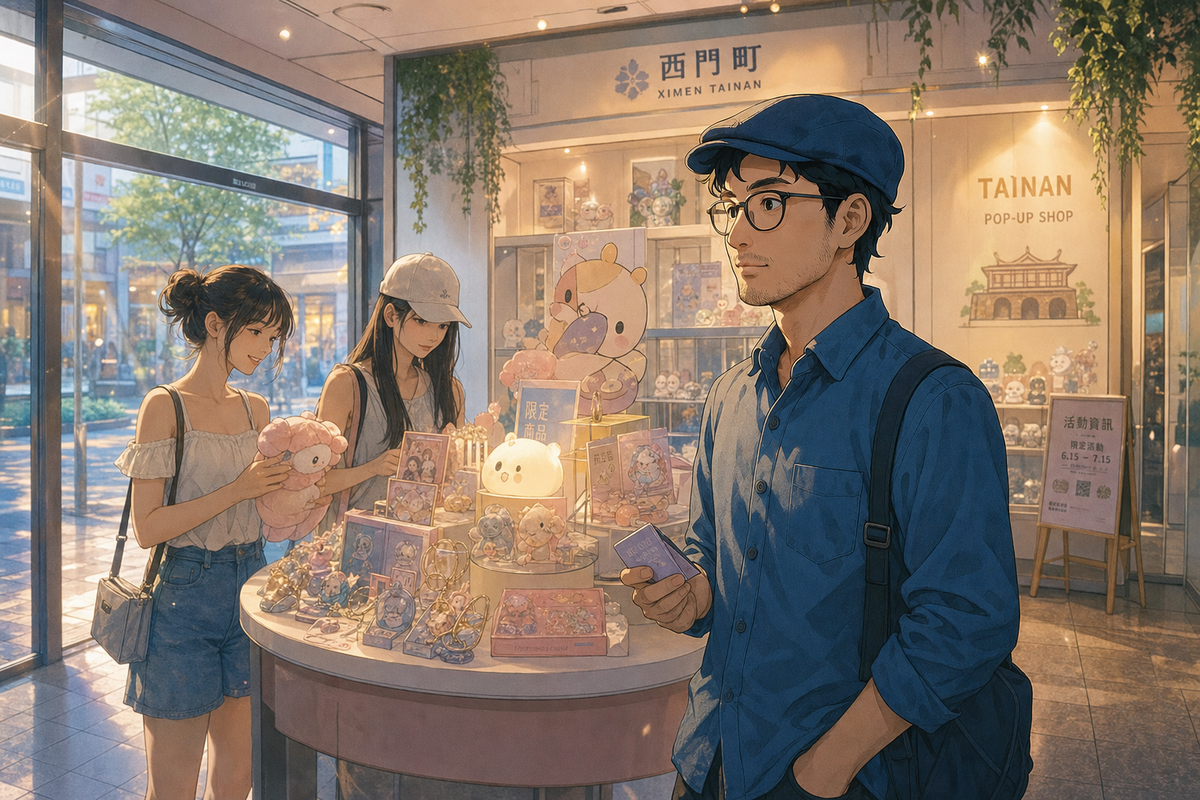
七月的新光三越西門新天地
卡娜赫拉的小動物「小日常研究室」快閃店,7月1日起在台南新光三越西門新天地開張,為期兩個月。五大療癒打卡點、限定周邊、發光充電頭——陳列邏輯和台中的「莓果祭典」相比,配方接近,但落腳的城市完全不同。
為什麼選台南,不選台北?
這個問題乍看像是租金計算或人流分析,但答案更不整齊。
台南的觀眾不接受「應該喜歡這個」
台北的IP快閃消費邏輯,很大程度上靠稀缺性驅動——限定、首發、排隊整理券。台北三創是日本動畫IP的常駐主場,中山地下書街在同一個暑假也迎來了「貓福珊迪」(Mofusand)。台北的快閃文化已經接近飽和,每一檔活動都在和前一檔競爭注意力。
台南的消費結構不一樣。這座城市的核心消費者——十五到三十歲、同時是台南旅遊與選品店的高頻使用者——選擇IP的判準是「這個角色的世界觀跟當下的生活邏輯有沒有交集」。紅不紅不是問題。這是一種更挑剔的閱讀方式。
卡娜赫拉的小動物從LINE原創貼圖起家,在台灣累積千萬次下載,台灣Facebook粉絲專頁擁有逾5.4萬個讚。這個數字在IP圈不算爆炸級,但黏著度異常穩定。角色語言——日常感、微小療癒、沒有英雄敘事——剛好和台南選品店美學共用同一套語彙。兩者都拒絕宏大,都在處理「怎麼讓一個平凡的下午有一點值得的東西」。
南台灣快閃版圖的幾何
同一時期,拉拉熊(Rilakkuma)的海外快閃巡迴繞過北部直接落地高雄,以「沉浸式體驗」取代傳統授權商品陳列。高雄是南台灣的另一個測試場。兩個日系療癒IP,一南一高,同時進行類似的市場探針實驗。日系IP在台灣的操作策略越來越清晰:台北已是既有市場,南台灣才是需要重新校準的場域。
矢野研究所的數據顯示,2024年日本角色市場規模達2.77兆日圓,年增幅逾102%。這個數字描述的是日本本土的能量,但台灣一直是最穩定的出海承接站之一。台灣寶可夢中心自2023年12月開幕後,每週推出限定商品、入場需排隊整理券,持續驗證台灣IP消費者對「儀式感購物」的高度耐受力。卡娜赫拉在台灣的快閃路線——台中草悟廣場「莓果祭典」、接著台南「小日常研究室」——是同一套策略的城市巡演版本。
快閃測的不是銷量
台中草悟廣場的「莓果祭典」打造了六大打卡點與近五十款周邊商品,兩個月的週期讓它接近「常設型體驗」而非一次性快閃。台南的「小日常研究室」也是兩個月——這個時間長度本身是一個設計決定:夠長,讓在地居民有機會回訪;夠短,讓稀缺感不消失。
做藝術的看快閃展和看常設展的方式不一樣。快閃迫使所有設計決策加速——空間、動線、商品階層、打卡點的視覺密度——每個細節都在做濃縮的品牌宣言。「小日常研究室」這個名字不是隨便取的:「研究室」暗示實驗性與嚴肅感,「小日常」把尺度壓縮到最低,兩個詞撞在一起是刻意製造的輕微矛盾,這種矛盾正是卡娜赫拉角色語言的核心語法。
台南是台灣IP市場最難通過的評審。台南的文化密度自然產生了更強的過濾機制,一個IP若能在這裡讓人覺得「這個角色跟街道氣氛對得上」,在台灣其他城市的成立就幾乎沒有疑問。
8月31日,快閃結束。數字會被統計,社群討論度會被分析,下一個城市的決策會從這裡開始算。
— 姚宇
Tainan Is the Hardest Audience in Taiwan
A Pop-Up That Chose the Wrong City on Purpose
On July 1, Kanahei’s Small Animals opened “Small Daily Lab” at Shin Kong Mitsukoshi Ximen in Tainan — five themed photo zones, limited merchandise, glowing charger accessories. The run lasts two months, through August 31. The question nobody is asking loudly enough: why Tainan, and not Taipei?
The answer is not about rent. Not about foot traffic projections. About what kind of audience Tainan produces and what passing that audience’s judgment actually means.
Taipei Is Already Spoken For
Taipei’s pop-up economy runs on scarcity mechanics — limited runs, first releases, queuing tickets. The same summer that Kanahei landed in Tainan, Mofusand opened in Taipei’s Zhongshan underground book street. Taipei Three Creative Center has become the default landing pad for Japanese animation IP. The capital is saturated. Each activation competes with the memory of the last one.
Tainan operates differently. The core consumers there — the 15-to-30 demographic that overlaps heavily with Tainan’s tourism visitors and specialty shop regulars — do not select an IP based on its trending status. The question is whether a character’s worldview intersects with local aesthetic logic. That is a harder filter to pass.
Kanahei’s Small Animals started as a LINE sticker IP and has accumulated tens of millions of downloads in Taiwan, with over 54,000 likes on the Taiwan Facebook page. The numbers are stable rather than explosive. What keeps them stable is the character’s grammar: small-scale, daily-life warmth, zero heroic narrative. That grammar happens to share vocabulary with Tainan’s select-shop culture. Both refuse grandeur. Both are working on the same question — how to make an ordinary afternoon slightly worth it.
The Southern Geometry
In the same period, Rilakkuma’s international pop-up tour bypassed Taipei entirely and landed in Kaohsiung, upgrading from licensed merchandise to full immersive experience. Two Japanese comfort-character IPs, one in Tainan, one in Kaohsiung — the southern region suddenly becomes a testing grid. This pattern reflects a clearer strategic read: Taipei is a known market; southern Taiwan requires recalibration.
Industry data from the Yano Research Institute puts Japan’s character merchandise market at 2.77 trillion yen in 2024, with year-over-year growth exceeding 102%. Taiwan has consistently been one of the most reliable international relay stations for that energy. Pokémon Center Taipei, which opened in December 2023, still requires queuing tickets for weekly limited releases — evidence that Taiwan’s IP consumers tolerate, even prefer, ritualized purchasing.
Kanahei’s Taiwan circuit — “Berry Festival” at Taichung’s Caowu Square, then “Small Daily Lab” in Tainan — follows the logic of a city tour, not a random booking. Each venue is a calibration point.
Two Months Is a Design Decision
The Taichung “Berry Festival” ran nearly two months, featured close to 50 merchandise items across six photo zones, and functioned closer to a semi-permanent installation than a traditional pop-up. Tainan’s edition runs the same length. That duration is deliberate: long enough for local residents to return more than once, short enough to preserve urgency.
The name “Small Daily Lab” is not casual. “Lab” implies experiment, rigor, something being tested. “Small Daily” collapses the scale to the granular. The tension between those two words is exactly how Kanahei’s character language operates — a slight, productive contradiction held together without resolution.
Whether Tainan’s audience accepts the frame is what August 31 will answer. The sales numbers will be analyzed. The social discussion volume will be tracked. The next city’s booking decision starts from whatever those numbers say.
— 姚宇
延伸閱讀
https://justfly.idv.tw/s/nDAG9wZ