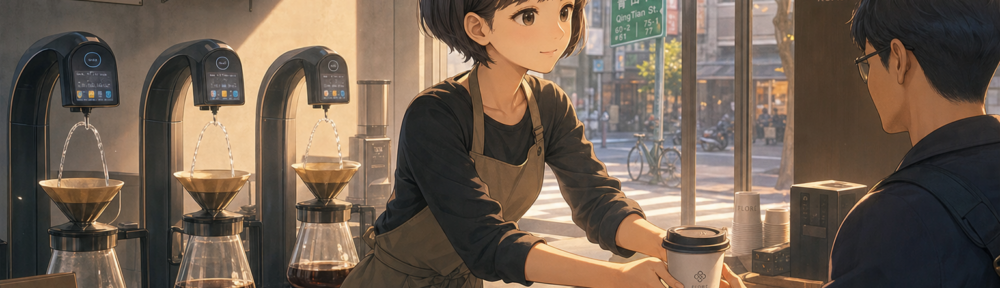
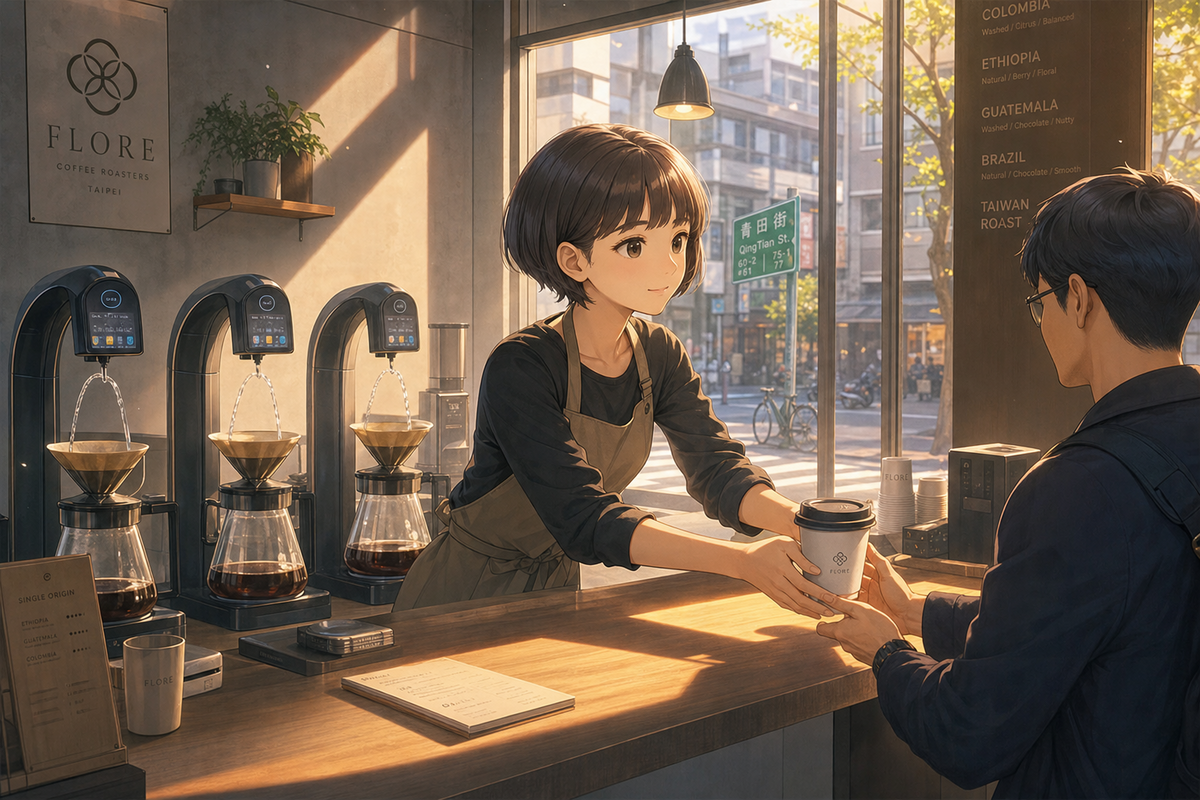
林森北路96之3號,一台機器正在做手沖咖啡。沒有人在旋轉手腕,沒有人在盯著細嘴壺的水流弧度。外帶一杯,銅賞,一百元。
這是涓流咖啡(Kenryu Coffee)2025年8月的開幕現場。創辦人中坊聖華出身日本奈良,2016年來台讀大學,疫情之後決定把想法變成一家店。店裡配置3台AI設備加上1名員工,10分鐘可以衝煮5到6杯。AI系統模擬的是日本專業手沖咖啡師的注水弧度、力道與抖粉動作——具體的、有出處的手法,不是通用程序。
一般精品手沖市場行情落在200到300元之間。銅賞外帶100元,差距是50%到67%。這個價差的來源,是人力成本和店租結構重組了,豆子沒有換。
「民主化」這個詞的實際意思
精品咖啡圈常講「民主化」。但多數時候那只是降價,換一個好聽的說法。涓流做的事稍微不同:價格確實壓下來了,但壓價的方式是把標準藏進機器裡,而不是換用較低等級的豆子或訓練時間較短的人手。
手沖咖啡的萃取結果對注水溫度、速度、水流落點極度敏感。同一支豆子、同一個配方,不同的人來沖,風味可以差到像兩支不同的豆。AI系統的價值不只是省人力——是能把「好的那次」複製無限次,而且不在週一早上狀態差的時候出錯。
流程是:秤豆、分豆、裝濾紙、刷卡啟動。剩下的交給機器。
台日之間的這條線
中坊聖華的背景是日本人在台灣創業,引進的是對日本手沖師傅動作的模擬。這個組合不是偶然。台灣在咖啡文化上長期受日系精品咖啡影響,消費者對手沖的感知框架本來就帶著一定的日系審美慣性。
同時期,台灣研發的咖啡器具也在往反方向流動。由台灣團隊主導開發的 HARIO Alpha Dripper Tritan,在日本 SCAJ 展會限定亮相後立即完售,之後正式在日本市場發售。研發端主導、設計輸出,台灣在精品咖啡器具上的角色從製造代工悄悄往前移了一格。
兩件事放在一起看:一個日本人來台灣把日本手法機器化,一個台灣團隊去日本把台灣設計賣出去。這條台日之間的咖啡文化線,正在雙向走。
AI進餐飲,這次不是噱頭
台灣AI進入餐飲的案例在2026年密集出現。手搖飲市場有品牌以AI智能製茶機為核心,主打7秒製茶、日銷最高2000杯,目標3年全球500店。政府層面,台灣同期宣布規模達1.5億美元的醫療AI計畫。AI進入日常生活的軌跡,在這幾個月密度明顯升高。
但餐飲業導入AI和製造業或醫療不同。需要一個答案:機器做出來的東西,客人願意買單嗎?涓流選擇的策略是讓定價先說話。一百元,門檻低到不需要說服。試了才能形成判斷,形成判斷才能建立習慣。
根據企業調查,仍有七成台灣企業沒有真正導入AI。餐飲業門檻本來就高:缺資金、缺人才、缺場景。涓流的模型是少數能在「小店規模」就跑得起來的案例——1名員工、3台設備、老街區的店面。這個配置的可複製性,才是值得觀察的地方。
喝下去之前不會知道的事
咖啡館存在一個根深蒂固的認知:手工製作等於更好。這個認知在精品咖啡圈尤其強烈,因為長期靠「咖啡師的技藝」作為品質敘事的核心。
涓流的商業模式在悄悄挑戰這個前提——但方式聰明,並沒有正面宣告「機器比人好」。說的是:這台機器模擬的是日本專業手沖師傅的動作。品質保證來自人,執行是機器。這個敘事框架讓機器站在人的延伸位置,而不是替代者。
喝下去之前,多數顧客不會知道那杯咖啡是AI做的。喝完之後,如果好喝,那個問題就不重要了。
銅賞,外帶,一百元。這個數字是真的。
— 陳映彤
The Barista Was an Algorithm All Along
At a small shop on Linsen North Road in Taipei’s Zhongshan District, a machine is brewing pour-over coffee. No one is tilting a gooseneck kettle. No one is watching the water arc. One cup, to-go, NT$100.
Kenryu Coffee opened in August 2025. Its founder, Nakabo Seika, is Japanese, originally from Nara, who came to Taiwan for university in 2016 and turned a post-pandemic idea into a café. The setup: three AI devices and one human employee. The system produces five to six cups in ten minutes. What the AI replicates isn’t a generic brewing routine — it’s the specific wrist angles, water pressure, and powder-tapping motions of Japanese specialty pour-over baristas.
Standard specialty pour-over in Taiwan runs NT$200 to NT$300. The entry-level takeout cup here is NT$100, a gap of 50 to 67 percent. That gap doesn’t come from cheaper beans. It comes from restructuring labor costs and rent.
What “Democratization” Actually Means
Specialty coffee circles often mention democratization. Most of the time it just means cheaper, dressed up in better language. Kenryu’s approach is technically distinct: the price came down, but the mechanism is hiding the standard inside the machine rather than substituting lower-grade inputs.
There’s a detail worth pausing on. Pour-over coffee is acutely sensitive to water temperature, pour speed, and where the stream lands on the grounds. The same beans, the same recipe, brewed by two different hands on two different mornings — the result can taste like entirely different coffees. An AI system’s value isn’t only the labor saving. It’s reproducing “the good cup” indefinitely, without the variance that comes from a tired Tuesday shift.
The workflow: weigh beans, separate them, fit the filter, tap a card to start. The rest is handled by the machine.
The Taiwan-Japan Current, Running Both Ways
Nakabo Seika is a Japanese founder in Taiwan, building a business around AI-reproduced Japanese barista technique. That’s not an arbitrary pairing. Taiwan’s specialty coffee culture has long absorbed Japanese aesthetics — the preference for clarity, restraint, and technique-centered flavor narratives is already baked into how local consumers think about a good pour-over.
Meanwhile, Taiwanese-developed coffee tools are moving in the opposite direction. The HARIO Alpha Dripper Tritan, developed by a Taiwan-based team, sold out immediately after its limited debut at the SCAJ exhibition in Japan and has since launched on the Japanese market. This isn’t OEM manufacturing. It’s design led from the research end, exported upstream.
The two stories together: a Japanese founder bringing Japanese technique to Taiwan via AI, and a Taiwanese team selling Taiwanese-designed tools back to Japan. The cultural and commercial current between these two coffee markets is running in both directions now.
When AI in Food Service Is Not a Gimmick
AI entering food and beverage in Taiwan is no longer a single headline — it’s a pattern. The tea drink sector has seen brands build their entire model around AI brewing systems, targeting thousands of cups per day and rapid multi-city expansion. At the same time, Taiwan announced a medical AI initiative valued at US$150 million, signaling that AI integration into daily infrastructure is moving across sectors simultaneously.
But food service AI faces a question that manufacturing AI doesn’t: will customers pay for something a machine made? Kenryu’s answer is to let pricing do the convincing first. At NT$100, the barrier to trying is low enough that the customer doesn’t need persuading — just a cup in hand. Habit forms after the fact, not before.
According to industry surveys, roughly seven in ten Taiwanese businesses have not meaningfully adopted AI. The barriers in food service are especially concrete: cost, talent, and finding the right operational context. Kenryu’s configuration — one employee, three devices, a neighborhood shopfront — is one of the few models that works at small-shop scale. That replicability is the more interesting story than the technology itself.
The Cup Doesn’t Announce Itself
Specialty coffee built its premium market on a specific story: craft matters, the barista’s skill is the product. Kenryu doesn’t directly challenge that story. Its framing is careful — the AI replicates a Japanese master’s technique, so the human expertise still exists in the lineage, just encoded rather than embodied.
Under that framing, the business model positions the machine as an extension of human craft, not a replacement for it. Whether that framing holds up as the model scales is an open question. For now, most customers picking up their NT$100 takeout cup have no idea an algorithm brewed it.
If it tastes right, the question doesn’t come up.
— 陳映彤
延伸閱讀
https://justfly.idv.tw/s/hqsJ38F