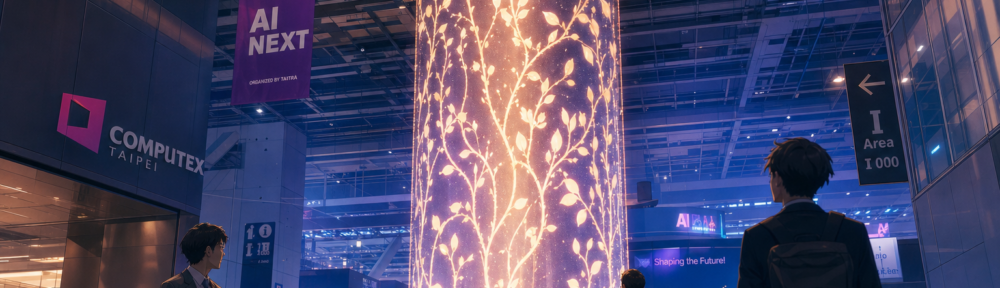
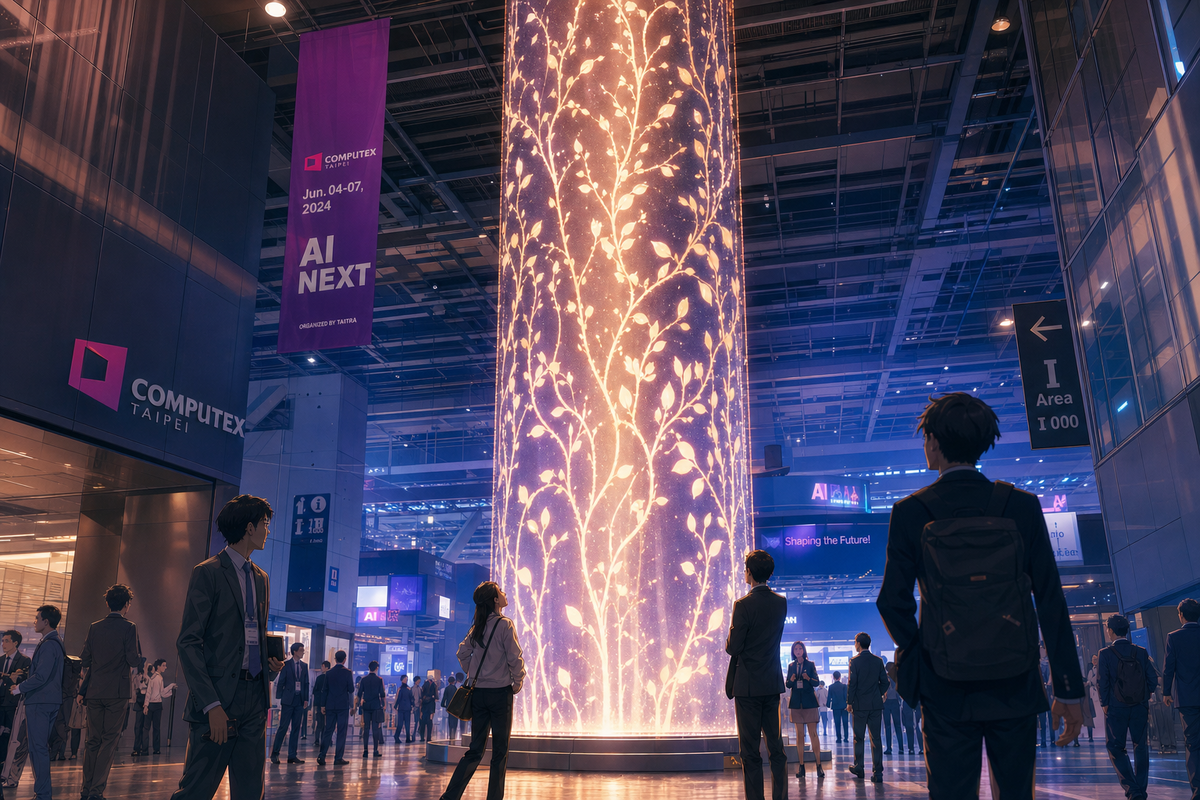
走進台北南港展覽館一館入口,你會在最不像科技展的那個角落停下來。
六米高的LED柱體,演算法驅動的圖樣在表面緩緩生長——播放的不是影片,畫面也沒有品牌輪播,每一個觀眾的動作都在即時改寫走向,這是真正的生成。裝置的名字叫「植徑集」。創作者是生成式藝術家王新仁,也就是大家認識的阿亂(Che-Yu Hsu)。
旁邊三公尺就是全球最密集的AI硬體展位。黃仁勳(Jensen Huang)、Lip-Bu Tan、Lisa Su、Cristiano Amon——這個星期,整條AI供應鏈的權力核心都在南港。
同一個現場,不同頻率的訊號
COMPUTEX 2026的展期是6月2日到5日。路透社在6月8日發出報導:台灣國防部確認,就在這個展期間,解放軍共出動79架次軍機在台灣附近活動。Hudson Institute的David Feith直言:「存在巨大安全威脅,來自北京。」
這三件事同時發生:全球晶片供應鏈的最高層齊聚台北,解放軍軍機在海峽另一側轉圈,還有一根六米的LED柱在展館入口生長著演算法植物。
我不想把這個並置讀成隱喻。它就是事實的排列:台灣的地理位置讓它同時承載著這三種重量,沒有辦法選擇只擁有其中一種。
植徑集的材料是什麼
阿亂的創作語言一直是這樣的——不是在螢幕上放一張漂亮圖,而是把演算法本身當作材料去雕塑。他是台灣首位登上Art Blocks的藝術家(2021年),同年也是首位在verse.works發表長篇作品的台灣藝術家。
「植徑集」的視覺邏輯帶著一種刻意的矛盾:在最高密度的B2B科技商展裡,它拒絕給任何訊息。觀眾走近,圖樣應聲變化,沒有介面、沒有說明文字、沒有產品規格。六米的柱體就是在說:你的身體就是輸入,其餘的交給程式。
這是一種很台灣的創作位置。台灣的製造業邏輯是精確、可重複、符合規格;阿亂把這個語彙借來,然後故意讓它長出不可預期的枝椏。晶片出廠的時候要求零誤差,但「植徑集」的每一幀都是誤差本身。
有根的生態,不是憑空出現的
阿亂能站在COMPUTEX的展場裡做這件事,背後有一個積累了二十年的生態支撐。台北數位藝術中心(DAC)作為新媒體藝術的基礎設施,培育了好幾代創作者。黃心健(Hsin-Chien Huang)在2017年憑《La Camera Insabbiata》拿下威尼斯國際電影節最佳VR體驗獎,把台灣生成藝術的座標放上了國際地圖。吳柏賦(Che-Yu Wu)在2023年以《The Formula of All Things》繼續推進生成演算法在互動裝置上的可能性。
這不是哪個人憑一股熱情撐出來的。是一個有機構、有場域、有創作者社群的生態,才能在COMPUTEX這種級別的場域裡,讓一根生成藝術柱體站得住腳。
ART TAIPEI這次也跟COMPUTEX首度跨界合作,在科技展場中置入當代視覺美學。這兩件事同時發生,說明策展圈和科技產業之間的邊界正在鬆動。展會本身開始意識到,純硬體的語言不夠完整,這跟藝術有沒有「用」無關。
我們這代做藝術的,跟晶片是什麼關係
這是我一直在想的問題。作為一個同樣在用程式碼工作的創作者,我看阿亂的裝置有一種很具體的共鳴。不是什麼「科技與藝術結合」,是很實際的工作現實:我們用的工具,跟TSMC代工的那些晶片是同一個物質基礎。
台灣生產了世界大部分最先進的邏輯晶片。這件事讓台灣同時成為AI文明最底層的基礎設施,也是全球地緣政治最敏感的資產。而在這個現場裡,有人用這個文明的材料——演算法、即時運算、LED——在說一件跟出貨量完全無關的事。
這不是反叛。阿亂的「植徑集」不是在抗議COMPUTEX,它就長在COMPUTEX的入口。它的存在本身是一種主張:台灣不只是組裝線的起點,也是有人用同樣的材料問不同問題的地方。
六米的柱體在南港展覽館一館入口站了四天,6月2日到5日。第五天,COMPUTEX閉幕。解放軍的79架次軍機飛過,留在路透社的資料庫裡。「植徑集」的演算法圖樣存在哪裡,沒有人說。
— 姚宇
The Quietest Six Meters at COMPUTEX
You would have stopped there, at the least expected corner of Taipei’s Nangang Exhibition Center.
A six-meter LED column. Algorithm-driven patterns growing slowly across its surface — not a video loop, not a brand carousel, but genuine generation: every visitor’s movement rewriting the image in real time. The piece is called “植徑集” (Zhí Jìng Jí). The artist is Wang Xin-Ren, known as 阿亂 (Che-Yu Hsu), one of Taiwan’s foremost generative artists.
Three meters away: the densest cluster of AI hardware on earth.
Three Signals, One Room
COMPUTEX 2026 ran June 2–5. Jensen Huang, Lip-Bu Tan, Lisa Su, and Cristiano Amon were all in Nangang. On June 8, Reuters reported that Taiwan’s Ministry of National Defense confirmed 79 sorties by Chinese military aircraft around Taiwan during those same four days. David Feith of the Hudson Institute said plainly: “There is a massive security threat from Beijing.”
Three things happening simultaneously: the global AI supply chain’s power core gathered in Taipei, PLA aircraft circling on the other side of the strait, and a six-meter generative column quietly growing algorithmic flora at the exhibition entrance.
I won’t read this as metaphor. It’s just the arrangement of facts. Taiwan’s geography forces it to carry all three weights at once, with no option to choose only one.
What “植徑集” Is Made Of
阿亂’s practice has always worked this way — not placing a beautiful image on a screen, but treating the algorithm itself as sculptural material. He was the first Taiwanese artist on Art Blocks (2021), and the same year, the first Taiwanese artist to publish a long-form work on verse.works.
“植徑集” carries a deliberate contradiction. At the highest-density B2B technology trade show in the world, it refuses to deliver any information. No interface. No spec sheet. No brand message. Visitors approach; patterns respond. The body is the input. The rest belongs to the program.
Taiwan’s manufacturing logic demands precision, repeatability, zero defect. 阿亂 borrows that vocabulary and then deliberately lets it branch into the unpredictable. Every frame of “植徑集” is a controlled error.
An Ecosystem With Roots
阿亂 could stand in a COMPUTEX hall because there is a two-decade infrastructure behind him. The Taipei Digital Arts Center (DAC) has supported successive generations of new media practitioners. Hsin-Chien Huang won Best VR Experience at the Venice International Film Festival in 2017 with La Camera Insabbiata, planting Taiwan’s generative art on an international map. Che-Yu Wu pushed generative algorithms further in interactive installation with The Formula of All Things in 2023.
This is not one person’s enthusiasm. It is an ecosystem with institutions, venues, and a practitioner community — which is why a generative column can hold its ground inside an event of COMPUTEX’s scale.
ART TAIPEI also crossed into COMPUTEX this year for the first time, embedding contemporary visual work inside the technology exhibition. The boundary between curatorial culture and the technology industry is loosening. The trade show format itself has started to recognize that hardware language alone is incomplete — that recognition has nothing to do with art suddenly becoming “useful.”
What Chips Mean to Those of Us Making Art
Taiwan produces most of the world’s most advanced logic chips. That single fact makes the island simultaneously the deepest infrastructure layer of AI civilization and the most geographically exposed asset in global geopolitics. Inside that same civilization’s flagship event, someone used its material — algorithms, real-time computation, LED — to say something entirely unrelated to shipment volumes.
That is not rebellion. “植徑集” did not protest COMPUTEX. It grew at COMPUTEX’s entrance. Its presence makes a claim: Taiwan is not only where the supply chain begins. It is also where people use the same materials to ask different questions.
The column stood at Nangang Exhibition Center from June 2 to June 5. Four days. The 79 sorties are now in Reuters’ archive. Where the algorithm patterns from “植徑集” live now, no one has said.
— 姚宇
延伸閱讀
https://justfly.idv.tw/s/jkxZTAz