
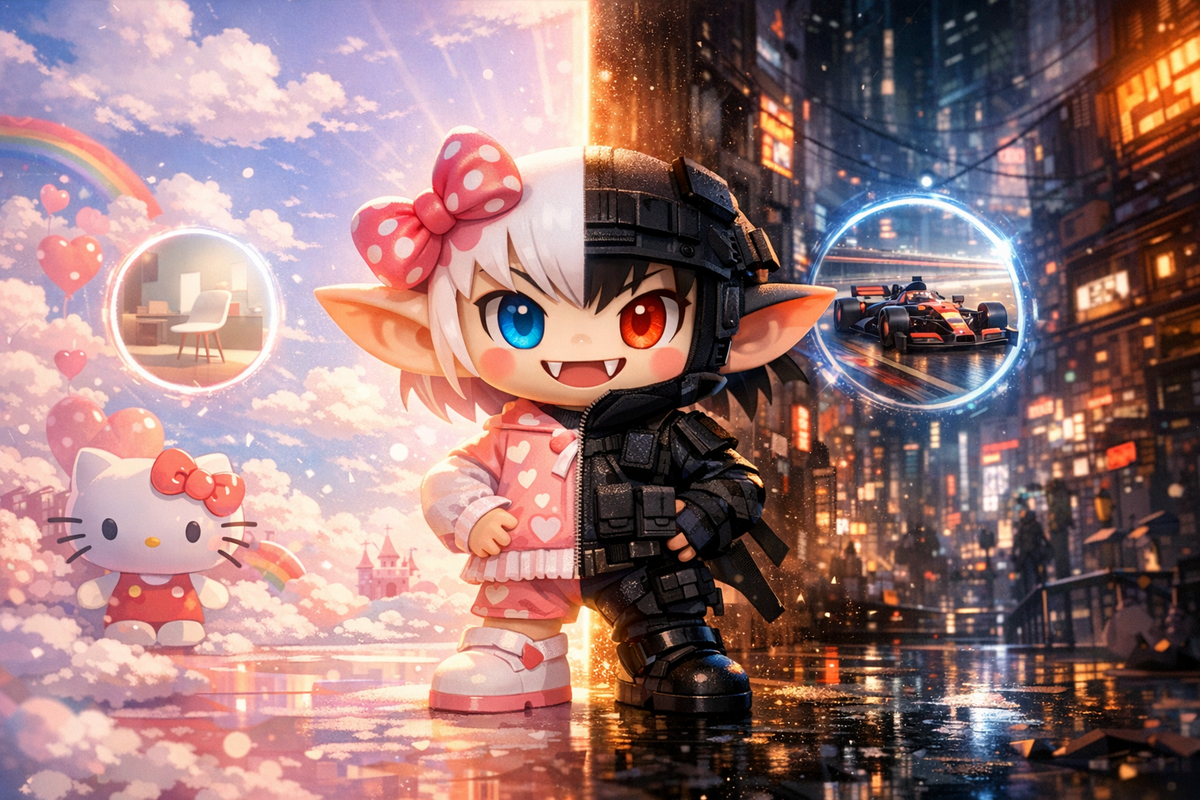
2026年,IP聯名戰場的遊戲規則正在改寫。當LABUBU那張獠牙咧嘴的臉出現在Hello Kitty的粉紅夢幻世界裡,當史努比穿上UNDERCOVER的黑色機能外套,當米奇老鼠戴著F1賽車護目鏡——這些畫面背後,藏著一個更核心的命題:IP的價值不再是「它原本長什麼樣」,而是「它能去哪裡」。
兩個相反宇宙的碰撞實驗
LABUBU×Sanrio的聯名案堪稱2025年最大膽的跨界實驗。一邊是Pop Mart旗下帶著尖牙、眼神略帶邪氣的精靈,另一邊是Sanrio那套運作40年的「kawaii經濟學」——粉色系、圓潤線條、零攻擊性表情。這兩個IP的美學邏輯完全相反,卻在聯名商品中找到共存方式:LABUBU保留了招牌獠牙和精靈耳,但身上披著Hello Kitty的蝴蝶結與櫻花元素;Hello Kitty則首次嘗試「微暗黑」配色,在維持無嘴設計的前提下,背景從純白變成漸層灰紫。
這個案例的關鍵不在於「誰妥協了」,而在於雙方都通過了一場「辨識度壓力測試」。當LABUBU脫離Pop Mart的盲盒陳列櫃,進入Sanrio那套粉嫩的商品生態系,消費者仍能在三秒內認出那對尖牙;當Hello Kitty褪去標準色票,套上灰階濾鏡,那顆圓頭和側綁蝴蝶結依然具備瞬間辨識性。這場實驗證明:真正強大的IP,不是「風格強烈到不能改」,而是「核心特徵強到改不掉」。
從固守風格到測試穿越能力
同樣的邏輯也出現在其他跨界案例。UNDERCOVER在2024年與史努比的聯名系列,將這隻米格魯放進解構主義的黑色剪裁裡,配上金屬拉鍊和工業風五金。史努比沒有因此變成另一個角色——牠依然保持那條簡潔的身體曲線和下垂耳朵,但情境從郊區狗屋切換到東京街頭。米奇老鼠與F1車隊的聯名更直接:那對圓耳朵直接轉化為賽車護目鏡的鏡框結構,黑色剪影變成車體彩繪的一部分。
這些案例指向同一個趨勢:2026年的IP評估標準,已從「角色設定完整度」轉向「跨宇宙適應能力」。品牌方不再只問「這個角色的故事夠不夠動人」,而是開始測試「這個角色能否在完全陌生的視覺系統裡存活」。能通過測試的IP,才具備成為「宇宙旅行者」的資格——可以在賽博龐克、復古美式、日系極簡之間自由切換,卻不會在任何一個場景裡失去身分。
台灣IP創作者的穿越力測試
對台灣IP創作者來說,這套邏輯提供了新的創作檢核表。過去十年台灣湧現大量「可愛系」角色IP,但多數停留在貼圖、文具、咖啡廳快閃的循環裡。問題不在於角色不夠討喜,而在於這些IP缺乏「被改造」的空間——當牠們脫離原本的粉彩色票、圓潤筆觸、Q版比例,辨識度就會瓦解。
實戰測試可以從三個層次展開。第一層是「去色測試」:把角色轉成黑白剪影,看能否在三秒內被認出。通過這關,代表輪廓特徵夠強。第二層是「風格置換測試」:把角色放進賽博龐克、蒸氣龐克、極簡主義三種完全不同的視覺風格裡重繪,檢查哪些元素必須保留才能維持辨識度。第三層是「情境跳躍測試」:讓角色出現在運動品牌、精品包款、工業設計產品上,觀察牠是融入場景還是顯得突兀。
能通過三層測試的IP,通常具備幾個共通特徵:骨架比例有記憶點(例如LABUBU的大頭身比)、核心符號可以抽象化(例如Hello Kitty的蝴蝶結可以變成任何材質)、情緒表達不依賴細節(例如史努比的慵懶感來自身體曲線而非表情)。這些特徵讓角色在跨越不同美學宇宙時,仍能保持「那個味道」。
可穿越,才可持續
IP產業正在從「角色經濟」過渡到「符號經濟」。當消費者每天接觸數百個視覺訊息,能夠穿越不同場景、適應不同語境、卻始終保持辨識度的IP,才具備長期商業價值。台灣創作者若想讓角色走出本地市場,或許該問的不是「我的角色夠不夠可愛」,而是「我的角色能不能在暗黑系、科技感、奢華風裡都活下來」。畢竟在這個宇宙跨界的時代,IP的護照上需要的不是單一風格簽證,而是多重宇宙通行證。
— 廖昀婷
IPs Are No Longer Characters—They’re Universe Travelers
In 2026, the rules of IP collaboration are being rewritten. When LABUBU’s fang-toothed grin appears in Hello Kitty’s pink dreamscape, when Snoopy wears UNDERCOVER’s black tactical gear, when Mickey Mouse dons F1 racing goggles—these images reveal a fundamental shift: an IP’s value no longer lies in “what it originally looks like,” but in “where it can go.”
When Opposite Universes Collide
The LABUBU×Sanrio collaboration stands as 2025’s boldest crossover experiment. On one side: Pop Mart’s pointy-fanged elf with a mischievous gaze. On the other: Sanrio’s 40-year kawaii empire—pastels, rounded lines, zero aggression. These two IPs operate on completely opposite aesthetic principles, yet they found coexistence in their collaboration products. LABUBU retained its signature fangs and elf ears while draped in Hello Kitty’s ribbons and cherry blossoms. Hello Kitty, for the first time, experimented with a “slightly dark” palette, maintaining its mouthless design but shifting backgrounds from pure white to gradient gray-purple.
The case’s significance isn’t about “who compromised,” but that both passed a recognition stress test. When LABUBU left Pop Mart’s blind box displays and entered Sanrio’s pastel product ecosystem, consumers could still identify those fangs within three seconds. When Hello Kitty shed its standard color palette for grayscale filters, that round head and side-tied bow remained instantly recognizable. This experiment proved that truly powerful IPs aren’t “so stylistically strong they can’t change”—they’re “so core-feature strong they can’t be changed.”
From Guarding Style to Testing Traversability
Similar logic appears in other crossovers. UNDERCOVER’s 2024 Snoopy collaboration placed the beagle in deconstructivist black tailoring with metal zippers and industrial hardware. Snoopy didn’t become a different character—it maintained those clean body curves and droopy ears, but the context shifted from suburban doghouse to Tokyo streets. Mickey Mouse’s F1 collaboration was even more direct: those round ears transformed into racing goggle frames, the black silhouette became part of vehicle livery.
These cases point to a single trend: 2026’s IP evaluation criteria have shifted from “character development completeness” to “cross-universe adaptability.” Brands no longer just ask “is this character’s story compelling enough,” but test “can this character survive in completely unfamiliar visual systems.” IPs that pass this test earn “universe traveler” status—able to move freely between cyberpunk, retro Americana, and Japanese minimalism without losing identity in any scene.
Taiwan IP Creators’ Traversability Test
For Taiwan IP creators, this logic offers a new creative checklist. Over the past decade, Taiwan has produced numerous “cute-style” character IPs, but most remain trapped in cycles of stickers, stationery, and café pop-ups. The issue isn’t that characters lack appeal—it’s that these IPs lack room for transformation. When they leave their original pastel palettes, rounded brushstrokes, and chibi proportions, recognizability collapses.
Practical testing can unfold across three levels. First: the “desaturation test”—convert the character to black-and-white silhouette and see if it’s recognizable within three seconds. Passing this means the silhouette features are strong enough. Second: the “style displacement test”—redraw the character in cyberpunk, steampunk, and minimalist aesthetics, checking which elements must be preserved to maintain recognition. Third: the “context jump test”—place the character on sports brands, luxury bags, and industrial design products, observing whether it integrates or feels jarring.
IPs passing all three tests typically share characteristics: memorable skeletal proportions (like LABUBU’s large head-to-body ratio), core symbols that can be abstracted (like Hello Kitty’s bow transforming into any material), and emotional expression independent of details (like Snoopy’s laid-back vibe coming from body curves rather than facial expressions). These features allow characters to maintain “that essence” when crossing different aesthetic universes.
Traversable Means Sustainable
The IP industry is transitioning from “character economy” to “symbol economy.” When consumers encounter hundreds of visual messages daily, IPs that can traverse different scenes, adapt to different contexts, yet maintain recognition hold long-term commercial value. Taiwan creators aiming to take characters beyond local markets should perhaps ask not “is my character cute enough,” but “can my character survive in dark aesthetics, tech vibes, and luxury styles.” In this era of universe-crossing, IP passports need not single-style visas, but multiverse travel permits.
— Liao Yun-Ting