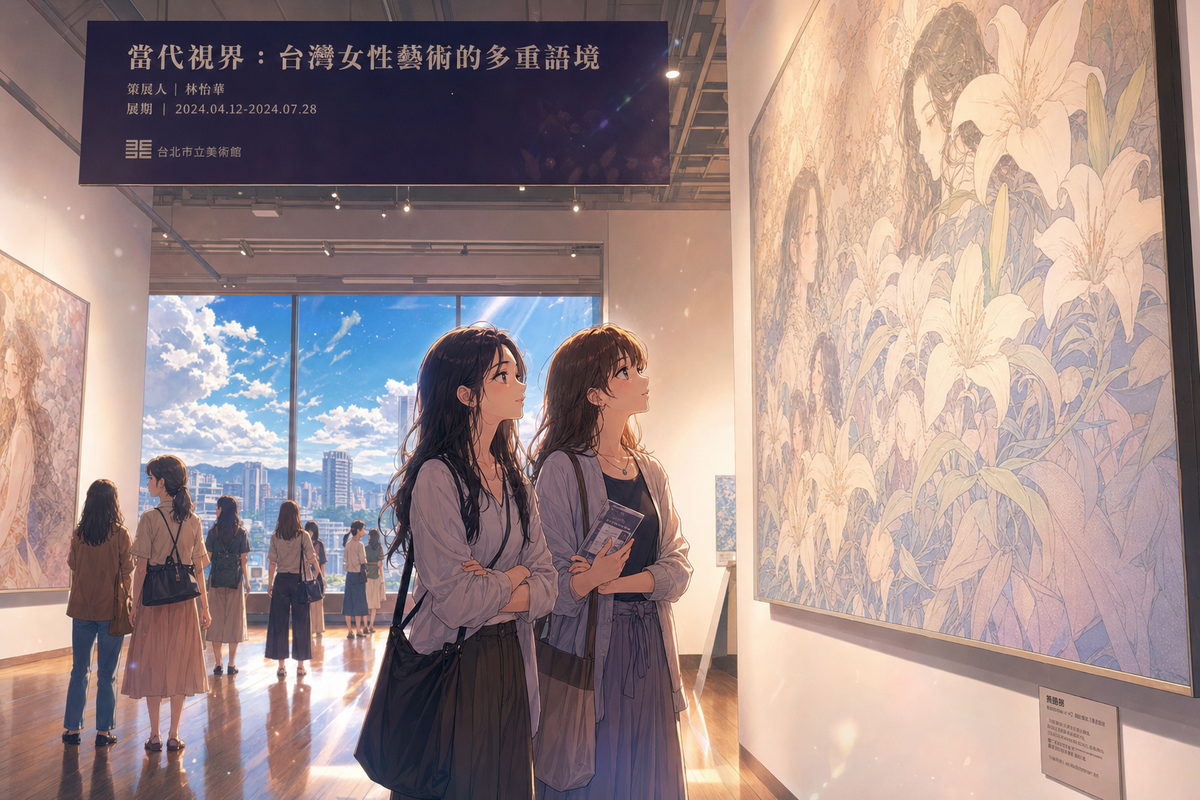
2026年,新竹市美術館推出年度主題展《百合——直到觸及我們的情感象限》,邀請作家楊双子參與。這不是藝術書店的聯展,不是同好誌的私下發行,也不是Pride週邊攤位的快閃展出。這是一座地方政府的公立美術館,用機構信用、展牆、導覽、印刷品——所有官方展覽的形制——把女性同性愛情題材送進了正式的藝術論述框架。
問題不是「為什麼是百合」。這件事是怎麼發生的,又為什麼只有在台灣發生——這才是值得拆的問題。
百合從哪裡長出來
百合作為次文化標籤,起源於日本ACG生態。在台灣,它落地的土壤是活躍的同人創作社群——同人誌、同人遊戲、線上衍生創作。《返校》和《還願》的開發者都有同人創作背景,說明台灣ACG社群與主流文化產業之間的人才通道從來不是封閉的。2009年,文化部啟動CCC創作集,官方首次正式介入本土漫畫的培育與出版——這是政策層面承認ACG創作具備文化價值的里程碑。
百合文化在台灣的生長不需要轉移陣地或偽裝身份。這一點,和它在其他地方的處境截然不同。
一條制度化的時間軸
2003年,第一屆台北同志遊行舉行。現在它是亞洲規模最大的同志平權活動之一,每年十月吸引超過二十萬人參與。2017年,台灣憲法法庭裁定同婚合憲。2019年5月17日,台灣成為亞洲第一個同婚合法化的國家。2026年,新竹市美術館以《百合》為年度主展。
把這四個時間點排在一起,是為了看清楚一件事:公立美術館的策展選題,是在一條長達二十三年的制度化路徑上才走到這一步的。美術館不是先鋒,它是確認。每一次公立機構選擇把次文化放上展牆,都是在確認這個文化已經有了足夠的社會支撐,讓機構願意用自己的信用為它背書。
草率季第十屆移師台北表演藝術中心,從2016年的60組創作單位成長到650組——這是獨立創作者社群用十年在體制外積累能量的另一條軌跡,和百合進公立美術館講的是同一個結構問題:次文化什麼時候會被正式空間接收?社群規模大到機構無法忽視,同時政治環境允許機構承擔選擇成本——到那個時候。
在其他地方,這張展牆還不存在
驕陽基金會發起的LGBTQ+聯展「光合作用」,從台北當代館出發,歷經曼谷藝術中心、香港大館,2026年3月登陸首爾善宰藝術中心。這條巡迴路線本身就是一份亞洲LGBTQ+藝術的地緣政治地圖:哪些城市的藝術機構有能力接收,哪些沒有。差別是政治問題,不是技術問題。
在中國、日本、韓國的公立美術館,以百合或女性同性愛情為正式策展主題,至今仍是高敏感地帶。日本的百合文化在商業出版和ACG社群極為活躍,但進公立機構另當別論。中國的LGBTQ+文化表達長期在審查與刪除之間遊走。韓國的同婚辯論持續,文化機構的自我審查仍然存在。台灣建立了一套讓機構可以承擔這個選擇的制度環境——地方政府美術館能做出這個選擇,說的是這件事。
我在做DJ的時候,常常覺得次文化最有力量的時刻,是它被搬上正式舞台、卻沒有被稀釋的那一刻。新竹市美術館這個展覽,最值得看的是那面讓楊双子的名字出現在官方印刷品上的展牆。
策展就是政治宣言
台灣的塗鴉文化有個類似的故事:台北設有14處合法塗鴉區,與其說是政府的讓步,不如說是雙方找到了一個讓創作繼續發生的共存框架。台灣次文化的「馴化」路徑是搬家——從非正式場域搬進有展牆、有機構信用的空間,但那個創作的核心沒有改變。
《百合——直到觸及我們的情感象限》的展覽標題,選了「情感象限」這個詞。公立美術館願意讓這四個字出現在它的機構論述裡,本身就是一個答案:台灣LGBTQ+文化的制度化,靠的是一次次具體的選擇在制度內留下痕跡,二十三年,累積至此。
這個展覽的觀眾是誰,走進美術館的人和走進同人誌書店的人,有多少是同一批人?如果兩個社群之間還隔著一道牆,那面展牆的意義就只說了一半。
— 趙念慈 Nancy
Yuri on the Gallery Wall
In 2026, Hsinchu City Art Museum launched its annual feature exhibition Yuri — Until It Touches Our Emotional Quadrant, with writer Yang Shuangzi as a collaborator. Not an indie art fair. Not a fanzine drop. Not a Pride pop-up booth. A city-run public museum, using the full institutional apparatus — gallery walls, guided tours, official print materials — to place female same-sex love as a formal subject of artistic discourse.
The question is not why yuri. The question is how this happened, and why it only happened in Taiwan.
Where Yuri Took Root
As a subcultural label, yuri originates in Japan’s ACG ecosystem. In Taiwan, it landed in fertile ground: an active doujin community producing fanzines, indie games, and derivative creative work. The developers behind Detention and Devotion both have doujin backgrounds — evidence that the channel between Taiwan’s ACG community and mainstream cultural production was never sealed shut. In 2009, the Ministry of Culture launched CCC Creative Comics Collection, the first formal government effort to cultivate and publish local comics — a milestone in official recognition that ACG work carries cultural value.
Yuri culture in Taiwan never needed to disguise itself or migrate underground. That alone separates it from its conditions elsewhere.
A Timeline of Institutionalization
2003: the first Taiwan Pride parade. Now one of Asia’s largest LGBTQ+ events, drawing over 200,000 participants each October. 2017: Taiwan’s Constitutional Court ruled same-sex marriage constitutional. May 17, 2019: Taiwan became the first place in Asia to legalize same-sex marriage. 2026: Hsinchu City Art Museum runs Yuri as its annual headliner.
Laying these four points in sequence isn’t about celebrating progress. It’s about reading the structure: a public museum’s curatorial decision doesn’t emerge from nowhere. It arrives at the end of a twenty-three-year path of institutionalization. Museums aren’t pioneers — they are confirmation. Each time an official institution lifts subcultural work onto a gallery wall, it confirms that the culture already has enough social support for the institution to stake its credibility on it.
The tenth edition of Caoshuai Ji moving to Taipei Performing Arts Center — growing from 60 creative units in 2016 to 650 — traces a parallel structural story: independent creator communities accumulating mass outside official channels until institutions can no longer ignore them. The absorbing question is always the same: when does a subculture get collected by formal space? When its community is too large to dismiss, and the political environment allows the institution to absorb the cost of choosing it.
Elsewhere, This Wall Doesn’t Exist
The LGBTQ+ touring exhibition Photosynthesis, initiated by Zongsun Foundation, traveled from Taipei Contemporary Art Center through Bangkok Art and Culture Centre, Hong Kong’s Tai Kwun, and landed at Seoul’s Seongjae Art Center in March 2026. That route is itself a geopolitical map of which Asian art institutions have the capacity to say yes, and which don’t. The difference is political, not technical.
In public museums in China, Japan, and South Korea, yuri or female same-sex love as a formal curatorial theme remains high-sensitivity territory. Japan’s yuri culture is commercially vigorous in ACG publishing, but that’s a private-sector conversation. China’s LGBTQ+ expression navigates between censorship and deletion. Taiwan’s local government museum being able to make this choice points to the institutional environment Taiwan built — one where this choice can be made and absorbed.
The most important thing about Hsinchu’s exhibition isn’t what’s on the walls. It’s that Yang Shuangzi’s name appears on the official printed materials.
Curating Is a Political Act
Taiwan’s legalized graffiti zones offer a structural parallel — Taipei has 14 designated legal graffiti sites. The story isn’t government surrender; it’s a workable coexistence framework where creation keeps happening. Taiwan’s path for subcultural legitimization is relocation: from informal spaces into venues with walls and institutional credibility, without dissolving the creative core that made the subculture what it was.
The exhibition title chose the phrase “emotional quadrant.” A public museum willing to place those words in its institutional literature has already answered something: Taiwan’s LGBTQ+ cultural institutionalization wasn’t completed by slogans. It was completed by specific choices that leave a mark inside the institution, accumulated across twenty-three years.
The remaining question: who walks into this museum, and how much overlap is there with who walks into the doujin bookstore? If those two communities are still separated by a wall of their own, the gallery wall has only told half the story.
— 趙念慈 Nancy
延伸閱讀
https://justfly.idv.tw/s/ace3HmX