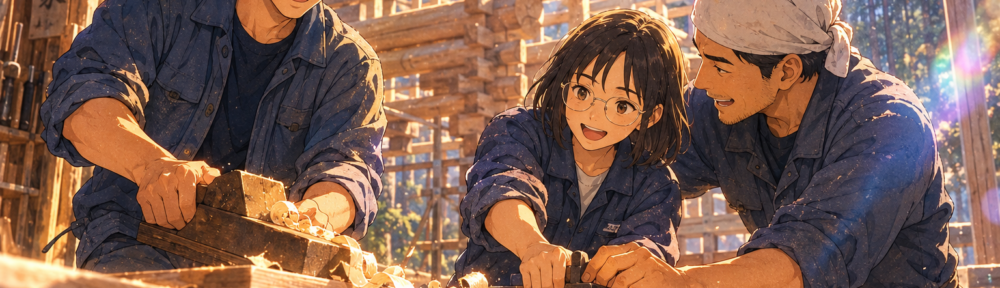

一根原木要先被剖開,才看得見裡頭的紋理往哪走。基隆八斗高中的22名阿美族學生這趟到日本,據報導學的就包括這件事:木材的剖削,以及把木頭削成能互相咬住的榫頭。
據墨新聞11月4日的報導,十日研修走訪長野縣信濃町、岐阜、郡上、奈良等地。11月4日是報導見報的日子,不是出發日,這點要先擺正,免得把新聞日期當成行程日期。
從樹到屋,一條完整的工序
報導描述的學習內容,排起來是一條從樹到屋的清單:走訪天然林與人造林,學育林、造林,木材的剖削、傳統凹凸榫接組裝,一直到完整小木屋(Log House)的結構建造。報導沒有給逐日行程,哪一天做哪一步、先後順序如何,這裡不替它排。
木工的人看這張清單,會注意到它沒有跳步。多數參訪團看林子、看工廠、拍照,手始終是乾淨的。這裡的學生既要認識樹怎麼長,也要用手把木頭削成能互相咬住的形狀。榫接的道理很樸素:凸的一端要準確進入凹的一端,差一點就晃,多一點就裂。木頭不吃客套,量錯了就是量錯了。
報導說,這些學生在專業匠師指導下完成了這套流程,日本《信濃毎日新聞》也報導了他們向業師學習小木屋建造的場面。至於哪個學生削壞了哪一塊、誰的榫頭第一次就合上,原文沒寫。這些細節得等學生自己開口,旁人不該替他們編。
Selal:報導裡的校園師徒制
這個計畫叫「才高八斗『Selal學伴師徒制』創新教育計畫」。Selal指阿美族的年齡階級,學校把它搬進課程與生活,族語認證成果也納入考核。實驗班已邁入第六年,出發前,校內教師還做了為期一個月的行前培訓。
Selal 與師徒制的連結,是報導對這個計畫的描述,本文照報導歸屬,不另外解釋阿美族年齡階級在部落裡實際怎麼運作。木工行業自己也有一套傳承:帶過徒弟的人都知道,手藝很少靠講解傳下去,多半是年長的先做一遍,年幼的跟著做,再輪到他們教下一批。校園裡的師徒制和木工的師徒制看起來相近,但那是兩套各有來歷的制度,不能直接畫上等號。
報導末了回到阿美族就地取材搭建家屋的傳統。這是學習的落點,不代表日本的小木屋和阿美族的家屋是同一套做法。兩邊的材料、結構、用途各有來歷,把它們說成同一個傳統,木工是不會點頭的。
人頭數要分開算
接待的一方也有自己的紀錄。奈良宇陀的林業公司森庄銘木產業在官網 9 月 24 日刊出〈【旅行レポート】台湾から研修旅行25名受入れ 八斗高級中學様〉,寫明 2026 年 9 月 8 日、9 日兩天接待「基隆市立八斗高級中學」25 名研修旅行,並註明這 25 名含帶隊教師;同一篇也提到學生在奈良之前先去過長野與岐阜,整趟日本研修從 9 月 1 日開始。墨新聞寫的是 22 名學生,森庄銘木寫的是 25 名含教師,兩個數字各有各的母數,這裡不把它們硬湊成同一個。
森庄銘木的報告附了參加者感想的摘錄,沒有署名,日文由主辦方整理,不是逐字原話。其中幾則是:「從原木到最後的產品,整個流程都理解了」、「林業和建築之間的連結,理解得更深了」、「下次想看看真正的競標」。至於學生自己用中文或族語怎麼說,兩篇來源都沒有具名的直接引述,本文也不替他們編。
報導也提到,出發前曾請日方專家到校做森林教育講座,這回由同一批專家在現場接待。看樣子,這條線是先在教室裡搭好榫位,再讓人走過去對上。
墨新聞有一張照片,圖說寫著「小木屋(Log house)建築實作後,基隆八斗高中同學們開心合影」。合影是在實作之後拍的,這是報導自己的歸屬;拍攝日期、小木屋當時蓋到什麼程度,報導沒寫,這裡不多猜。
— 曾柏宇
Wood Doesn’t Lie: Ten Days of Joinery in Japan
A log has to be split open before anyone can see which way the grain runs. For the 22 Amis students from Badou Senior High School in Keelung, that, according to the report, was part of what they learned in Japan: splitting and shaving timber, and shaping wood into joints that grip each other.
MORE News reported on November 4 that the ten-day program visited Shinanomachi in Nagano, Gifu, Gujo, Nara and other places. November 4 is the publication date, not the departure date, and the two should not be mixed up.
One unbroken chain, from tree to house
Laid out, the learning content described in the report is one list from tree to house: visits to natural and planted forests, silviculture and afforestation, splitting and shaving timber, traditional tongue-and-groove joinery, and the structural building of a complete log house. The report gives no day-by-day itinerary, so which step came on which day, and in what order, is not something this article will arrange for it.
A woodworker reading that list notices that no step is skipped. Many study tours look at forests and factories and take photos, and the hands stay clean. Here, students had to learn how a tree grows and also shape wood by hand into pieces that grip each other. The logic of a joint is plain: the tenon has to enter the mortise exactly, a little loose and it wobbles, a little tight and it splits. Wood doesn’t take politeness, and a wrong measurement stays wrong.
The report says the students did this under professional craftsmen, and Japan’s Shinano Mainichi Shimbun also covered them learning log-house building from their instructors. Which student ruined which piece, whose first joint closed on the first try, none of that is in the article. Those details have to come from the students themselves, not be invented for them.
Selal: the school apprenticeship as the report describes it
The program is called the “Selal peer-apprenticeship” innovation program. Selal refers to the age-grade system of the Amis people. The school brought it into classes and daily life, and results in language certification count toward assessment. The experimental class is in its sixth year, and teachers ran a month of pre-departure training.
The link between Selal and apprenticeship is the report’s description of the program; this article attributes it to the report and does not go on to explain how the Amis age-grade system actually works within a community. Woodworking has its own line of transmission: anyone who has trained an apprentice knows that craft is rarely passed on by explanation. The elder does it first, the younger follows, and then the younger teaches the next group. The school’s apprenticeship and the woodworker’s look alike, but they are two systems with separate histories, and the one is not simply the other.
The report ends by returning to the Amis tradition of building homes from local materials. That is where the lesson lands, which does not mean a Japanese log house and an Amis house are one tradition. Materials, structure and use each have their own history, and no woodworker would nod at calling them the same.
Count the heads separately
The host side keeps its own records. Morisho Meiboku Sangyo (森庄銘木産業), a forestry company in Uda, Nara, published a trip report on its website on September 24 stating that on September 8 and 9, 2026, it hosted a study trip of 25 people from Keelung Municipal Badou Senior High School, with a note that the 25 includes accompanying teachers. The same report says the students had visited Nagano and Gifu before Nara, and that the Japan program as a whole began on September 1. MORE News counts 22 students; Morisho counts 25 including teachers. Each number has its own base, and this article does not force them into one.
Morisho’s report also carries excerpts of participant feedback, unsigned, compiled in Japanese by the host, and not verbatim. A few of them: “I understood the whole flow from raw log to final product,” “I understand the connection between forestry and architecture more deeply,” and “Next time I want to see a real auction.” As for what the students said in their own words, in Mandarin or in Amis, neither source carries a named direct quote, and this article will not invent one.
The report also mentions that Japanese experts had visited the school earlier for a forest-education talk, and the same group hosted the students on site. It looks like the joint was cut in the classroom first, then people walked over to meet it.
One photo in MORE News carries the caption “Badou Senior High School students pose happily after the log-house building practice.” That the group photo was taken after the practice is the report’s own attribution. The date it was taken, and how far along the log house was at that point, the report does not say, and this article will not guess.
— 曾柏宇
延伸閱讀
- 竹筒裡的魚礁:阿美族巴拉告如何被寫進國際生態帳本
- 花蓮狐蝠的宵夜時間,開進了百貨公司一樓
- 寶可夢工藝展 台北:屬性是材料,不是貼紙
- 跟著一台投石器走過大崎村落的巷子
- 松園別館 展覽裡的竹帆船,船還沒下水,繩結先上了手
https://justfly.idv.tw/s/p5TUsyD