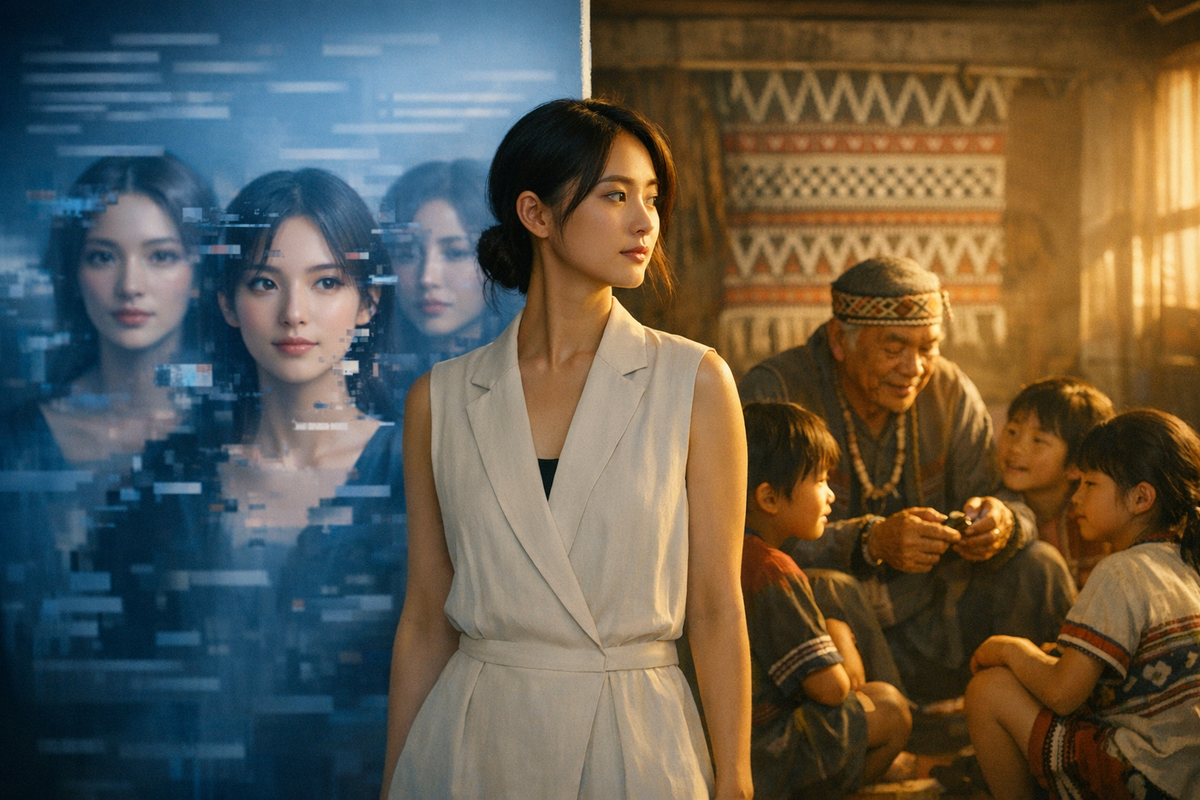
這幾個月,在部落藝術教室裡出現一個奇怪的現象:幾位阿美族的孩子拿手機展示,螢幕上是一張張「原住民」的照片配上文章,說著「我們都是炎黃子孫」。那些臉孔精緻得不像真人,那些文字千篇一律得像工廠生產線。孩子們困惑地問:「老師,我們真的是中國人嗎?」
那一刻,一場看不見的戰爭已經打到了偏鄉教室的手機螢幕上。
AI成為認知戰的新武器
立委伍麗華在今年2月公開發出警告:中共正在利用AI技術,大規模生成假的原住民形象和模板化文章。這不是科幻小說,而是正在發生的現實。從高金素梅事件後,網路上突然湧現大量「AI原住民」帳號,用生成的頭像、制式化的語言,反覆傳播同一個訊息——把原住民納入「中華民族」的敘事框架裡。
更可怕的是,這只是開始。深偽影片技術一旦成熟,可能出現「AI部落耆老」說著被篡改的歷史,或者「AI族語老師」教著錯誤的文化內容。對於資源本就匱乏的偏鄉社��,這種認知攻擊的殺傷力難以估量。
科學證據不會說謊:台灣是南島語族的起源地
但真相藏在基因裡、刻在語言中、埋在土地下,是AI無法偽造的。
中研院鍾國芳老師2015年發表在PNAS期刊的構樹基因研究,帶來令人震撼的發現。研究團隊追蹤構樹的cp-17單倍型基因,發現這個獨特的基因型只出現在台灣南部,卻沿著太平洋島嶼一路延伸到波里尼西亞。構樹不會自己游泳渡海,它的分佈路徑就是南島祖先的航海地圖。
語言學的證據更加驚人。當阿美族說「mata」(眼睛),毛利人、夏威夷人、塔加洛語的使用者也說著幾乎相同的詞;「lima」(五/手)、「wai」(水)這些基本詞彙,跨越萬里海洋卻驚人地相似。語言學家Robert Blust說得好:「南島語族的擴散是人類歷史上最偉大的篇章之一」。
這不是民族主義的浪漫想像,而是5000年前從大坌坑文化開始、經過3500年前抵達美拉尼西亞、最終在1500年前到達夏威夷和紐西蘭的人類遷徙史詩。
偏鄉教室裡的數位防線
伍麗華提出的三大數位防線——建立原住民族數位資料庫、培養媒體識讀能力、發展AI檢測工具——不該只是政策文件上的文字。在部落的藝術教室裡,這些防線必���變成實際的課程。
教育工作者開始教孩子們辨識AI生成的圖像:注意手指、耳環、背景的不自然;師生一起建立部落真實影像的小型資料庫,用族人自己的照片對抗那些假臉孔;用族語錄製耆老說故事,把真實的聲音保存下來。
最重要的是,讓孩子們了解那些同源詞彙的故事。當他們知道自己說的「mata」連結著整個太平洋的兄弟姊妹,當他們明白構樹基因證明了祖先的偉大航程,他們眼中會亮起一種驕傲——那是任何AI生成的謊言都無法熄滅的光。
語言是最後的堡壘
在這場數位時代的敘事主權爭奪戰中,越來越明顯的是:語言不只是溝通工具,更是文化的DNA,是AI最難偷走的東西。每一個ma-詞綴(如mata、maCaN)、每一個獨特的語法結構,都是5000年演化的密碼。
當孩子們用族語唱歌、用母語說笑話、在日常生活中自然地切換語言,他們就在建立最堅固的認知防火牆。因為真正的文化不是背誦出來的標準答案,而是活在呼吸、眼神、笑聲裡的生命經驗。
AI可以生成千萬張假臉,卻生成不了一個孩子聽到耆老用母語說故事時眼中的淚光;可以複製模板文章,卻複製不了族人圍著營火唱古調時那種靈魂的共振。這就是原住民族的主體性,也是任何統戰話術無法收編的東西。
When AI Steals 5,000 Years of Memory: Austronesian Digital Sovereignty
A few months ago, something unsettling emerged in an art classroom in a tribal community. Several Amis children showed their phone screens—images of “Indigenous people” paired with articles claiming “we are all descendants of the Yellow Emperor.” The faces were too perfect to be real, the texts too uniform to be authentic. The children asked, confused: “Teacher, are we really Chinese?”
That moment revealed: an invisible war has reached the smartphone screens in remote classrooms.
AI as a New Weapon of Cognitive Warfare
In February this year, Legislator Eleng Tjaljimaraw publicly warned that the CCP is using AI technology to mass-generate fake Indigenous identities and templated articles. This isn’t science fiction—it’s happening now. Following the Kao Chin Su-mei incident, the internet suddenly flooded with “AI Indigenous” accounts using generated avatars and formulaic language, repeatedly broadcasting one message: absorbing Indigenous peoples into the “Chinese nation” narrative framework.
More alarmingly, this is just the beginning. Once deepfake video technology matures, there might appear “AI tribal elders” speaking falsified histories or “AI language teachers” teaching incorrect cultural content. For under-resourced remote communities, the damage from such cognitive attacks is immeasurable.
Science Doesn’t Lie: Taiwan as the Austronesian Homeland
But truth is encoded in genes, carved into language, and buried in the earth—things AI cannot forge.
Dr. Chung Kuo-Fang’s 2015 PNAS study on paper mulberry genetics revealed shocking findings. The research team traced the cp-17 haplotype and found it appears only in southern Taiwan, yet extends along Pacific islands all the way to Polynesia. Paper mulberry doesn’t swim across oceans—its distribution is the Austronesian ancestors’ navigation map.
Linguistic evidence is even more striking. When Amis people say “mata” (eye), so do Māori, Hawaiians, and Tagalog speakers—nearly identically. Words like “lima” (five/hand) and “wai” (water) remain remarkably similar across thousands of miles of ocean. As linguist Robert Blust noted: “The Austronesian dispersal is one of the greatest chapters in human history.”
This isn’t romantic nationalism but a human epic spanning 5,000 years—from the Dabenkeng culture, reaching Melanesia 3,500 years ago, finally arriving in Hawai’i and New Zealand 1,500 years ago.
Digital Defense Lines in Remote Classrooms
The three digital defense lines proposed by Legislator Eleng—building Indigenous digital databases, cultivating media literacy, developing AI detection tools—shouldn’t remain policy documents. In tribal art classrooms, these defenses must become actual curriculum.
Educators have started teaching children to identify AI-generated images: noticing unnatural fingers, earrings, backgrounds. Teachers and students together are building a small database of authentic tribal images, using Indigenous people’s real photos to counter fake faces. They record elders telling stories in Indigenous languages, preserving genuine voices.
Most importantly, children learn about cognate words. When they know their “mata” connects them to siblings across the Pacific, when they understand paper mulberry genes prove their ancestors’ great voyages, their eyes light up with a pride no AI-generated lie can extinguish.
Language as the Last Fortress
In this digital-age battle for narrative sovereignty, it becomes increasingly clear: language isn’t just a communication tool—it’s cultural DNA, the thing AI finds hardest to steal. Every ma- prefix, every unique grammatical structure is a 5,000-year evolutionary code.
When children sing in tribal languages, joke in mother tongues, naturally code-switch in daily life, they’re building the strongest cognitive firewall. Because authentic culture isn’t memorized standard answers—it’s life experience living in breath, glances, laughter.
AI can generate millions of fake faces but cannot replicate the tears in a child’s eyes hearing an elder’s story in their mother tongue. It can copy templated articles but cannot duplicate the soul-resonance when people sing ancient songs around a fire. This is Indigenous subjectivity—something no united front tactics can co-opt.
— 鍾雅筑