
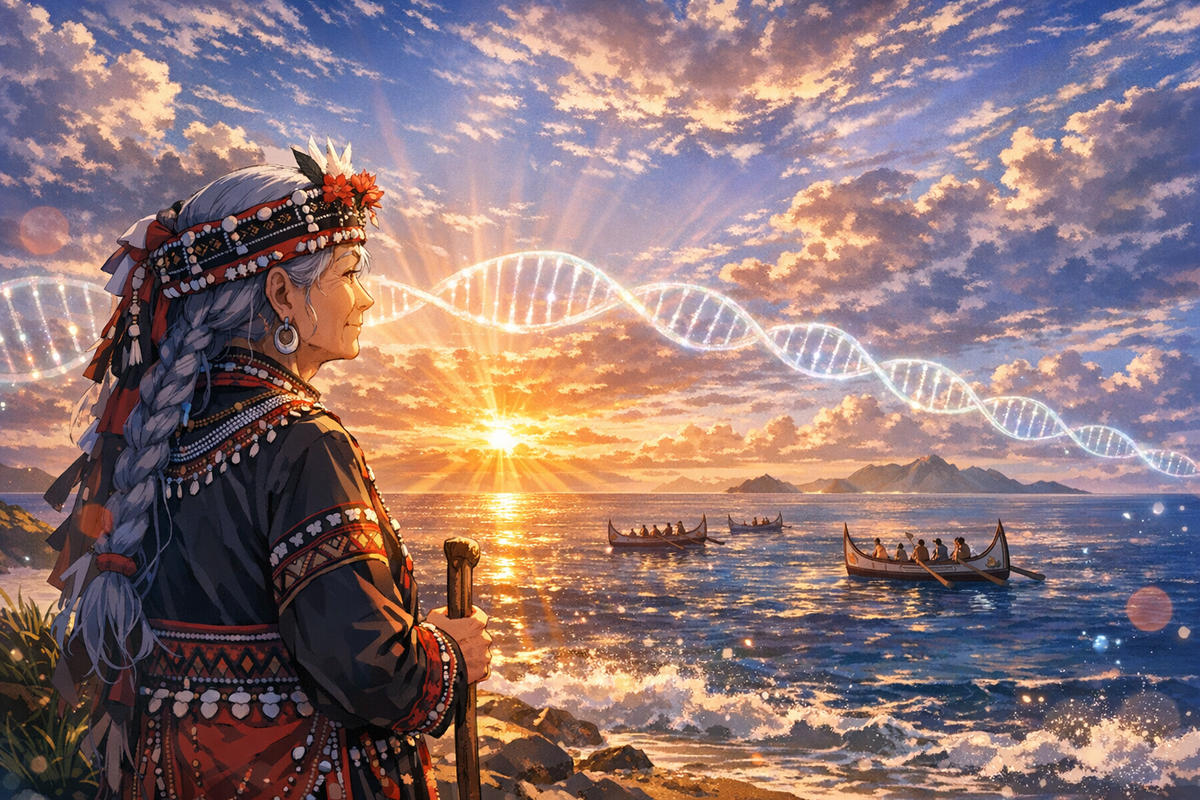
Max Planck研究所在2014年發表的全基因組研究裡,Ko et al.團隊比對了25個族群的DNA序列後得出一個結論:所有島嶼東南亞族群的基因都源自台灣原住民。不是部分相似,是直接溯源。血統佔比介於30%到90%之間,其中排灣族、卑南族、賽夏族的遺傳標記最為明顯。
語言學家Robert Blust說這是「人類歷史上最了不起的篇章之一」。他沒有誇大。當基因科學、考古遺址、語言學三條證據線在台灣交會時,我們看到的是一幅5000年前就啟動的人類遷徙地圖——從台東海岸出發,向南穿過菲律賓,西抵馬達加斯加,東到復活節島,北達夏威夷。半個地球的語言都屬於南島語系。而這個語系最古老的分支,全在台灣。
三重驗證
大坌坑文化距今約6,500年,標誌著台灣進入陶器時代與農業生活。考古學家在遺址裡挖出來的陶片紋路,和菲律賓、印尼出土的早期陶器驚人相似。語言學家則發現,台灣16個原住民族中的15個都使用Formosan語群——這是南島語族最古老的語言分支,保留了其他地區已經消失的音韻結構。阿美族語裡的文法接語ma,和三千公里外的夏威夷語共享同一個詞根。
基因證據更直接。Ko et al.的研究覆蓋了從台灣到太平洋各島的DNA樣本,結果顯示所有南島語族的基因標記都指向台灣。排灣族的遺傳特徵在玻里尼西亞人身上的佔比高達90%,這意味著當年出海的航海者不是零星移民,而是整批社群的遷徙。卑南族和賽夏族的DNA同樣在菲律賓、馬來西亞、印尼的族群裡留下了清晰的印記。
文明起點的遺忘
長濱文化可追溯至50,000年前,是台灣最早的人類活動證據。但多數台灣人不知道自己腳下的土地是太平洋文明的原鄉。阿美族人口超過22萬,是台灣最大的原住民族;卡那卡那富族僅剩436人,是最小的。這些數字背後是語言的瀕危、文化的斷裂、記憶的流失。
學術界早已確認台灣是南島語族的擴張原點。中研院Zeitoun主編的專題、IJTS 2026年3月號的研究、Max Planck研究所的基因報告——三個不同領域的證據互相支撐,形成無法反駁的結論。但這些發現停留在期刊頁面裡,沒有進入教科書,沒有成為外交論述,更沒有轉化為民間的文化認同。
半導體之外
台灣的國際能見度建立在晶片製造上,這沒有錯。但當我們談論台灣的戰略價值時,為什麼不提它是太平洋文明的基因庫?為什麼不說排灣族的DNA航行了5000年,抵達了地球上最遙遠的島嶼?
Ko et al.的研究發表至今已超過十年。基因不會說謊,數據不會消失。但知識如果只存在於學術圈內部,它就無法轉化為文化力量。台灣現有62萬原住民人口,16個官方認定的族群,每一個都是活的語言標本、活的文化遺產、活的歷史證據。這些不是博物館裡的陳列品,而是仍在呼吸的文明根源。
問題不是證據不足,而是我們選擇遺忘了什麼。
— 許敬元
延伸閱讀
How Paiwan DNA Reached Hawaii
In 2014, Ko et al. at the Max Planck Institute published a whole-genome study comparing DNA sequences from 25+ ethnic groups. Their conclusion: all island Southeast Asian populations trace their genetic ancestry directly to Taiwan’s indigenous peoples. Not partial similarity. Direct lineage. Ancestry proportions range from 30% to 90%, with the Paiwan, Puyuma, and Saisiyat tribes showing the strongest genetic markers.
Linguist Robert Blust called this “one of the most remarkable chapters in human history.” He wasn’t exaggerating. When genetic science, archaeological sites, and linguistics converge on Taiwan, we see a 5,000-year-old map of human migration—launching from Taiwan’s east coast, threading south through the Philippines, west to Madagascar, east to Easter Island, north to Hawaii. Half the world’s languages belong to the Austronesian family. And the oldest branches of this family are all in Taiwan.
Triple Evidence
The Dabenkeng culture, dating back 6,500 years, marks Taiwan’s entry into the pottery age and agricultural life. Pottery shards excavated from sites show striking similarities to early ceramics found in the Philippines and Indonesia. Linguists have found that 15 of Taiwan’s 16 indigenous tribes use Formosan languages—the oldest branch of Austronesian, preserving phonetic structures that have disappeared elsewhere. The grammatical particle ma in Amis shares the same root with Hawaiian words three thousand kilometers away.
The genetic evidence is even more direct. Ko et al.’s research covered DNA samples from Taiwan to Pacific islands, showing all Austronesian genetic markers point back to Taiwan. Paiwan genetic features account for up to 90% in Polynesian populations, meaning those early seafarers weren’t scattered immigrants but entire migrating communities. Puyuma and Saisiyat DNA left clear imprints in ethnic groups across the Philippines, Malaysia, and Indonesia.
Forgotten Origin Point
The Changbin culture traces back 50,000 years—Taiwan’s earliest evidence of human activity. Yet most Taiwanese don’t know the land beneath their feet is the Pacific’s civilizational origin. The Amis number over 220,000, Taiwan’s largest indigenous group; the Kanakanavu have only 436 people remaining, the smallest. Behind these numbers lie endangered languages, fractured cultures, and lost memories.
Academia confirmed long ago that Taiwan is the expansion origin of Austronesian peoples. Research edited by Zeitoun at Academia Sinica, studies in IJTS March 2026 issue, genetic reports from Max Planck—three different fields of evidence supporting each other, forming an irrefutable conclusion. But these findings remain trapped in journal pages, absent from textbooks, missing from diplomatic discourse, untranslated into popular cultural identity.
Numbers That Don’t Lie
Taiwan’s 620,000 indigenous population across 16 officially recognized tribes represents living linguistic specimens, living cultural heritage, living historical evidence. Ko et al.’s study was published over a decade ago. Genes don’t lie. Data doesn’t disappear. But when knowledge stays confined within academic circles, it cannot transform into cultural power.
The question isn’t insufficient evidence. It’s what we’ve chosen to forget.
— 許敬元