橋還沒開放行車,已經先有人在上面跳舞了
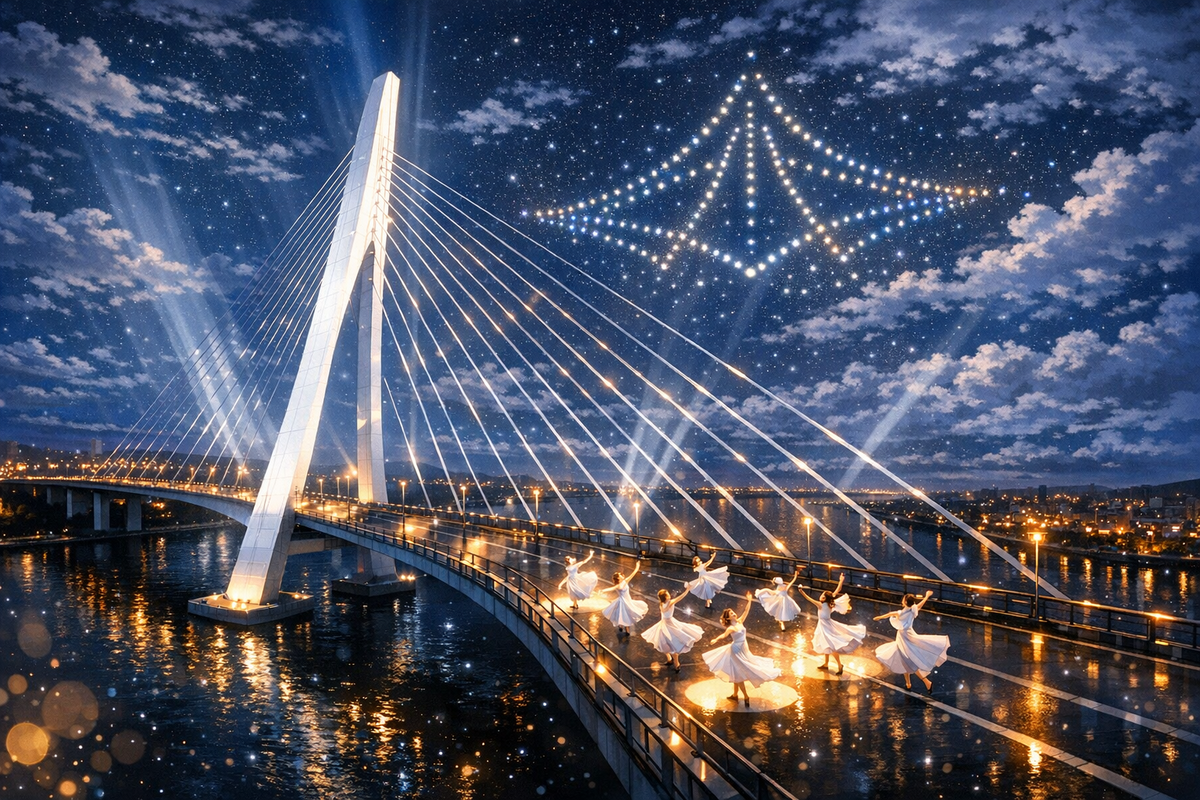
淡江大橋從動工到完成,花了13年。Zaha Hadid事務所設計的這座橋,單塔斜張結構在北台灣的天空劃出一條不對稱的弧線,光是結構本身就是一道視覺命題。工程師花了13年回答的問題:一座橋能不能同時是一件建築藝術品?開幕那晚,雲門舞集給了另一個答案——它還可以是一個舞台。
《光鏈》在橋面上演出,雲門的身體語言在這裡有了不同的重量。林懷民1973年創立雲門,把太極導引、書法、京劇身段融進現代舞,《紐約時報》稱它為「亞洲最重要的現代舞團」,因為它做出了屬於自己的現代,而不是模仿西方的版本。橋上沒有鏡框舞台,沒有劇場的黑盒子保護,舞者直接面對淡水河與夜空。身體在橋梁結構之間移動時,工程美學與身體美學產生了一種對話——這兩種語言的文法完全不同,卻在同一個空間裡沒有互相干擾。
600架無人機同時起飛,代表的不只是技術
然後是600架無人機。這個數字本身已經說明了一些事:這不是補充節目,這是第三個主角。無人機光影在橋的上方重新描繪橋的輪廓,Zaha Hadid設計的物理結構,被即時生成的數位圖像重新詮釋了一次。這是台灣新媒體藝術能力的一次公開展示——台灣藝術家吳哲宇以演算法創造數位生命體,作品在威尼斯雙年展與Art Basel Miami展出;黃心健的VR作品在2017年拿下威尼斯影展最佳VR大獎。這個技術藝術生態系積累了幾十年,淡江橋上空的600架無人機是一次集中釋放,不是偶然冒出來的。
更早的前例是2017年台北世大運,LuxuryLogico藝術家團隊設計了21公尺高的機械花聖火台,把工程技術直接嵌入儀式現場。台灣有一種習慣,把科技能力不往工廠藏,往文化活動推。這和歐洲某些城市的邏輯不一樣——歐洲是先有百年藝術傳統,再用它包裝新的城市事件。台灣是工程師、舞者、演算法藝術家坐在同一張桌子前面,問的問題:我們有什麼,可以同時出現在同一個夜晚?
把基礎建設變成文化事件,需要的不只是預算
能做這件事的地方,世界上屈指可數。這需要不同系統之間的信任,錢夠不夠是另一回事。公路局、文化部、表演藝術機構、科技公司要在同一個開幕夜晚協調,而且每一個都必須願意讓自己的作品成為別人作品的背景。工程師要接受橋面上有舞者,舞者要接受橋梁結構是他們的舞台設計,無人機團隊要接受他們的光是為了強調橋的形狀而不是取代它。
台灣有一個空間轉化的傳統值得注意:C-LAB,也就是台灣當代文化實驗場,是由前空軍總司令部改建而來的創作基地。軍事空間變成藝術空間,這本身就是一種基礎建設再定義的練習。淡江大橋的開幕藝術季,是這種思維在更大尺度上的操演。一座橋不只是交通基礎建設,它是一個可以被賦予文化意義的城市空間。
三種美學語言的語法問題
工程美學講的是荷重、張力、跨距——它的美藏在力學的必然性裡。身體美學講的是重力與克服重力之間的張力——雲門的舞者訓練了多年,就是為了讓那種張力在觀眾眼前變得可見。數位美學講的是演算法在即時時間裡生成的秩序——無人機的隊形是程式在夜空中持續解題的結果,開演前沒有固定圖案。
這三種語言在開幕夜同時落地,沒有互相翻譯,也不需要翻譯。這是台灣在那個夜晚做到的事——讓三套完全不同的美學系統在同一個空間共存,而且每一套都沒有委屈自己去遷就另外兩套。這比建一座橋難。
— 林柏仁
One Bridge, Three Aesthetics, One Taiwanese Night
The Bridge Opened With Dancers Before Cars
It took 13 years to build. Zaha Hadid Architects designed the Danjiang Bridge with an asymmetric single-pylon cable-stayed structure that cuts an unexpected arc across the northern Taipei skyline. On opening night, before a single vehicle had crossed it, Cloud Gate Dance Theatre performed Light Chain on the deck. The question engineers spent 13 years answering was whether a bridge could also be architecture. Cloud Gate answered a different question: whether it could also be a stage.
Cloud Gate’s movement vocabulary — built by Lin Huai-min since he founded the company in 1973, fusing tai chi, calligraphy, and Beijing opera into modern dance — carries different weight outdoors, on a bridge, against the Danshui River at night. The New York Times called it Asia’s most important modern dance company not because it borrowed from the West, but because it invented its own version of contemporary. On the bridge deck, with no proscenium and no theater walls, that invention landed somewhere new.
600 Drones Is a Statement, Not a Feature
Then 600 drones launched simultaneously. That number makes them a third protagonist, not a closing spectacle. The light formations re-drew Zaha Hadid’s physical structure in the air above it — the engineering geometry interpreted a second time by generative algorithm. This is a capability Taiwan has been building for decades. Artist Wu Zhe-yu creates digital life forms through generative code; his work has shown at the Venice Biennale and Art Basel Miami. Huang Hsin-chien’s VR work took the best VR prize at the Venice Film Festival in 2017. The drone display above Danjiang Bridge was not an isolated technical stunt. It was one output from a media arts ecosystem that has been accumulating for a generation.
The precedent that keeps coming up: at the 2017 Taipei Universiade, the LuxuryLogico artist collective built a 21-meter mechanical flower as the cauldron structure for the opening ceremony. Engineering embedded inside ritual. Taiwan has a habit of pushing its technical capacity toward cultural events rather than keeping it inside factories. That habit was on full display on opening night.
What It Takes to Turn Infrastructure Into a Cultural Event
The number of places in the world that could do this is small. Not because of budget — because it requires different institutional systems to trust each other. Transportation agencies, cultural ministries, performing arts organizations, and technology companies all had to coordinate toward a single evening, and each had to accept that their work would sometimes be the background for someone else’s. Engineers had to accept dancers on the bridge deck. Dancers had to accept that a cable-stayed structure was their set design. The drone team had to accept that their light existed to amplify the bridge’s geometry, not to replace it.
Taiwan has been practicing this kind of spatial rethinking for years. C-LAB — the Taiwan Contemporary Culture Lab — was converted from the former Air Force Command Headquarters into an arts and creation base. A military compound became a production space. The Danjiang Bridge opening is that logic operating at a larger scale: infrastructure as a site that can hold cultural meaning.
Three Grammars, One Night
Engineering aesthetics is about load, tension, and span — beauty compressed inside structural necessity. Somatic aesthetics is about the visible tension between gravity and its defeat — what Cloud Gate dancers train for years to make legible. Digital aesthetics is about order that an algorithm generates in real time — the drone formations were not a pre-set image but a program continuously solving for shape in night air.
All three arrived on the same night without translating themselves into each other. That is the harder achievement. Not the bridge. Not the performance. Not the drones. The fact that none of the three had to compromise to share a space.
— 林柏仁
延伸閱讀
https://justfly.idv.tw/s/kHXFS8M