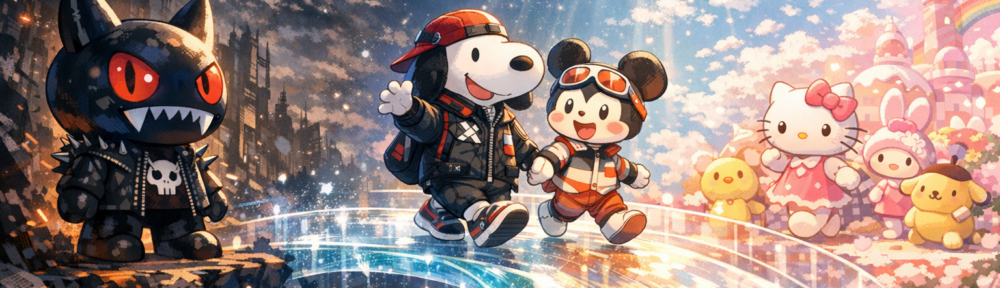
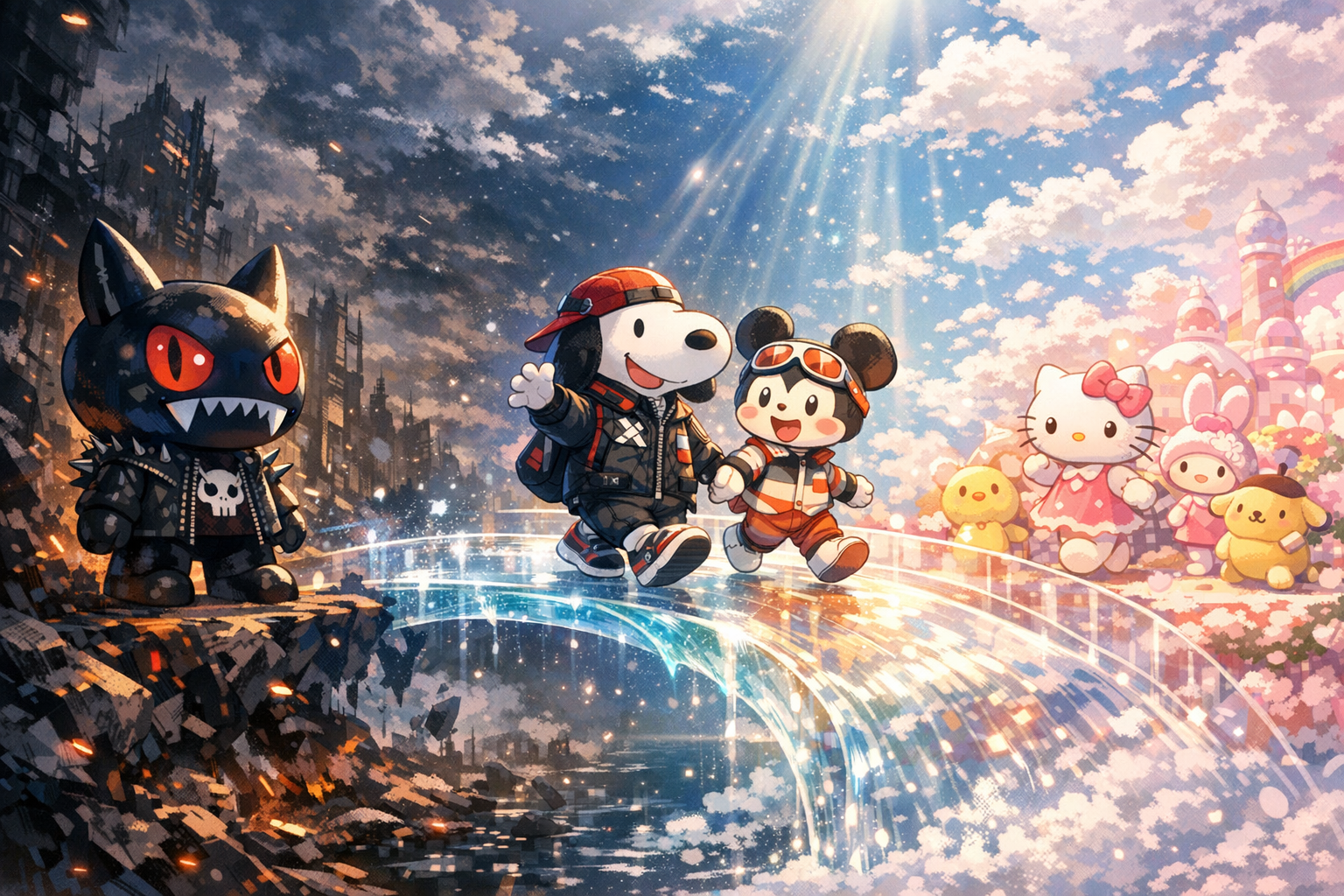
當LABUBU那雙尖銳的獠牙出現在Sanrio粉紅泡泡的世界裡,當史努比被UNDERCOVER賦予暗黑街頭氣質,當米奇老鼠戴上F1賽車眼鏡——2026年的IP聯名已經不再只是「風格融合」的遊戲,而是進入了一場更大膽的實驗:測試IP能否脫離原生世界觀,仍然保持核心辨識度。
美學對立的共存實驗
LABUBU與Sanrio的聯名案例,是這波「宇宙跨界」浪潮中最引人注目的範例。LABUBU來自Pop Mart旗下,帶著輕微的詭異與叛逆氣質,而Sanrio宇宙則以Hello Kitty為首,代表著溫柔、可愛與正向能量。兩個完全相反的美學系統,卻成功在同一個產品線中共存。
這種合作的成功,並非建立在「風格妥協」之上——LABUBU沒有變得更可愛,Hello Kitty也沒有長出獠牙。關鍵在於雙方都擁有足夠強大的「IP核心」,即使置身於完全陌生的視覺語境中,仍能被瞬間辨識。這證明了真正的跨宇宙級IP,不依賴固定的場景、色調或故事背景,而是擁有某種超越環境的「性格密碼」。
從「可愛」到「可穿越」的典範轉移
對台灣IP產業而言,這波趨勢帶來了重要的戰略啟示。過去十年,台灣創作者擅長打造「可愛的角色」——從圖文創作到LINE貼圖,可愛美學幾乎成為台灣IP的主流語言。然而,可愛並不等於可穿越。
真正的「宇宙旅行者」需要具備三個特質:首先是高度濃縮的視覺符號,能在任何背景下被快速識別;其次是富有彈性的性格設定,能適應不同文化場景而不失真;最後是開放的敘事結構,允許其他品牌或文化體系植入自己的詮釋。
史努比是絕佳示範。當UNDERCOVER將這隻經典米格魯置入街頭暗黑美學時,史努比依然是史努比——那種慵懶、哲思、略帶疏離的性格特質,反而在暗黑風格中得到了新的詮釋空間。這證明了角色的「性格強度」比「視覺風格」更具穿越力。
台灣IP的跨宇宙測試指南
對於想要測試自己IP是否具備「跨宇宙」潛力的台灣創作者與品牌,可以進行幾個實戰演練:首先,將角色置於完全相反的美學語境中——如果你的IP是可愛風,試著想像它出現在賽博龐克或工業風場景;如果是暗黑系,想像它進入童話或療癒系世界。
其次,嘗試「去背景化」測試:移除所有固定的場景、道具、色彩系統,僅保留角色的核心輪廓與表情,是否仍能被辨識?米奇之所以能跨越近百年仍然強大,正因為那對圓耳朵與臉部輪廓,已經超越了任何特定的故事或風格。
最後,思考「性格可翻譯性」:你的IP的核心性格,能否用不同文化、不同世代、不同場景的語言重新表述?如果角色只能活在單一敘事或特定社群的梗文化中,它的穿越潛力就會受限。
聯名的終極目標:成為文化接口
當IP聯名從「兩個品牌的加法」進化為「宇宙穿越測試」,它真正測試的是IP是否已經成為一種「文化接口」——能夠承載不同美學、連結不同社群、觸發不同詮釋,卻始終保持自己的核心識別。
米奇戴上F1眼鏡,不只是迪士尼與賽車運動的聯名,而是證明米奇可以進入任何次文化而不被稀釋。這才是2026年IP競爭的真正戰場:不是誰更可愛、更精緻、更有故事,而是誰能在最多元的宇宙中自在穿梭,成為真正的「跨界旅行者」。
— 胡凱翊
IP Evolution: From Character Mashups to Universe Travelers
When LABUBU’s sharp fangs appear in Sanrio’s pink bubble universe, when Snoopy receives a dark streetwear makeover from UNDERCOVER, when Mickey Mouse dons F1 racing goggles—IP collaborations in 2026 are no longer just about “style fusion.” They’ve evolved into a bolder experiment: testing whether an IP can maintain its core identity while completely departing from its native worldview.
The Coexistence of Opposing Aesthetics
The LABUBU × Sanrio collaboration stands as the most striking example of this “universe-crossing” wave. LABUBU, from Pop Mart’s roster, carries a subtle eeriness and rebellious edge, while the Sanrio universe—led by Hello Kitty—represents gentleness, cuteness, and positive energy. Two diametrically opposed aesthetic systems successfully coexist within the same product line.
This success isn’t built on aesthetic compromise—LABUBU didn’t become cuter, and Hello Kitty didn’t grow fangs. The key lies in both possessing sufficiently powerful “IP cores” that remain instantly recognizable even in completely foreign visual contexts. This proves that true universe-crossing IPs don’t rely on fixed scenes, color palettes, or story backgrounds, but possess a “personality code” that transcends environment.
From “Cute” to “Crossable”: A Paradigm Shift
For Taiwan’s IP industry, this trend carries significant strategic implications. Over the past decade, Taiwanese creators have excelled at crafting “cute characters”—from illustration-based content to LINE stickers, cute aesthetics have dominated Taiwan’s IP landscape. However, cute doesn’t equal crossable.
True “universe travelers” require three qualities: highly concentrated visual symbols that can be quickly identified against any background; flexible personality settings that adapt to different cultural contexts without losing authenticity; and open narrative structures that allow other brands or cultural systems to plant their own interpretations.
Snoopy exemplifies this perfectly. When UNDERCOVER placed this classic beagle into dark streetwear aesthetics, Snoopy remained Snoopy—that lazy, philosophical, slightly detached personality actually found new interpretive space within the dark style. This proves that a character’s “personality strength” holds more cross-universe power than “visual style.”
Taiwan IP’s Universe-Crossing Test Guide
For Taiwanese creators and brands wanting to test their IP’s “cross-universe” potential, several practical exercises can help. First, place your character in completely opposite aesthetic contexts—if your IP is cute-styled, imagine it in cyberpunk or industrial settings; if it’s dark-themed, imagine it entering fairy tale or healing-oriented worlds.
Second, attempt a “background removal” test: strip away all fixed scenes, props, and color systems, retaining only the character’s core silhouette and expressions. Can it still be recognized? Mickey’s ability to remain powerful across nearly a century stems from those round ears and facial contours having transcended any specific story or style.
Finally, consider “personality translatability”: Can your IP’s core personality be re-expressed in the language of different cultures, generations, and contexts? If a character can only live within a single narrative or specific community’s meme culture, its cross-universe potential remains limited.
The Ultimate Goal: Becoming Cultural Interface
As IP collaborations evolve from “two-brand addition” to “universe-crossing tests,” they’re truly examining whether an IP has become a “cultural interface”—capable of carrying different aesthetics, connecting different communities, triggering different interpretations, while always maintaining its core identity.
Mickey wearing F1 goggles isn’t just a Disney-racing collaboration; it proves Mickey can enter any subculture without dilution. This is the real battlefield of 2026 IP competition: not who’s cuter, more refined, or more story-rich, but who can navigate the most diverse universes with ease, becoming a true “cross-boundary traveler.”
— Hu Kai-Yi