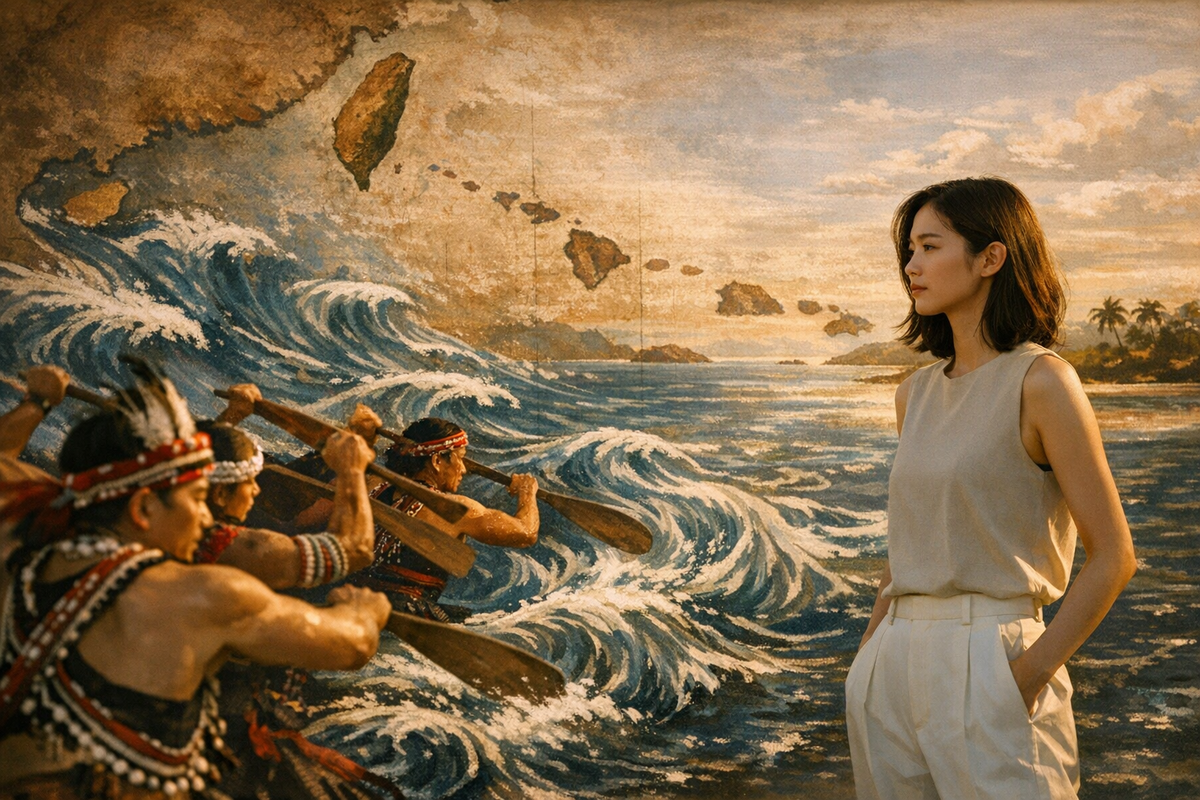
在花蓮港口部落觀看阿美族人跳傳統舞蹈時,人們總會注意到那些模擬划槳的動作——身體前傾,雙臂有力地向後拉,彷彿千年前的航海記憶刻在肌肉裡。現在,語言學研究告訴世人,這個動作是真實的歷史痕跡,不是借來的比喻。
語言裡的航海基因
最新發表在《Diachronica》期刊的研究揭示了一個驚人發現:台灣東部四個原住民族群——阿美、噶瑪蘭、巴賽-三貂、西拉雅——的語言中,共享一種特殊的「ma-」語法詞綴用法。這個看似微小的語言特徵,在台灣其他原住民語言中完全不存在,卻廣泛出現在從馬達加斯加到復活節島的馬來-玻里尼西亞語系中。
對編舞者而言,這種「共享但獨特」的模式特別引人注目。就像不同地區的祭典舞蹈可能有相似的基本步法,但各自發展出獨特的變化——語言也是如此。這個「ma-」詞綴就像是舞蹈動作的「原始型」,被最早的航海者帶到太平洋與印度洋的各個角落,然後在不同土地上開枝散葉。
三重證據鏈:當語言、基因與陶片相遇
真正讓這項研究站得住腳的,是語言學、遺傳學、考古學三方面證據的完美吻合。全基因組分析追蹤到台灣東部人群的遺傳標記,考古學家在同一區域挖掘出具有航海文化特徵的器物,而語言學家則從詞彙和語法中找到擴散路徑。這三條獨立的線索指向同一個起點:台灣東部,阿美族的傳統領域。
編排關於豐年祭的作品時,創作者往往會花很多時間研究阿美族的儀式動作。那些看似簡單的手勢——指向海洋、模擬捕魚、祈求平安——其實蘊含著深刻的文化記憶。當人們了解到阿美語中的「poki」與菲律賓他加祿語、馬來語中的同源詞相連時,便能明白:語言就像舞蹈動作一樣,是身體與文化的共同記憶載體。
世界第二大語系的起點在這裡
南島語系涵蓋超過十億人口,從非洲東岸的馬達加斯加,橫跨整個太平洋到南美洲外海的復活節島,是人類歷史上最大規模的海洋擴散。這個語系的多樣性與分布範圍,僅次於印歐語系。而現在人們知道,這趟史詩級的航海旅程,就從台灣東岸啟航。
對台灣的創作者來說,這個發現促使人們重新思考「本土」與「世界」的關係。社會常說要發揚在地文化,但原來台灣東部的原住民文化,本身就是世界級的文化擴散源頭。阿美族連接著半個地球的文化脈絡,從花蓮出發,一路延伸到馬達加斯加與復活節島。
從廟會到現代舞:身體記得的比人們以為的更多
這項研究對創作有深刻啟發。當創作者將民俗儀式轉化為現代舞蹈,傳遞的是一種跨越時空的身體敘事,動作本身就是載體。那些在部落祭典中反覆出現的手勢、步伐、節奏,可能承載著數千年前航海者的經驗與記憶。
語言學家用「ma-」詞綴追溯遷徙路徑,編舞者則試圖用身體動作解碼文化基因。當花蓮的阿美族青年跳著傳統舞蹈,他們的身體其實在述說一個關於勇氣、冒險與連結的故事——一個從台灣東岸出發,最終抵達世界盡頭的故事。這段歷史沒有結束,它現在還活著。
The Ocean’s First Step: How Amis Language Reveals Austronesian Origins
Watching Amis dancers in the Makotaay community of Hualien, observers are always struck by their paddling gestures—bodies leaning forward, arms pulling back with force, as if muscle memory carries the weight of ancient voyages. Now, linguistic research confirms this is historical truth, not metaphor.
The Grammatical Fingerprint of Seafarers
A groundbreaking study published in Diachronica reveals a remarkable finding: four Indigenous groups in eastern Taiwan—Amis, Kavalan, Basay-Trobiawan, and Siraya—share a unique usage of the “ma-” grammatical prefix. This seemingly minor linguistic feature is completely absent in other Taiwanese Indigenous languages, yet appears widely throughout the Malayo-Polynesian language family, from Madagascar to Easter Island.
For choreographers, patterns that are “shared yet distinctive” are particularly intriguing. Like how ritual dances across regions may share basic steps while developing unique variations, language follows similar patterns. This “ma-” prefix is like the original choreography, carried by the first seafarers across the Pacific and Indian Oceans, then blooming into countless variations on different shores.
When Language, Genes, and Pottery Align
What makes this research compelling is the convergence of three independent evidence streams. Whole-genome analysis traces genetic markers to eastern Taiwan populations. Archaeologists unearth artifacts showing maritime culture in the same region. Linguists map expansion routes through vocabulary and grammar. These three separate threads point to one origin: eastern Taiwan, the traditional territory of the Amis people.
While choreographing a piece about the Amis harvest festival, creators often spend months studying ritual movements—gestures pointing to the ocean, mimicking fishing, invoking safe passage. Learning that the Amis word “poki” shares roots with Tagalog and Malay cognates suddenly crystallizes something: language, like dance, is embodied cultural memory.
The Starting Point of Earth’s Second-Largest Language Family
The Austronesian language family encompasses over a billion speakers, stretching from Madagascar off Africa’s east coast across the entire Pacific to Easter Island near South America—the largest oceanic expansion in human history. This language family’s diversity and range is second only to Indo-European. And now the world knows this epic maritime journey began on Taiwan’s eastern shore.
For Taiwanese creators, this discovery reshapes how people understand “local” versus “global.” Society often speaks of promoting indigenous culture, but eastern Taiwan’s Indigenous peoples are the cultural matrix connecting half the planet—from Hualien all the way to Madagascar and Easter Island. Not peripheral. Foundational.
Bodies Remember More Than People Know
This research profoundly influences creative practice. When artists transform folk rituals into contemporary dance, they transmit embodied narratives that traverse time. The movements are the vessel. Those gestures, steps, and rhythms repeated in tribal ceremonies may carry the experiences and memories of seafarers from millennia past.
Linguists trace migration routes through “ma-” prefixes; choreographers attempt to decode cultural DNA through bodily movement. When young Amis dancers perform traditional choreography in Hualien, their bodies tell a story of courage, adventure, and connection—a story that began on Taiwan’s eastern coast and reached the world’s edges. The history didn’t stop. It’s still moving.
— 鍾雅筑
延伸閱讀
https://justfly.idv.tw/s/ZTDSkgE