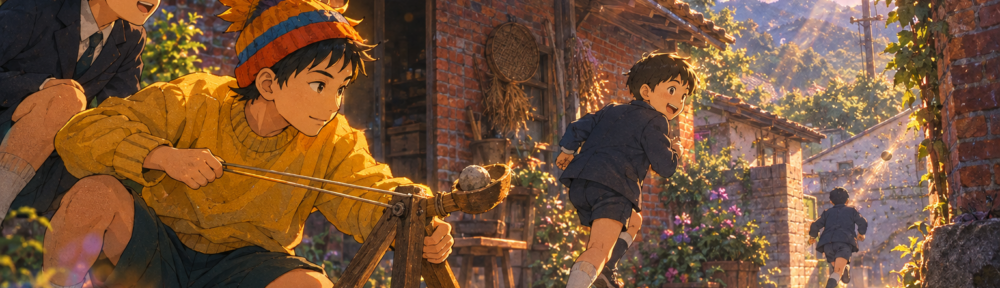
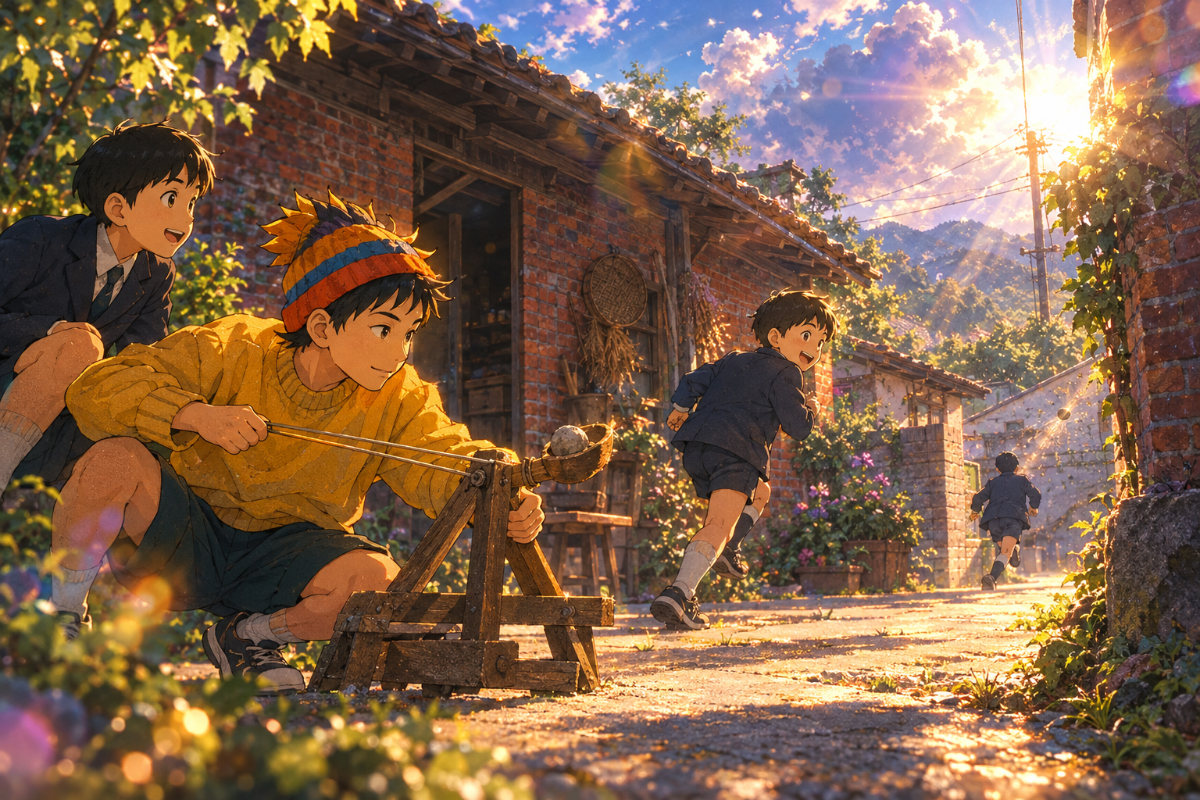
(配圖說明:本文配圖為示意插畫,不是新聞照片;新聞原圖見文末來源。)
新聞裡有一張教育部提供的照片,說明只有一行:大崎村落創藝基地團隊帶領學童於村落巷弄體驗自製「投石器」遊具。得獎消息很快會被別的新聞蓋過去,這件投石器值得多看幾眼。
一件遊具,要一條巷子才玩得開
投石器這種東西,在客廳裡只能是模型。要玩,大概得有一段能拋的距離、一個可以瞄的目標,還有讓亂飛的東西有地方落下的邊界。照片說明把場地寫成「村落巷弄」,巷弄有長度、有兩側的牆,看起來是合用的尺度;實際怎麼拋、往哪裡瞄、用什麼擋,公開資料沒有交代。這是小型遊戲團隊做企劃時最常撞見的事:好規則會自己去找場地,找不到就變成放在櫃子裡的盒子。
桌上遊戲常被桌面的大小綁住。大崎村落的做法反過來,桌子本來就是整條巷。青年署公告的說法是「村落遊戲島」,以輕量的空間介入與遊戲體驗設計,讓農村閒置的老屋、庭院與巷弄成為遊戲、學習與體驗的場所。「輕量」兩個字下得準。照公告的字面讀,重點放在玩法而不是工程;至於實際動了多少空間,公告沒有細說。
身體先到,認知才跟上
照片只給了一個瞬間。往前後推想:如果投石器是在院子裡組裝、在巷子裡放手,石頭落在哪、要跑多遠去撿,孩子會在跑的過程裡量到老屋的門檻多高、牆多厚、院子多深。這是推論,不是報導寫的情節;但遊戲最擅長的就是這個:讓身體替腦袋量空間。孩子未必會說出「農村文化」這種詞,更可能記住的是某個院子很大、下次想換個位置射。空間因此多了一個名字,叫「那個院子」,而不是「某戶閒置的老屋」。
分散的據點,是遊戲地圖的好材料
公告提到,團隊串聯村落中分散的空間據點,建構兼具教育體驗與永續經營的農村服務系統。「分散」在導覽設計裡常被當缺點,在遊戲設計裡剛好相反。據點之間隔著巷子,巷子就是關卡之間的路,每一段路都有可以發生的事。集中在一處的景點,走完十分鐘就沒了;散開的地方,要走。
得獎本身只是背景。2026年日本GOOD DESIGN AWARD共有3組青聚點團隊獲獎,另外兩組做的是校園危險樹木的循環利用與青少年陪伴,是不同團隊、不同題目,成果不能混著算。大崎村落這一組能確認的,只有「村落遊戲島」的概念、公告的描述,以及那張學童玩投石器的照片。
想自己去看的人
- 青年署新聞稿(115-11-02):三組得獎團隊的介紹與成果展資訊。https://www.yda.gov.tw/docDetail.aspx?docid=69738&pid=53&uid=30320
- 自由時報報導(2026-11-02):同一則消息,附教育部提供的照片。https://news.ltn.com.tw/news/life/breakingnews/5626385
- 青聚點計畫官網:https://changemaker.yda.gov.tw/,成果展與各團隊資訊以這裡為準。
- GOOD DESIGN AWARD 官網:https://www.g-mark.org/,得獎作品可在這裡查。
投石器怎麼做、用什麼材料、改過幾版,這兩篇報導都沒有寫;本文也沒有見到實物。遊具的好壞要在細節裡看:高度、重量、彈性、會不會夾手,這些得到現場才知道。
青年署表示,12月5日(六)至6日(日)將在臺北松山文創園區2、3號倉庫舉辦「115年Changemaker暨青聚點成果展」,集結50組青聚點、46組行動團隊與41組Dream idea績優點子。投石器會不會出現在現場,目前沒有資料;若有一件實物能讓人動手拉一拉、放一次,會比任何看板更有說服力。
— 張誠書
Following a Homemade Catapult Through Daci Village
(Image note: the illustration in this post is a rendered concept image, not the news photo. The original photo is in the sources at the end.)
The news coverage carries one photo, supplied by the Ministry of Education, with a single-line caption: the team from 大崎村落創藝基地 led schoolchildren to try a self-made “catapult” play object in the village lanes. The award news will be buried by other headlines soon. The catapult deserves a longer look.
A toy that needs a whole lane
Indoors, a catapult is a model. To actually play, it probably needs distance to throw, a target to aim at, and some boundary where stray stones can land. The caption places it in “village lanes,” which have length and walls on both sides, so the scale looks right. How it is thrown, what is aimed at, and what stops the stones is not in the public record. Small game teams planning a project meet this often: a good rule set goes looking for a venue, and without one it becomes a box on a shelf.
Tabletop games are bound by the size of the table. At 大崎村落 the approach is reversed: the table is the lane itself. The Youth Development Administration announcement calls the idea 「村落遊戲島」, a “village play island”: light spatial intervention plus play-experience design, turning idle farmhouses, courtyards and lanes into places for play, learning and experience. “Light” is the right word. Read literally, the emphasis is on rules of play rather than construction; how much of the space was actually altered, the announcement does not say.
The body arrives first
The photo gives one moment. Reasoning forward and back from it: if the catapult is assembled in a courtyard and released in a lane, then where the stone lands and how far a child runs to fetch it would teach, in the running, how high the old threshold is, how thick the wall, how deep the yard. That is an inference, not a scene from the reports. But play is good at exactly this: letting the body measure space for the head. A child is unlikely to say “this is rural culture.” What sticks is more likely that a yard was big and that next time they would shoot from a different spot. The space gains a name, “that yard,” instead of “a vacant old house.”
Scattered sites make a decent game map
The announcement says the team links dispersed spaces across the village into a rural service system combining educational experience with long-term sustainability. In tour design, “scattered” counts as a flaw. In game design it is the opposite. Lanes between sites are the paths between levels, and each stretch can hold something. An attraction packed into one spot is finished in ten minutes. A spread-out place demands walking.
The award itself is background. Three 青聚點 teams won the 2026 Good Design Award in Japan; the other two work on recycling hazardous campus trees and on mentoring at-risk teenagers. They are different teams with different subjects, and their results should not be pooled. What can be confirmed for 大崎村落 is the “village play island” concept, the announcement’s description, and the photo of children with a catapult.
If you want to see for yourself
- Youth Development Administration press release (2 Nov 2026): the three winning teams and the exhibition. https://www.yda.gov.tw/docDetail.aspx?docid=69738&pid=53&uid=30320
- Liberty Times report (2 Nov 2026): the same story, with the Ministry of Education photo. https://news.ltn.com.tw/news/life/breakingnews/5626385
- Changemaker / 青聚點 programme site: https://changemaker.yda.gov.tw/, the authoritative source for the exhibition and team listings.
- Good Design Award official site: https://www.g-mark.org/, where winning entries can be looked up.
How the catapult was built, from what materials, over how many revisions, is in neither report, and this article has not seen the object. A play object is judged on details: height, weight, spring, whether it pinches fingers. Those can only be checked in person.
The Youth Development Administration says the “115 Changemaker and 青聚點 Exhibition” will run December 5 (Sat) to 6 (Sun) at Warehouses 2 and 3, Songshan Cultural and Creative Park, Taipei, gathering 50 青聚點 teams, 46 action teams and 41 Dream Idea projects. Whether the catapult will be there is not announced. If a real one is, something visitors can pull back and release, it will persuade better than any wall panel.
— 張誠書
延伸閱讀
- 日本商圈感受到的「特色」,其實是一套治理制度
- 松園別館 展覽裡的竹帆船,船還沒下水,繩結先上了手
- 石頭在呼吸 花蓮:13公尺的巨石,其實是一袋空氣
- 金蘋果樂園 1.21.0,朋友家門口可以插木牌了
- 模型上那個洞,對準了中央公園
https://justfly.idv.tw/s/jNaCiMr