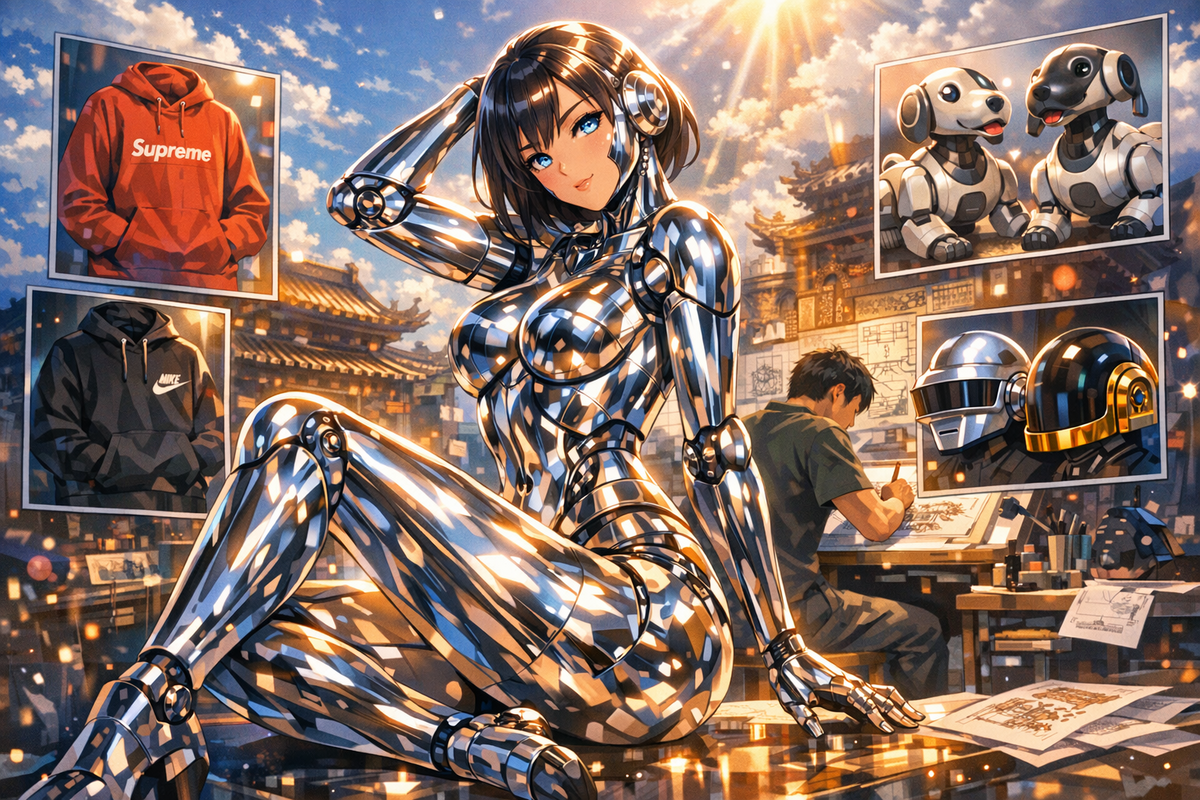
1999年,Sony推出第一代AIBO機器狗時,找來空山基(Hajime Sorayama)設計視覺形象。那隻鍍鉻銀色、關節精密到可以看見每個螺絲孔的機械犬,售價超過15萬日圓,三個月內賣出15萬隻。二十年後,Supreme 2019春季系列再次找上空山基,把他1983年畫的機械性感女體印上衛衣——那張圖誕生時Madonna還沒發《Like a Virgin》,但放在Instagram時代竟然毫無違和感。
2026年3月,東京將舉辦空山基生涯最大回顧展。這個從1970年代就開始用噴槍畫機械人體的畫家,五十年來視覺語言幾乎沒變:超寫實鍍鉻表面、女性身體與機械零件的完美接合、每條反光都精確到像工程圖。問題是,什麼讓一種視覺語言跨越半世紀不過時?
慾望與恐懼的精確配比
空山基抓住的不是「科技感」這種會過期的東西。他捕捉的是人類對機械化身體的矛盾情感——既想觸碰那完美無瑕的金屬曲線,又害怕自己也會被科技取代。1970年代這個命題還只是科幻小說的想像,2024年當你看著ChatGPT寫文章、Sora生成影片時,那種恐懼變得具體得多。
DAFT PUNK找空山基設計《Discovery》專輯MV裡的機器人造型,不是因為他畫得「很未來」,而是因為他的機械人體永遠帶著一種曖昧的情色張力。那些鍍鉻女體不是冰冷的工業產品,每個關節、每條肌肉紋理都在提醒你:這本來是有溫度的肉身。2024年LVMH旗下百年皮件品牌Moynat跟空山基聯名,把機械手臂印在售價三十萬台幣的手袋上——買的人要的不是「科技風」,是那種「人造物比真人更完美」的不安快感。
台灣有過一個鄭問
台灣其實有過類似案例。鄭問1991年以《東周英雄傳》拿下日本漫畫家協會優秀賞,成為首位非日籍得主。日本漫畫界叫他「亞洲至寶」,不是因為他畫得「很東方」,而是他把水墨潑染、工筆線條、西方透視法跟漫畫分鏡熔接成全新語言。那些畫面放在1991年震撼,2017年他過世後在故宮辦回顧展,那些二十年前的分鏡稿依然能讓人停下來盯著看。
鄭問跟空山基的共通點不是「fusion」(融合)這種安全的策略。他們都在處理一個本體性的矛盾:鄭問處理的是「東方古典美學如何承載現代敘事速度」,空山基處理的是「機械如何承載肉身慾望」。這種矛盾不會過期,因為它不是風格,是人性裡永遠解不開的結。
廟宇美學可以遇上演算法嗎
台灣設計師常問的問題是:我們可以建立什麼樣的視覺語言?答案可能不在「原住民圖騰+AI」或「廟宇雕刻+賽博龐克」這種加法。空山基從來不是「性感+機械」的簡單疊加,他抓的是那個接合處的張力——金屬如何模擬肌膚的柔軟,冰冷的螺絲如何長在有體溫的軀體上。
鄭問也不是把水墨「應用」在漫畫上。他讓墨的流動性去承載武俠世界裡氣的流動,讓工筆的靜止感去捕捉時間停格的殺意。這些是視覺語言的本體性創造,不是風格的混搭。
2026年3月那場東京回顧展,會有多少人去看五十年前的機械性感人體畫?可能比你想像的多。因為當AI生成的圖像每秒鐘產出百萬張時,人們反而更想看那些用噴槍、用手、用五十年時間打磨出來的精確——那種精確裡有執念,有人類還願意為一個形象投入一生的痕跡。這是演算法生成不出來的東西。
— 姚宇
延伸閱讀
Why Sorayama’s Chrome Bodies Still Matter After 50 Years
In 1999, when Sony launched the first-generation AIBO robot dog, they commissioned Hajime Sorayama for the visual design. That chrome-plated silver mechanical canine, with joints so detailed you could see every screw hole, sold for over 150,000 yen. Within three months, 150,000 units were gone. Twenty years later, Supreme’s Spring 2019 collection featured Sorayama again, printing his 1983 gynoid illustration on hoodies—a drawing born when Madonna hadn’t yet released “Like a Virgin,” yet it looked perfectly at home in the Instagram era.
In March 2026, Tokyo will host Sorayama’s largest career retrospective. This artist who’s been airbrushing mechanical bodies since the 1970s has maintained an almost unchanged visual vocabulary for fifty years: hyperrealistic chrome surfaces, seamless fusion of female anatomy and mechanical components, every reflection rendered with engineering precision. The question is: what makes a visual language remain current across half a century?
The Exact Ratio of Desire and Fear
Sorayama didn’t capture something perishable like “tech aesthetics.” He captured humanity’s contradictory relationship with mechanized bodies—the simultaneous urge to touch those flawless metal curves and the fear of being replaced by technology ourselves. In the 1970s, this was just science fiction speculation. In 2024, watching ChatGPT write articles and Sora generate videos, that fear became concrete.
When DAFT PUNK hired Sorayama to design the robot costumes for their “Discovery” album MVs, it wasn’t because he drew “futuristic” imagery. It was because his mechanical bodies always carried an ambiguous erotic tension. Those chrome gynoids aren’t cold industrial products—every joint, every muscle contour reminds you: this was once warm flesh. When LVMH’s century-old leather brand Moynat collaborated with Sorayama in 2024, printing mechanical arms on handbags priced at 10,000 USD, buyers weren’t seeking “tech style”—they wanted that unsettling pleasure of “artificial perfection surpassing the human.”
Taiwan Once Had Zheng Wen
Taiwan actually had a parallel case. In 1991, Zheng Wen won the Japan Cartoonists Association Excellence Award for “Heroes of the Eastern Zhou,” becoming the first non-Japanese recipient. The Japanese manga world called him “Asia’s Greatest Treasure”—not because he drew “very Eastern” work, but because he fused ink wash techniques, meticulous line work, Western perspective, and manga paneling into an entirely new language. Those images stunned audiences in 1991; when his retrospective opened at the National Palace Museum in 2017 after his death, those decades-old storyboards still commanded attention.
The commonality between Zheng and Sorayama isn’t “fusion”—that safe strategy. Both addressed ontological contradictions: Zheng grappled with “how Eastern classical aesthetics can carry modern narrative velocity”; Sorayama with “how machinery can embody carnal desire.” These contradictions don’t expire because they’re not styles—they’re permanently unresolved knots in human nature.
Can Temple Aesthetics Meet Algorithms?
Taiwanese designers often ask: what kind of visual language can we establish? The answer probably isn’t in addition formulas like “indigenous motifs + AI” or “temple carvings + cyberpunk.” Sorayama was never simple “sexy + mechanical” layering. He captured the tension at the junction point—how metal simulates skin’s softness, how cold screws grow from warm-blooded torsos.
Zheng never merely “applied” ink wash to manga. He made ink’s fluidity carry the flow of qi in martial arts worlds, used meticulous painting’s stillness to capture the frozen moment of killing intent. These are ontological creations in visual language, not style mashups.
That March 2026 Tokyo retrospective of fifty-year-old mechanical gynoid paintings—how many will attend? Probably more than you’d expect. Because when AI generates millions of images per second, people increasingly want to see what’s made with airbrush, by hand, refined across fifty years—that precision contains obsession, traces of humans willing to invest a lifetime in one vision. That’s something algorithms cannot generate.
— 姚宇