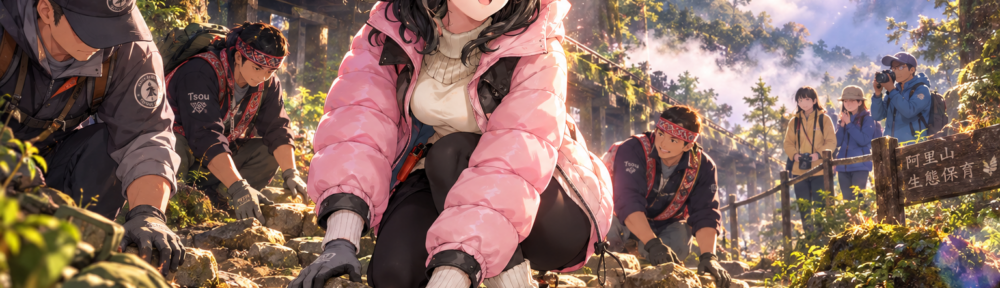
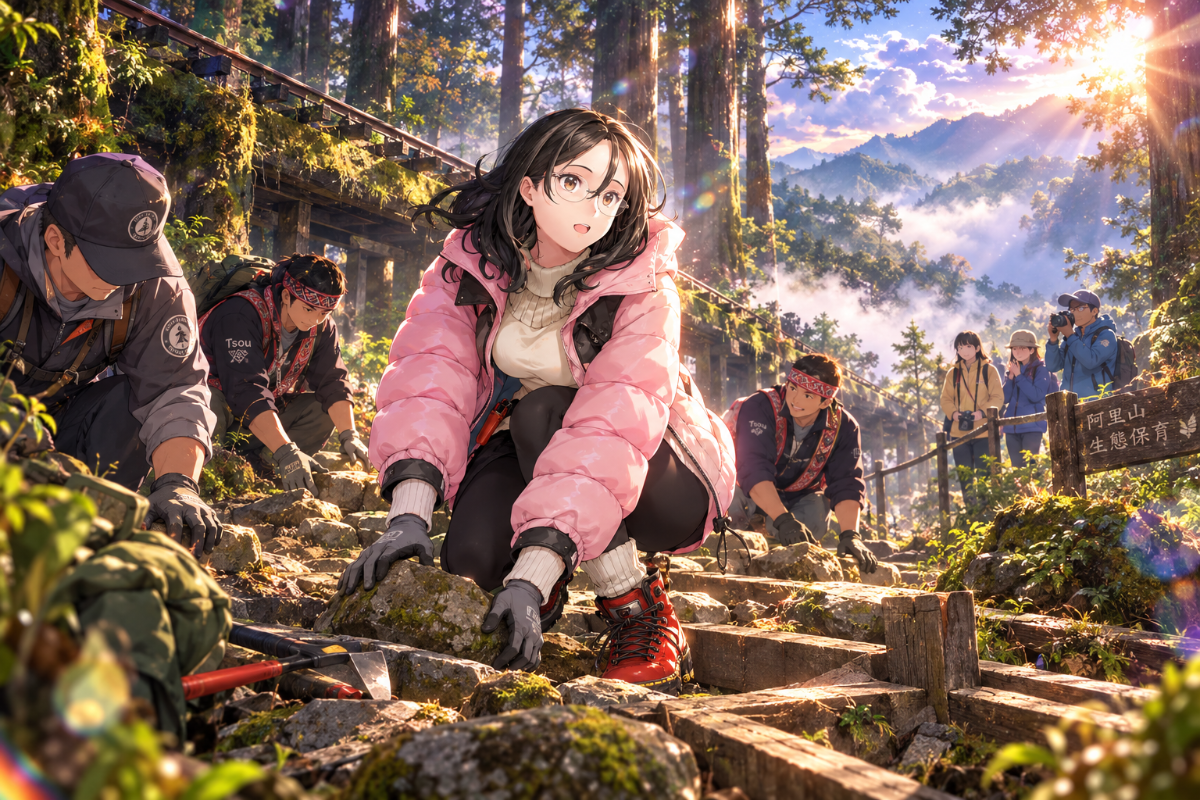
情境圖:林鐵舊路基旁,幾個人蹲在石階上整理石塊,手邊放著鐵橇,身後是柳杉林、雲海與在旁觀摩的訪客。畫面為示意,非活動現場照片。
舊鐵道下方的一小段路基
特富野古道上,2K+700 是一個很小的座標。10月26日,嘉義分署在這裡辦了「山海圳手作步道」活動:台灣千里步道協會的專業步道師團隊指導,阿里山鄉公所鄒族保育隊參與,處理的是舊鐵道下方的路基與護坡。
步道師前一日先到現地勘查,確認施作工項;活動當天,先講工具使用安全,再在施作現地講工法。順序很重要:先講怎麼拿工具、怎麼站,再談怎麼砌。
木格柵加砌石,公告寫了什麼
公告對工法的描述只有一句:針對 2K+700,以「木格柵加砌石」工法進行舊鐵道下方路基重整與護坡,材料採現地天然素材,目的是避免大型動力機具過度擾動山林,把人為干擾降到最低。木格柵與砌石各自怎麼受力、石頭之間怎麼咬合,公告沒有展開,這裡也不替步道師補寫;具體手法以現場示範為準。
起因也寫在公告裡:假日遊客多,環境承載力吃緊,加上颱風豪雨一再擾動邊坡與路基。需要說清楚的是,這次整理的是 2K+700 的局部路段,不等於全線修妥,也不代表現況可通行;通行與否,仍以官方另行公告為準。公告沒有附工法成效或後續追蹤的數據,讀者能帶走的結論是:這是一次局部整理,走這條古道前,先查嘉義分署的開放資訊。
一條路的三層記憶
特富野古道舊稱水山古道,早年是鄒族人的獵徑,也是通婚、探親的要道。農業部的古道介紹寫得更細:1941 年日本政府為擴大阿里山森林資源的開發,把古道東段鋪上鐵軌,成為阿里山森林鐵路水山線,運的是檜木;1971 年禁伐天然林後森林火車停駛,2001 年嘉義林區管理處重新整建古道,保留多處軌道與木棧橋。沿線的柳杉,是檜木、扁柏採伐之後引進種植的人工林。腳下這段路基,上頭壓著鐵道的歷史,更早之前是人走出來的路。這次動手的阿里山鄉公所鄒族保育隊,公告把這場活動稱為國際步道組織與在地原住民族部落的對話;保育隊自己怎麼看這條路,公告沒有記錄。
遠道來看的訪客
加拿大布魯斯步道保育協會(Bruce Trail Conservancy)的夥伴到現場參訪,公告的說法是實地交流、參訪觀摩,談長距離步道的營運機制、維護工法與社區共管。訪客是來看與聊的,公告沒有寫他們一起施工。
這層關係有來歷。2022 年 12 月,當時的林務局與布魯斯步道保育協會簽署合作備忘錄,山海圳國家綠道的特富野古道與布魯斯步道的 Waterdown 段締結友誼,牌誌就立在特富野古道口;媒合的是台灣千里步道協會。
手作步道的概念,是 2007 年台灣千里步道協會從美國阿帕拉契山徑引進的。十九年後,一個加拿大的步道組織站在阿里山的坡面前,看這一套在台灣怎麼做。
步道上看到整修過的石砌或木格柵,照原路走過就好,不要自己加石頭、挪木頭,也不要為了避開它離開步道。公告最後提醒的「無痕山林」,落在這一小段路上就是這件事。那一小段的穩,來自勘查、工具安全與手法的訓練。
— 詹爍茹
Tefuye Trail at 2K+700: Setting One Stone
Illustration: a few people crouch on stone steps beside an old logging-railway grade, sorting rocks with a pry bar at hand, cedar forest, a sea of clouds and visiting observers behind them. A staged scene, not a photo from the event.
One small stretch of roadbed
On the Tefuye Trail (特富野古道), 2K+700 is a very small coordinate. On October 26, the Chiayi Branch ran a hands-on trail day there. According to the official announcement, professional trail builders from the Taiwan Thousand Miles Trail Association (台灣千里步道協會) gave guidance, and the Tsou conservation team of the Alishan Township Office took part. The work was the roadbed and slope below the old railway grade.
The trail builders surveyed the site the day before to confirm the work items. On the day itself the session covered tool safety first, then technique on site. The order matters: how to hold the tools and how to stand come before how to build.
Timber grid and stone: what the announcement says
The announcement describes the method in one sentence: at 2K+700, a timber grid combined with stacked stone was used to rebuild the roadbed below the old railway and protect the slope, with natural materials gathered on site, so that heavy powered machinery would not disturb the mountain and human interference stays minimal. How the grid and the stone each carry load, or how the stones lock together, is not spelled out, and this article does not fill that in for the trail builders. The actual technique is whatever they demonstrate on site.
The announcement gives the reasons: crowded weekends strain the trail, and typhoons and heavy rain keep disturbing slopes and roadbeds. This is a local repair at 2K+700. It does not mean the whole trail is fixed or open to pass; access remains subject to separate official notices. No performance or follow-up data is attached, so the useful takeaway is simple: this was a local repair, and anyone planning to walk the trail should check the Chiayi Branch’s access notices first.
Three layers of memory
The Tefuye Trail was formerly known as the Shuishan Trail. It began as a Tsou hunting path and a route for marriage and family visits. The Ministry of Agriculture’s trail profile adds the detail: in 1941 the Japanese administration laid rails on the eastern section to expand logging in Alishan, creating the Shuishan Line of the Alishan Forest Railway, which hauled cypress; after Taiwan banned logging of natural forest in 1971 the trains stopped, and in 2001 the Chiayi Forest District Office rebuilt the trail, keeping stretches of track and timber bridges. The Japanese cedar along the way is a plantation planted after the cypress had been cut. The roadbed under the repair sits on that railway history, and under it a path laid down by footsteps. The announcement frames the day as a dialogue between an international trail organization and a local Indigenous community; how the Tsou team itself sees this trail is not recorded there.
Visitors who came to look
Partners from the Bruce Trail Conservancy of Canada came to observe and talk. The announcement describes a visit and exchange on long-distance trail operations, maintenance methods and community co-management. It does not say they worked on the build.
The relationship has a history. In December 2022, the then Forestry Bureau and the Bruce Trail Conservancy signed a memorandum of understanding, the Tefuye Trail section of the Mountains to Sea National Greenway and the Waterdown section of the Bruce Trail were paired as friendship trails, and a plaque was set up at the Tefuye trailhead. The match was coordinated by the Taiwan Thousand Miles Trail Association.
The hands-on trail concept was introduced to Taiwan in 2007 by the Taiwan Thousand Miles Trail Association from the Appalachian Trail in the United States. Nearly two decades later, a Canadian trail organization stood in front of a slope in Alishan to see how that idea is practiced here.
Where a stretch of stonework or timber grid has been repaired, walk straight over it on the existing path. Adding stones, shifting timbers, or stepping off the trail to avoid the work are all off the table. The announcement closes with a reminder to follow Leave No Trace; on this short section, that is what it means. The stability of that short section comes from survey, tool safety and trained hands.
— 詹爍茹
延伸閱讀
- 大溪工藝週開工場:先看榫頭,再看椅子
- 金蘋果樂園 1.20.6,差 10 秒就三星的那一下
- 夢幻湖到海邊,母蟹要過一條馬路
- 《看見幻貓又何妨》:觀眾座位換成一隻貓
- 六本木藝術之夜 2026:同一排警示燈,三種看法
https://justfly.idv.tw/s/xvwcEnH